




Rajarshi Guha has yet again made a key contribution to our UsefulChem project by connecting us with Gus Rosania at the University of Michigan. Gus is interested in a fully open collaboration to help us further prioritize our drug targets based on predicted subcellular drug transport:
It is the first time I hear about Open Notebook Science, but it sounds like a fantastic idea! My research group studies the subcellular transport of small molecules.

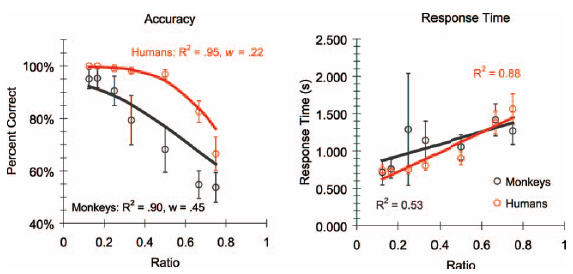
Adult humans possess some mathematical abilities that are unmatched by any other member of the animal kingdom but there is increasing evidence that the ability to count sets of objects nonverbally is a capacity that humans share with other animal species.

In PLoS Biology, Elizabeth Brannon and Jessica Cantlon discuss how humans and nonhuman animals share a capacity for nonverbal arithmetic. The researchers tested monkeys and college students on a nonverbal arithmetic task in which they had to add the numerical values of two sets of dots together and choose a stimulus from two options that reflected the arithmetic sum of the two sets.


Monkeys perform addition like humans.

MIT scientists have found a way to induce cells to form parallel tube-like structures that could one day serve as tiny engineered blood vessels.

The researchers found that they can control the cells' development by growing them on a surface with nano-scale patterning. A paper on the work was posted in Advanced Materials.

Engineered blood vessels could one day be transplanted into tissues such as the kidneys, liver, heart or any other organs that require large amounts of vascular tissue, which moves nutrients, gases and waste to and from cells.

"We are very excited about this work,” said Robert Langer, MIT Institute Professor and an author of the paper.

Researchers at Oregon Health & Science University’s Neurological Sciences Institute have uncovered the system that tells the body when to perform one of its most basic defenses against the cold: shivering. Most interesting is that it's not the same sensory pathway as conscious cold detection.

Our bodies use two different but related sensory systems to conscious and subconsciously detect cold at the same time.

Shivering is one of the many automatic and subconscious regulatory body functions, often called homeostatic functions, that the brain regulates. Other examples include the adjustment of breathing rates, blood pressure, heart rate and weight regulation. Throughout the day, all of these important functions take place in the body without conscious thought.

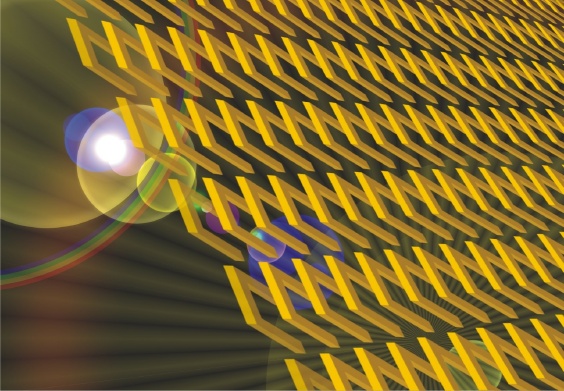
Researchers stunned the world when they announced a cloaking device for the microwave range. This device made use of metamaterials that had a negative refractive index for electromagnetic radiation. The metamaterials were carefully designed split-ring resonators with a structure size much smaller than the wavelength. Only 10 stacked layers of metamaterials were necessary to achieve the desired invisibility effect.

Now, researchers from the group of Harald Giessen at the University of Stuttgart have succeeded in manufacturing a stacked split-ring metamaterial for the optical wavelength range (Na Liu et al., Nature Materials Jan. 2008 issue).

New research published today in the Journal of Cell Biology illuminates the mechanical factors that play a critical role in the differentiation and function of fibroblasts, connective tissue cells that play a role in wound healing and scar tissue formation.

When we are injured, the body launches a complex rescue operation. Specialized cells called fibroblasts lurking just beneath the surface of the skin jump into action, enter the provisional wound matrix (the clot) and start secreting collagen to close the wound as fast as possible. This matrix is initially soft and loaded with growth factors.

The fibroblasts "crawl" around the matrix, pulling and reorganizing the fibers.

This term, the students in my organic chemistry class were presented with an opportunity to do an extra credit assignment using Second Life to represent concepts they learned in the course. When I was an undergraduate, finding molecules in articles was mainly done using the Chemical Abstracts books. A convenient way to find a specific molecule would be to look up the molecular formula and find the corresponding IUPAC name. Theoretically, one could figure out the IUPAC name from scratch but this can be very tricky for complex molecules and prone to error.

The brain remains a complicated machine but researchers from the Center for the Neural Basis of Cognition (CNBC), a joint project of Carnegie Mellon University and the University of Pittsburgh have made progress in explaining why, when we notice a scent, the brain can quickly sort through input and determine exactly what that smell is.

To do it, they created a biologically inspired algorithm for analyzing the brain at work and they have described a mechanism called “dynamic connectivity,” in which neuronal circuits are rewired “on the fly” allowing stimuli to be more keenly sensed.

“If you think of the brain like a computer, then the connections between neurons are like the software that the brain is running.

About 10 years ago, a UC San Diego psychology professor named Ben Williams, who is in my area of psychology (animal learning), managed to successfully cure his own terminal cancer by self-experimentation. He wrote a book about it called Surviving Terminal Cancer. As this WSJ story shows, his approach — which can be summed up think for yourself — is spreading.

Researchers of the Institute of Molecular Biology, Russian Academy of Sciences, have been working for more than 20 years on designing biological microchips for efficient and quick diagnostics of tuberculosis and other diseases.

The BIOCHIP-IMB company was set up at the Institute for production of domestic microchips. During the press-tour on November 15, 2007, the researchers told journalists about progress and achievements. The project of the laboratory of biological microchips at the Institute of Molecular Biology (Russian Academy of Sciences ) is one of the winners at the contest of projects on the “Living Systems” priority direction of the Federal Target Program guided by the Federal Agency for Science and Innovations (Rosnauka).

