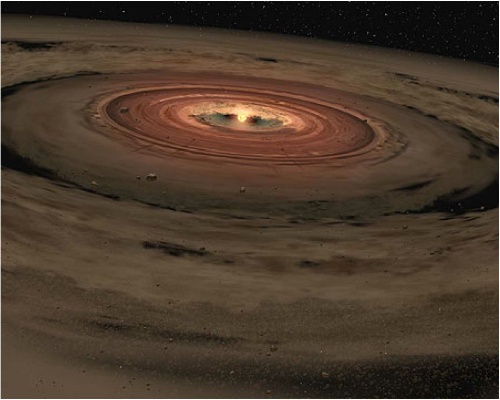






Four billion years ago, says Steve Desch, assistant professor in the School of Earth and Space Exploration at Arizona State University, Uranus and Neptune switched places.

His research work appears in this week’s Astrophysical Journal. Desch based his conclusion on his calculations of the surface density of the solar nebula. The solar nebula is the disk of gas and dust out of which all of the planets formed. The surface density – or mass per area – of the solar nebula protoplanetary disk is a fundamental quantity needed to calculate everything from how fast planets grow to the types of chemicals they are likely to contain.


Credit: NASA

Surrounding the small islands of genes within the human genome is a vast sea of non-coding DNA. While most of this DNA is junk, some of it is used to help genes turn on and off.

Hopkins researchers write in Genome Research that they have now found that regulatory DNA, which contributes to inherited diseases like Parkinson’s or mental disorders, may be more abundant than we realized.

By conducting an exhaustive analysis of the DNA sequence around a gene required for neuronal development, Andrew McCallion, Ph.D., an assistant professor in the McKusick-Nathans Institute of Genetic Medicine, and his team found that current computer programs that scan the genome looking for regulatory DNA can miss more than 60 percent of these important DNA regions.

At a Monday meeting of the American Geophysical Union, NASA's Associate Administrator for Science Alan Stern announced the selection of a new mission that will peer deep inside the moon to reveal its anatomy and history.

The Gravity Recovery and Interior Laboratory, or GRAIL, mission is a part of NASA's Discovery Program. It will cost $375 million and is scheduled to launch in 2011. GRAIL will fly twin spacecraft in tandem orbits around the moon for several months to measure its gravity field in unprecedented detail. The mission also will answer longstanding questions about Earth's moon and provide scientists a better understanding of how Earth and other rocky planets in the solar system formed.

A hydrogen fuel cell works by pumping hydrogen gas through a proton exchange membrane causing the hydrogen to give up electrons in the form of electricity, which combines with oxygen gas to form water as the by-product. It can also work in reverse – when current is applied, water is split into its component gases, hydrogen and oxygen.

Fuel-cell cars are on the verge of being commercially viable but, despite their promise, scientists have struggled to explain just how the fuel-cell’s central component, that proton exchange membrane, really works.

A team of researchers at the Ames Laboratory has offered a new model that provides the best explanation to date for the membrane’s structure and how it functions.

Organic compounds contain carbon and hydrogen and form the building blocks of all life on Earth. By analyzing organic material and minerals in the Martian meteorite Allan Hills 84001, scientists at the Carnegie Institution's Geophysical Laboratory have shown for the first time that building blocks of life formed on Mars early in its history.

Previously, scientists have thought that organic material in ALH 84001 was brought to Mars by meteorite impacts or more speculatively originated from ancient Martian microbes.

The Carnegie-led team made a comprehensive study of the ALH 84001 meteorite and compared the results with data from related rocks found on Svalbard, Norway.

Measures to protect astronauts from health risks caused by space radiation will be important during extended missions to the moon or Mars, say researchers in a paper currently online in Experimental Neurology.

Using a mouse model designed to reveal even slight changes in brain cell populations, scientists found radiation appeared to target a type of stem cell in an area of the brain believed to be important for learning and mood control.

The findings — from a team of researchers from the Cold Spring Harbor Laboratory, Brookhaven National Laboratory, NASA’s Kennedy Space Center and the McKnight Brain Institute of the University of Florida — suggest that identifying medications or physical shielding to protect astronauts from cosmic and solar radiation will be important for the success

Researchers at the University of Illinois have developed a new model of global carbon and nitrogen cycling that will fundamentally transform the understanding of how plants and soils interact with a changing atmosphere and climate.

The new model takes into account the role of nitrogen dynamics in influencing the response of terrestrial ecosystems to climate change and rising atmospheric carbon dioxide.

Current models used in the assessment reports of the Intergovernmental Panel on Climate Change do not account for nitrogen processing, and probably exaggerate the terrestrial ecosystem’s potential to slow atmospheric carbon dioxide rise, the researchers say. They will present their findings this week at the annual meeting of the American Geophysical Union in San Francisco.

A new study comparing the composite output of 22 leading global climate models with actual climate data finds that the models do an unsatisfactory job of mimicking climate change in key portions of the atmosphere.

This research, published in the Royal Meteorological Society’s International Journal of Climatology, raises new concerns about the reliability of models used to forecast global warming.

“The usual discussion is whether the climate model forecasts of Earth’s climate 100 years or so into the future are realistic,” said the lead author, Dr. David H. Douglass from the University of Rochester. “Here we have something more fundamental: Can the models accurately explain the climate from the recent past? It seems that the answer is no.”

A team of astronomers have used the NASA/ESA Hubble Space Telescope to detect, for the first time, strong evidence of hazes in the atmosphere of a planet orbiting a distant star. The discovery comes after extensive observations made recently with Hubble’s Advanced Camera for Surveys (ACS).

The team, led by Frédéric Pont from the Geneva University Observatory in Switzerland, used Hubble’s ACS to make the first detection of hazes in the atmosphere of the giant planet. "One of the long-term goals of studying extrasolar planets is to measure the atmosphere of an Earth-like planet, this present result is a step in this direction" says Pont.

We've reached an important milestone on our CombiUgi project involving the synthesis of falcipain-2 inhibitors. In my last update I described how our focus was more on doing many reactions in parallel and only looking for Ugi products that precipitate in pure form within a few days. It took little longer than I hoped. In order to do more reactions, we reduced our efforts towards monitoring. One of the assumptions that we made was to trust a bottle's label to accurately describe its contents.

