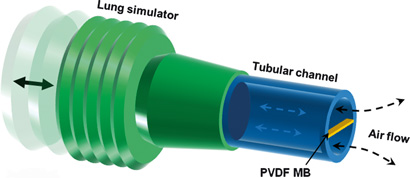
Breathe in, Breathe out, charge your implant. It sounds like a dream, but researchers at the University of Wisconsin-Madison
report that the simple act of human breath can create enough energy to power a small biomedical device.
Time to ring in a new year with pressure waves. We can see, but not, hear true sonic waves generated from stars, as the planet-hunting
Kepler space telescope is finding. We also get to learn a new word, 'astroseismology': the study of pressure waves in cosmic objects. Sudden surface event on stars (such as our sun) can include flares, plasma ejections, and loops of plasma. When the surface gets disturbed, just like dropping a coin into a pool, you get waves that ripple through the whole star.
Welcome to the world's slowest clock.
The 'argon-argon clock' works by measuring the ratio of the amount of radioactive potassium in a sample of rock to the amount of its decay product, argon. As scientists already know the half-life of argon's radioactive decay - 1.25 billion years - it can be used to date rocks back to the time of the formation of the Earth, some 4.5 billion years ago. The older a rock is, the more potassium has decayed and the more argon is found in the rock.
New research has been able to improve the calibration of the 'argon-argon clock' and that could mean up to a 1.2 per cent difference in a rock's age from the original calculation.
It's not correlation/causation (though less and less is, since science has learned that causation is now teaching us less and less about how to actually fix things) but some in the social fields are claiming there are biological truths to stereotypes about the left and right, like that progressives are self-indulgent and clueless on national issues while conservatives are fear-mongers with a fetish for exaggerated dangers.
One of the most effective arguments for science solutions to agriculture issues is the misuse of pesticides. It's one area where activists and scientists agree.
Brown planthoppers are one of a rice farmer's worst fears. Considered a major scourge in rice-producing countries, planthoppers cause considerable damage by sucking sap from rice plants, causing them to wilt and die. They also transmit three viral diseases that stunt rice plants and prevent grain formation. The obvious solution of the past few decades has been to rely on pesticides but beneficial insects that prey on planthoppers are killed inadvertently when insecticides are misused or are used indiscriminately.
Precognition is under scientific investigation, though often with the aim to obtain null-results in order to discredit such ideas. In fact, “extra-sensory perception” (ESP) and “precognition”, “premonition”, “presentiment”, and so on are misleading terms, as was discussed in detail in “
The Science of Precognition: Cosmic Habituation versus Decline Effect”. A better term is “paranormal”, which implies that the effect, if it exists, requires mechanisms outside of what is known. “Precognition” is at most “paranormal prediction”. If it exists at all, it will become normal after we figured out how it works.
Squid Drop is an iPhone game* based on the premise that squid are negatively buoyant. Any serious iGamers must ask themselves: is it true? Barring the application of any external forces,
would a squid sink to the depths of the sea?
Never fear, the cephalopodiatrist is here to answer this pressing concern!
Your typical squid is robust and active, packed with dense, heavy muscles. Not to mention the hard parts that are also heavier than water: the chitinous pen and braincase, and the calcified beak. This would all seem to be positive evidence for sinking squid.
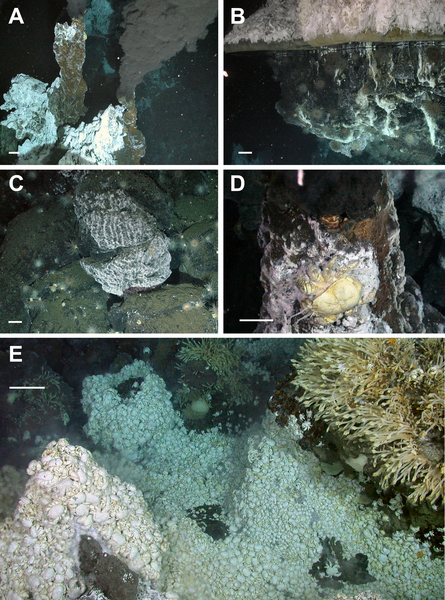
In the East Scotia Ridge deep beneath the Southern Ocean, hydrothermal vents including 'black smokers' reaching temperatures of up to 382 degrees Celsius have created a unique environment that lacks sunlight, but is rich in certain chemicals.
It also has communities of species previously unknown to science on the seafloor.
This hot, dark environment surrounding hydrothermal vents was explored using a Remotely Operated Vehicle (ROV) and the researchers found new species of yeti crab, starfish, barnacles, sea anemones, and potentially an octopus.
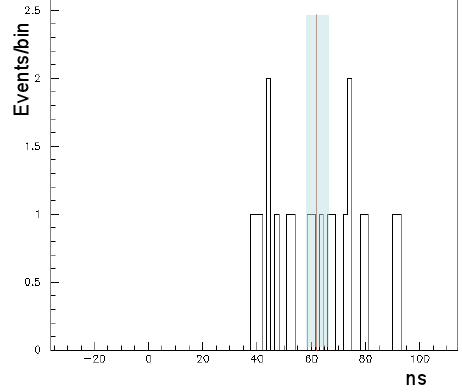
Update: I have modified the title of this post [originally: "Opera's Statistical Booboo"] and the text below (in places I marked accordingly) upon realizing, thanks to a very good point raised by a reader in the comments thread below, that the idealization I was making of the measurement described below made my conclusions too hasty. Read the text to the end if you want more detail.
Two recent studies are providing a foundation for a more complete understanding of distinct kidney cancer subtypes, which could pave the way for better treatments.
In a study published in Cancer Cell led by Kyle Furge, Ph.D. and Aikseng Ooi, Ph.D. of Van Andel Research Institute, they provide a more complete understanding of the biology of Type 2 papillary renal cell carcinoma (PRCC2), an aggressive type of kidney cancer with no effective treatment, which lays the foundation for the development of effective treatment strategies.