




You are all familiar with a solar eclipse, when our Moon passes in front of the Sun and blocks its light, but a similar situation can happen with asteroids, those Sun-orbiting, rocky objects left over from the formation of the Solar System or formed by collisions between other asteroids.

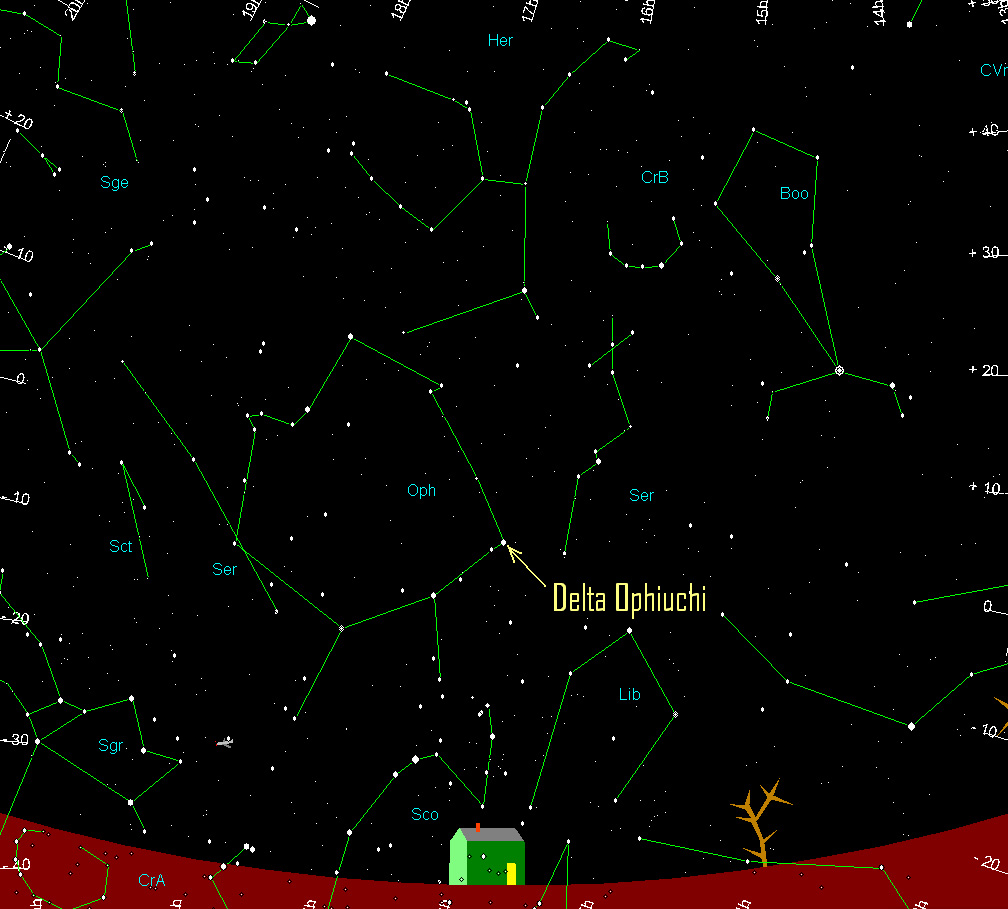
We know of about 400,000 asteroids, which range in size from a few hundred kilometers to just a few meters.   Obviously an asteroid is too small to cover the Sun but because of proximity one will occasionally move directly in front of one of the stars in the night sky and block its light from our view, causing a stellar eclipse or 'occultation'.
Homeopathy's origin should be a clue to why there is no evidence to show it has ever worked.  In the words of Samuel Hahnemann, the German physician at a time when being an M.D. was not a mark of respect, believed
"The vital force that animates the healthy body, rules with unbounded sway, and retains all the parts of the organism in admirable, harmonious, vital operation . . . so that our indwelling, reason-gifted mind can freely employ this living, healthy instrument for the higher purpose of our existence."

...

"when a person falls ill, it is only this spiritual vital force, everywhere present in his organism, that is primarily deranged by another dynamic influence hostile to his life." 
Nature is never inexplicable
It's World Cup time and that means sports fans worldwide are focused on important issues, like complaining about vuvuzelas and this year's soccer ball, the Jabulani, which will push fan and player hatred of the 2006 ball, Teamgeist, into the background.

Why does this happen (the ball complaints, not the vuvuzelas) every World Cup?  FIFA, governing body of Big Football, loves controversy, that's why. So FIFA has strict regulations on the size and weight of the balls but makes no regulations at all about the outside surface of the balls.  Thus, we go from an inordinately smooth ball one World Cup to one with ridges the next.
As a younger, unmarried man I wanted to visit Sweden, but more for the volleyball team than for the science(1), but since I don't want to find out if there 'are other fish in the sea' these days I might instead like to go to Kosterhavet Marine National Park.
Am I Allowed To Say This?

Law is the means by which the simplest ideas are expressed in the most complex language.

Civil law is the means by which private arguments are rapidly made public at great expense.


Right!  That's the whimsy out of the way.  What follows is my attempt to throw down some ideas for open discussion of the following proposition:


The world's nations should get together and formulate an international treaty on libel law.


Freedom of speech

Freedom of speech is the highest degree of freedom known to mankind.  If you can suppress freedom of speech, you can suppress any human behaviour.
Lest you think that the AoAers have a hold on promoting woo or, just as bad, think that the mainstream media had potentially wised up (Kudos, Tsouderos!), a local reporter in
I have just finished four slides (well, five, if you count the cover) which I will show at ESOF 2010, the "EuroScience Open Forum" which is starting in Torino tomorrow. At ESOF, Sense About Science has organized two interesting sessions. One of them is about Peer Review, and it will discuss the results of a recent survey that SAS conducted on the subject with the help of Elsevier.
It's a common phrase; money can't buy happiness.   But a worldwide survey of more than 136,000 people in 132 countries that included questions about happiness and income revealed that life satisfaction certainly does rise with income, though it seems to depend on how you define happiness because positive feelings don't necessarily follow, the researchers report.  

It may be a fundamental part of the human condition that few are content, no matter what they have.  The findings, from an analysis of data gathered in the first Gallup World Poll, appear this month in the Journal of Personality and Social Psychology.
Politicians and education activists believe computer access is creating a generation of "have not" students that will be unable to compete in a digital world.  Their very expensive solution is to guarantee subsidize home computers and even high-speed Internet service.

It may not only be incredibly expensive but also a bad idea for the poorest kids, according to a new study by Duke University's Sanford School of Public Policy, who say such efforts would actually widen the achievement gap in math and reading scores. Students in grades five through eight, particularly those from disadvantaged families, tend to post lower scores once these technologies arrive in their home.

