


"No one should approach the temple of science with the soul of a money changer." 

Thomas Browne (1605-1682)


"There are two possible outcomes: if the result confirms the hypothesis, then you've made a measurement. If the result is contrary to the hypothesis, then you've made a discovery."

Love Thine Enemy


It is exceedingly rare that the scientist and the believer can stand on the same platform and present the same message to the world in the form of a law of universal application.  What is scientific, you may ask, about an injunction to love our enemies?  I hope to explain that point.

Lives of great men all remind us
  We can make our lives sublime,
And departing, leave behind us
  Footprints on the sands of time.

Henry Wadsworth Longfellow - A Psalm of Life


Where science meets belief
I'm not a Russell fan so his followers will have different opinions. One particular quirk of symbolic logic is the reason for this column. First it should be said that symbolic logic owes a great debt to Bertrand Russell for early work on that branch of mathematics.

My complaint is mainly one situation that occurs when a contradiction is found in a logical sequence.

The rules allow almost any type of mischief to be attached to remove the contradiction, whether the attachment has any validity or not. A link is given to a good introductory text on symbolic logic for people with little background in mathematics.
What does the Neanderthal genome have to with post-apocalyptic science fiction? It may seem like odd inspiration, but Neanderthals have aroused my interest in one of the most venerable genres of science fiction. Last summer I was awaiting the release of The Road movie, reading a piece of classic post-nuclear sci-fi (John Wyndham's 1955 The Chrysalids), and thinking about some recent news stories on the (then) forthcoming Neanderthal genome sequence.

I was struck by the thought that the last Neanderthals lived in what could be thought of as a post-apocalyptic world. They were going extinct. Did they notice? What kind of world did the last survivors live in?
Computing networks of tomorrow will be evolving meshes of different processors, various legacy and newer hardware, and numerous software and operating platforms spanning generations - making it costly, bordering on impossible, to rely solely on human programmers to build and manage so many diverse systems.

The ancient Greeks believed that, above the terrestrial sphere, the universe was filled with a mysterious element called ether or aether - the ‘fifth element'.   In 19th century physics, ether was believed to be the substance that filled all of space, basically an undefined thing like 'dark matter' that is necessary or the universe does not make sense.
While going through old boxes of miscellaneous detritus, I came upon several sheets of paper from my health journalism grad school days. The scribes packed a lot of wisdom into those articles and bullet points, and I'll share various nuggets of knowledge in upcoming articles.1
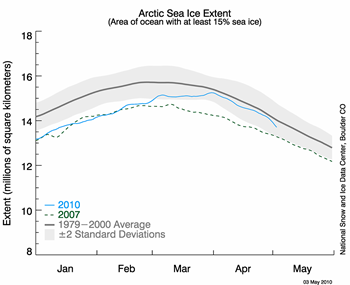
Desperately Denying Arctic Warming

This is the age of rapid public access to satellite images.  If you want to know what is happening to the Arctic ice you can see for yourself.

There are some people who don't want you to look.  They want you to read their drivel instead, and go away believing that the Arctic ice isn't really melting, or if it is then that is nothing unusual.

On Saturday, May 01, 2010, Paul Driessen wrote a piece of blatant propaganda called "(Desperately) Looking for Arctic warming".  It was "co-authored by scientist Willie Soon".
http://townhall.com/columnists/PaulDriessen/2010/05/01/desperately_looki...

The article has been multiply published, see e.g.
When I'm not delving into the science and pseudoscience surrounding autism, I have other areas of interest that I turn my attention to. The psychology of religion is one of those areas of interest.


Introduction to the subject:

NASA is dead.  Jedi killed it.

Used to be, growing geeks wanted to go to Space Camp.  To fly rockets, to mimic operating a shuttle, to #$^ing be an astronaut.  It was engineering and space heaven.  Based on an idea tossed out by rocket god Wernher von Braun and given life in 1982 by a state agency, it was all about to know what it’s like to train like an astronaut.

"We have band camp, football, cheerleading; why don't we have a science camp?" [von Braun]

Conservatives have long lamented the politicization of science.  And why wouldn't they?  Scientists as a bloc haven't voted Republican in decades and when Republicans limit science, there is an outcry (and even whole books!) but when a Democrat limits science the outcry is pretty much limited to ... me.   Conservatives have not, for example, lamented the politicization of talk radio because they do much better there.

