


Coastal microbes may offer a smart solution for plastic contamination in the world's oceans, according to research presented at the Society for General Microbiology's spring meeting.

The research shows that the combination of marine microbes that can grow on plastic waste varies significantly from microbial groups that colonize surfaces in the wider environment. This raises the possibility that the plastic-associated marine microbes have different activities that could contribute to the breakdown of these plastics or the toxic chemicals associated with them.
A team of neuroscientists claim it is possible to influence people's moral judgments by disrupting a specific brain region called the the right temporo-parietal junction (TPJ).

The study offers "striking evidence" that the right TPJ, located at the brain's surface above and behind the right ear, is critical for making moral judgments, the authors say.
An analysis of tree rings and archeological remains suggests that decades of drought, interspersed with intense monsoon rains, may have helped bring about the fall of Cambodia's ancient Khmer civilization at Angkor nearly 600 years ago.

The findings, published this week in PNAS,  indicate that advanced civilizations are still vulnerable to the influence of climate change.
Marine ecosystems could be radically altered by ocean acidification resulting from increasing levels of atmospheric CO2, say researchers presenting at the Society for General Microbiology's spring meeting.

As a result of it's impact on fish stocks and erosion of coral reefs, researchers say ocean acidification could also have serious socioeconomic ramifications as well. 

The team simulated ocean acidification as predicted by current trends of carbon dioxide (CO2) emissions and found that the decrease in ocean pH (increased acidity) resulted in a sharp decline of a biogeochemically important group of bacteria known as the Marine Roseobacter clade.
Scientists writing in BMC Ecology say the "giggle" sound made by spotted hyenas has revealed that the animals' laughter encodes information about age, dominance and identity.
 
Researchers recorded the calls of 26 hyenas in captivity and found that variations in the giggles' pitch and timbre may help hyenas to establish social hierarchies.

"The hyena's laugh gives receivers cues to assess the social rank of the emitting individual. This may allow hyenas to establish feeding rights and organize their food-gathering activities," said Frédéric Theunissen, a researcher the University of California at Berkeley.

In a study sure to delight the Lamarckian in you, and not part of our annual April Fool's Day science content, a new study by Royal Holloway, University of London, says Iraqi children born in areas affected by high levels of violence are shorter in height than children born in less violent areas.

Not factored in; whether or not the Baathists who live in the nice, less-violent areas and have money marry taller women, though look for that in a follow-up.
Understanding Climate : #4 - Calculating Sunshine


The Fire In The Sky
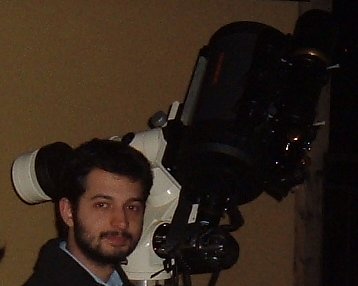
Marco Silva (right) is an amateur astronomer since the 1997 Hale-Bopp comet passage. He is also an amateur scientist. His studies can be found in his web site. When I knew of his interesting measurements of cataclysmic variable stars, I invited him to write about the matter for us here....

Cataclysmic Variables
"Francisco J. Ayala, an evolutionary geneticist and molecular biologist who has vigorously opposed the entanglement of science and religion while also calling for mutual respect between the two, has won the 2010 Templeton Prize." Yet again the prize has gone to a scientist who says nice things about religion.

"Ayala, 76, a naturalized American who moved from Spain to New York in 1961 for graduate study and soon became a leader in molecular evolution and genetics, has devoted more than 30 years to asserting that both science and faith are damaged when either invades the proper domain of the other.
CO2 Emissions : More Is The New Less


As part of its climate change strategy, the Government set a UK aviation target in January 2009, to reduce UK aviation emissions back to 2005 levels in 2050. Together with deep cuts in other sectors, this would achieve the UK’s legislated economy-wide greenhouse gas (GHG) target to reduce emissions by 80% in 2050 relative to 1990. 
http://www.theccc.org.uk/sectors/aviation

Saturday, 27 March 2010
The political arguments about a third runway for London's Heathrow airport broke out again fiercely last night after a High Court judge declined to quash the project but told the Government to get its aviation policy in order.


