A new study in Environmental Science and Technology suggests that controlled burns release substantially less carbon dioxide emissions than wildfires of the same size and could be used to help the United States reduce its contribution to climate change.
Drawing on satellite observations and computer models of emissions, the researchers concluded that widespread prescribed burns can reduce fire emissions of carbon dioxide in the Western U.S. by an average of 18 to 25 percent, and by as much as 60 percent in certain forest systems.
Legislation restricting or banning smoking in public places reduces heart attacks, a study in the Australian and New Zealand Journal of Public Health suggests.
The study examined trends in acute heart attacks in Christchurch, New Zealand following the enactment of legislation which made smoking illegal in all workplaces including bars and restaurants.
Three years after a smoking ban in all workplaces was introduced hospital admissions for heart attacks among men and women aged 55-74 fell by 9 per cent. This figure rose to 13 per cent for 55-74 year olds who had never smoked.
Overall, the research showed heart attacks among people aged 30 and over fell by an average of 5 per cent in the three years following the ban.
The key to silk's pound-for-pound toughness, which exceeds that of steel, is its beta-sheet crystals, the nano-sized cross-linking domains that hold the material together, say researchers writing in Nature Materials.
Using computer models, researchers simulated how the components of beta sheet crystals move and interact with each other. They found that an unusual arrangement of hydrogen bonds--the "glue" that stabilizes the beta-sheet crystals--play an important role in defining the strength of silk.
Bees see the world almost five times faster than humans, giving them the fastest color vision of all animals, according to new research appearing in the Journal of Neuroscience.
The ability to see at high speed is common in fast-flying insects; allowing them to escape predators and catch their mates mid-air. However, until now it wasn't known whether the bees' full colour vision was able to keep up with their high speed flight. This research sheds new light on the matter; suggesting that although slower, it is also much faster than human vision.
Indiana and Rutgers researchers have modified Playstation 3 video game systems to help teenagers with cerebral palsy improve their hand functions. In a pilot trial with three participants, the system improved the teens' abilities to perform a range of daily personal and household activities.
The modified system combined the gaming console with a Fifth Dimension Technologies 5 Ultra sensing glove, a flat-panel television, mouse, keyboard and digital subscriber line modem for Internet communication. Researchers reprogrammed the Playstation console using the open-source Linux operating system and developed games written in Java3D.
I'm launching a satellite to make music from the ionosphere. But what would that look like, in a dramatic sense? In an evocative sense?
In a perfect world, I could just ask a couple of children to draw me their impression of what 'a satellite making music out of the ionosphere' would look like. Since we live in a perfect world, I did that.
The absolute coolest thing to come out of this was a new Calliope tagphrase:
'Around the world in 48 beats'.
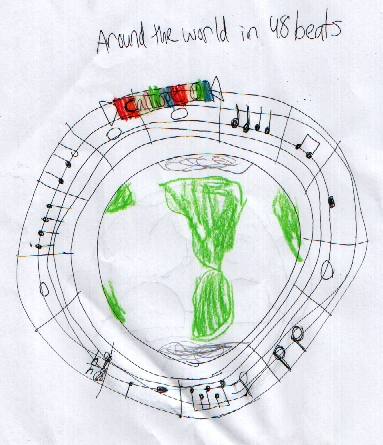 |
'Around the world in 48 Beats', by Ivy
|
and
The ability to remember a briefly presented scene depends on a number of factors, such as its saliency, novelty, degree of threat, or behavioral relevance to a task. Generally, attention is thought to be key, in that people can only remember part of a visual scene when paying attention to it at any given moment.
University of Washington researchers, however, say that memory for visual scenes may not depend on attention level or what a scene contains, but when the scene is presented. Their study, they say, shows how visual scenes are encoded into memory at behaviorally relevant points in time.
The results are published in PLoS Biology.
Though people tend to give journalists a hard time for reporting overly negative news, the media is a little too optimistic when it comes to cancer research, experts say.
A study in the Archives of Internal Medicine reports that newspaper and magazine coverage of cancer research is more likely to discuss aggressive treatment and survival, than treatment failure, adverse events or death, and unlikely to mention end-of-life palliative or hospice care.
New Thermal images of Jupiter's Great Red Spot show swirls of warmer air and cooler regions never seen before, enabling scientists to make the first detailed interior weather map of the giant storm system linking its temperature, winds, pressure and composition with its color.
“This is the first time we can say that there’s an intimate link between environmental conditions — temperature, winds, pressure and composition — and the actual color of the Great Red Spot,” says Leigh Fletcher, lead author of the study in Icarus that documents the research results.
Global meat production has tripled in the past three decades and could double its present level by 2050, according to a new report on the livestock industry by an international team of scientists and policy experts led by Standford University.
If not addressed, the impact of this 'livestock revolution' is likely to have significant consequences for human health, the environment and the global economy.