




Global Cooling : Beyond Parochialism

During the next 10 years, climate science and climate science reporting will, I believe, change the public perception of climate change.  More people will come to understand the difference between parochial weather and global climate.  As more and more people become directly affected by climate change, former deniers will begin to ask why "they" didn't do something about the problem.
Illustration of this article
In the beginning, like attracts like to make a dimer. Nobel Prizes are a rich source of dimers. I counted twenty-three Nobel Lectures with dimers. The wealth in dimers can compound a case not only in biochemistry but also in organic chemistry. A new certainty sparkles here with a metal form, the beryllium dimer. 
 

Earlier this week I argued that biological systems posses dynamical properties that are biologically important, and understandable primarily through mathematical modeling. As an example, I discussed a paper that explored the advantages of double positive feedback loops in bistable switches.

I glossed over the math behind the model because of space and time constraints. (Constraints on a blog, you wonder? Well, I ran out of time, and once a blog post gets beyond 1000 words, the number people who read it to completion probably drops exponentially for every word over 1000.)
Where are we?  Cosmically, I mean.  We have barely made steps to get to the edge of our solar system, via Voyager 1 and 2.  It's ironic that we can see back 13 billion years using telescopes, but we have little idea of what 'stuff' is out there-- matter, dark matter, energy.  Or even what is just outside our local solar system.
Global Cooling : How Wrong Can You Get?

Despite media reports to the contrary, the Antarctic ice is still melting, as noted here:
Climate change is warming the Amundsen Sea, which is at the southern margin of the Pacific Ocean. As rising sea levels push the warm water beneath the ice shelves, it melts them from below, pushing the grounding line higher up the continental shelf.
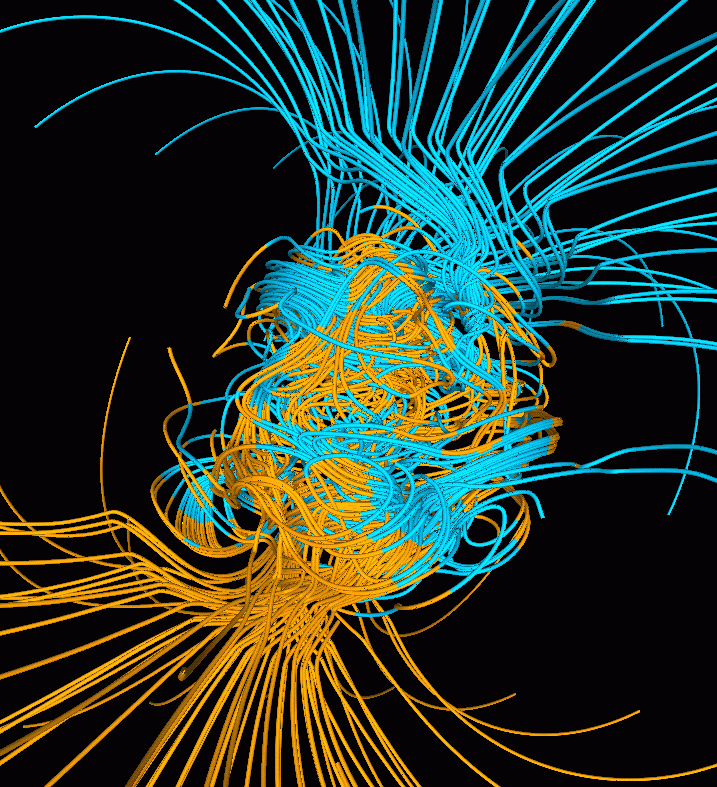
This morning I was asked to settle an argument about the Magnetic North Pole being a magnetic south pole. That discussion started me wondering about the dynamo theory, widely accepted now, that the Earth's swirling, agitating liquid outer core, interacting through convection with Earth's inmost magnetism, is what regenerates our planet's geomagnetic field.
Using proteosome inhibitors to trick cells into producing a chaperone protein called Hsp70 may be one way of enhancing the natural ability of cells to restore their own mutant proteins. Researchers at the Fox Chase Cancer Center say the discovery may help treat certain debilitating – or even fatal – genetic diseases.
New technology developed by researchers at the Fraunhofer Institute in Sankt Augustin, Germany may soon help consumers save energy by allowing them to track which devices in their homes are using the most energy. The basis for the technology is the "Hydra" middleware,
which is extended by an energy protocol. A middleware reduces the workload of programmers: in Hydra's case, by administering the communication between devices.

Each device in the home is given a power plogg, which is a small adapter located between the power plug and the power outlet. It reports the power consumption at any given time to a PC via a radio signal. People can tell which device is guzzling the most energy by taking a look at the computer monitor.
 A new study conducted by Loyola University researchers could lead to new treatments for skin cancer that would shrink the tumors with a class of drugs called protein kinase inhibitors. The drugs would work by turning on a gene called protein kinase C (PKC), which prevents skin cells from becoming cancerous, said senior author Mitchell Denning, Ph.D. The study was published today in the Journal of Biological Chemistry.

More than 1 million people in the United States are diagnosed with skin cancer each year. In the new study, researchers examined a type of skin cancer, called squamous cell carcinoma, which accounts for between 200,000 and 300,000 new cases per year.
What we learn from our siblings when we grow up has a considerable influence on our social and emotional development as adults, according to researchers from the the University of Illinois and the University of California, Davis. The team says that a clearer understanding of how siblings function as "agents of socialization" will help answer critical societal questions such as why some children pursue antisocial behavior. Their volume on the subject appears in a recent issue of New Directions for Child and Adolescent Development.

