Back in August, I gave a talk at the
Pacific AAAS meeting explaining why research scientists need to blog. After a long delay to put my incomprehensible notes in to readable (but still somewhat fragmented) form, here is my argument for why scientists need to blog:
Expert Blogging in the Science Communication EcosystemMy talk is about scientists writing science directly for the public. Specifically, I want to get at the question, "What can blogging by scientists bring to the science communication ecosystem of newspapers, TV, and magazines?"
Tomorrow I will be packing up and leaving CERN to fly back home, after a quite eventful, productive, extenuating, exhilarating week. The reason for my coming to Geneva was the CMS week, an event that takes place four times a year, and where a good fraction of the members of our 2400-strong collaboration gather to listen to updates of the experiment, the detector, the analyses, and to discuss rules, appointments, organizational issues.
Via
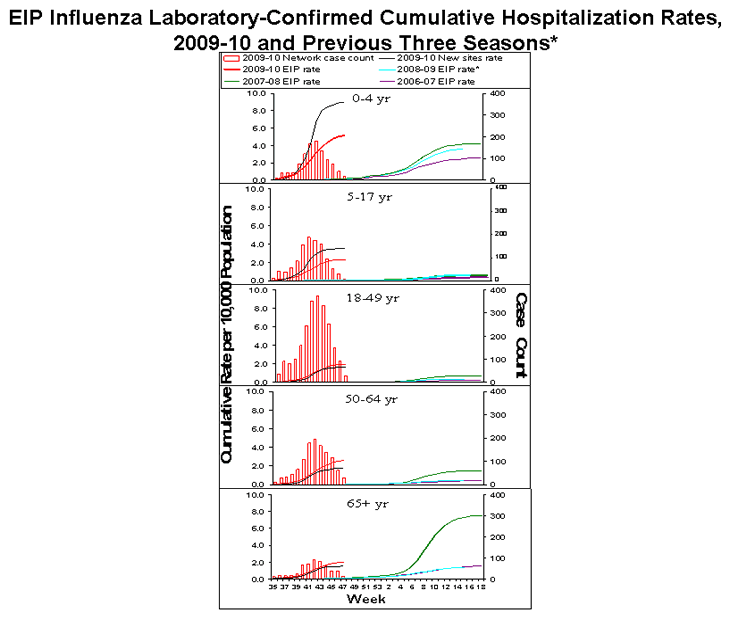
Chris Mooney, I learn that Rush Limbaugh, whose ability to smell out a conspiracy is on par with the ability of the male silk moth to sniff out the presence of a female from miles away, has called the whole H1N1 thing a hoax:
[from guest blogger and podcast co-host Julia Galef]
Hey there, rational readers! I’m honored to be Massimo’s guest blogger and co-host of the upcoming Rationally Speaking podcast for the NYC Skeptics. Since our second episode is scheduled to air the week of Valentine's Day, we couldn’t resist making that show's topic, “The Skeptic’s Guide to Love.”
A team of scientists has detected tiny quantities of the unreactive volcanic trace gases Krypton and Xenon in Earth's mantle, which reveal an isotopic 'fingerprint' matching that of
meteorites.
The researchers say this means the gases that formed the Earth's atmosphere - and probably its oceans - did not come from inside the Earth but from outer space.
The report published this week in the journal Science demonstrates that the age-old view that volcanoes were the source of the Earth's earliest atmosphere must be put to rest, the researchers suggest.
When it comes to gambling, many millions of people just don't know when to walk away. The behavior can take a tremendous toll on their finances and family life, and currently available treatments are often associated with extremely high relapse rates.
According to new research presented at the annual meeting of the American College of Neuropsychopharmacology (ACNP), however, there may be alternative and surprisingly simple treatments available for gambling addicts--medications that decrease urges and increase inhibitions. In other words, medications often used to treat
drug abuse.
An international team of environmental scientists says that sea-level rise along the Atlantic Coast of the United States in the 20th century was 2 millimeters faster than at any point in the last 4,000 years.
Sea-level rise prior to the 20th century is generally attributed to coastal subsidence. This occurs as land is lost to subsidence as the earth continues to rise in response to the removal of the huge weight of ice sheets during the last glacial period.
Researchers at Rice University and Baylor College of Medicine (BCM) have found an unexpected weakness in H1N1's method for evading detection by the immune system. They say the virus has been keeping a secret that may be the key to defeating it and other flu viruses as well.
Comparing its genetic sequences going all the way back to the virus's first known appearance in the deadly "Spanish flu" outbreak of 1918, they discovered a previously unrealized role of receptor-binding residues in host evasion, which effectively becomes a bottleneck that keeps the virus in check. The team compared the sequences of more than 300 strains of H1N1 to track its evolution; Their results appear in a recent online edition of PLoS One.
With the fall semester coming to a close, a Purdue University psychologist has some advice for all those college students who are poring over their notes in preparation for finals. Don't.
In a paper recently featured in the Journal of Experimental Psychology: General, psychologist Jeffrey D. Karpicke suggests that students spend their study sessions testing themselves repeatedly, improving their memory retrieval skills, as opposed to cramming for tests using written notes. He says this strategy will make recalling the information much easier when the pressure is on.
Karpicke found in his study that college students are more likely to invest their time in repetitive note reading, and those who do practice retrieval spend too little time on it.
Paleontologists have unearthed a previously unknown Theropod dinosaur from a fossil bone bed in northern New Mexico, settling a debate about early dinosaur evolution, and hinting at how dinosaurs spread across the supercontinent Pangaea.
The description of the new species, named Tawa after the Hopi word for the Puebloan sun god, appears in the Dec. 10 issue of the journal Science.