







Yesterday I posted a short article whose main purpose was to show a figure I had received from Sven Heinemeyer, a phenomenologist who specializes in the study of Minimal Supersymmetric extensions of the Standard Model (MSSM).

Besides predicting a mirror copy of Standard Model (SM) particles, MSSM models are characterized by containing not just one, but five distinct Higgs bosons; over much of the space of possible parameters of these theories, one of the five Higgs bosons is quite similar to the one and only SM Higgs, so that one can discuss the SM Higgs and the lightest neutral scalar of the MSSM together without generating confusion.

Science is occasionally a life-threatening career choice, particularly for those scientists who risk shipwreck, starvation, disease, and large, arctic carnivores to unlock the mysteries of the life's past.

Sean Carroll, in Remarkable Creatures, looks at how the drive to explore, the itch for discovery that pushed Columbus and Magellan on their great voyages, has worked its magic on those great scientists who have pursued scientific adventures to the most extreme corners of the earth.

Games2Win, an online game company, today announced the launch of Apollo 11: Mission to the Moon, which recreates the historic mission to the moon, without the mind-numbing terror of knowing you were sitting on top of a mess o' solid rocket fuel protected by nothing except parts contracted out to the lowest bidders. The game’s release is schedule to coincide with, and  commemorate, the 40th anniversary of Apollo 11’s success on July 20, 1969.

"Apollo 11: Mission to the Moon" is what the vendor calls a "free-to-play Flash game" and you can find at http://www.games2win.com/ap1.   The game play mimics pretty small parts of the first manned mission to land on the moon (without the mind-numbing terror of knowing you were sitting on top of a mess o'  ...

A lunar geochemist at Washington University in St. Louis says that there are still many answers to be found in moon rocks brought back by the Apollo 11 astronauts nearly 40 years ago.   And he's been studying them since then, so he should know.

Randy L. Korotev, Ph.D., a research professor in the Department of Earth and Planetary Sciences in Arts&Sciences, has studied lunar samples and their chemical compositions since he was an undergraduate at the University of Wisconsin and "was in the right place at the right time" in 1969 to be a part of a team to study some of the first lunar samples.

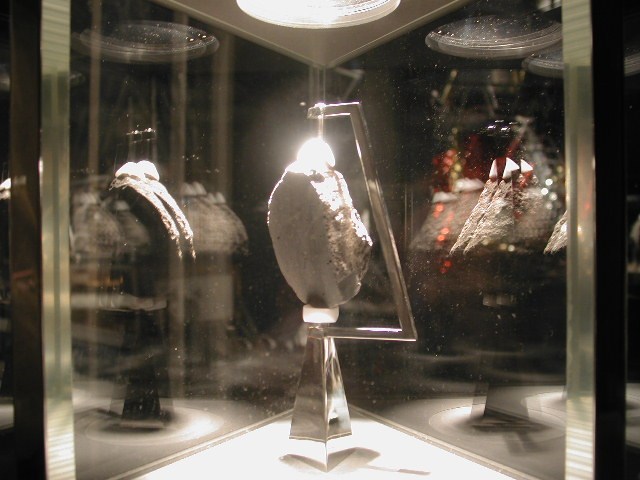
Apollo 11 moon rock
The Voynich Manuscript : An Enigma, Part #2

It is nearly 100 years since the Voynich manuscript arrived in America.  In that time, not one person or group has managed to decode even a single word of it.

I suggest that decryption of any document requires as much prior knowledge as possible about the physical document, its origin and purpose.  For that reason, I am compiling a background to the Voynich manuscript before any discussion of possible encryption schemes.

Synthetic Genomics Inc. (SGI), a privately held company co-founded by Craig Ventner in the business of applying genomic-driven commercial solutions to challenges like energy and the environment, announced a multi-year research and development agreement with ExxonMobil Research and Engineering Company (EMRE) to develop next generation biofuels using photosynthetic algae. 

SGI will receive milestone payments for achievements in developing biofuel products. Total funding for SGI in research and development activities and milestone payments could amount to more than US$300 million with the potential for additional income from licensing to third parties. 

Scientists in Atlantic Canada say they have found a gene that may play a role in skin aging. Researchers were investigating the genetic cause of a rare disorder known as cutis laxa type 2 (CL2), which causes skin on the hands, feet and face to be loose and older looking, as well as growth and developmental delays including effects on the brain. In the process, researchers found some interesting correlations with the synthesis of proline, a chemical associated with skin and joint health.

Several maritime Canadian families with CL2 were identified by clinicians at the IWK Health Centre’s Maritime Medical Genetics service.

You want to live healthier and probably look better; that's a good start.  Diet popularity can either be a sign that something works or an indication that people believe in crazy stuff.   Either way, it can't hurt to spend 5 minutes reading an article on the Internet before you commit.

A site called Realbuzz.com says it has put popular dieting approaches to the test - giving you the pros, the cons and each one has been rated on how they satisfy hunger, their ease to follow, expense and most importantly - the impact they can have on your overall health.

Accera, Inc., a biotechnology company delivering therapies in central nervous system diseases, today announced further evidence for genetic interactions impacting the efficacy of the ketogenic compound AC-1202 (Axona(TM)) in Alzheimer’s disease.

New data from the company’s previously completed double-blind, placebo-controlled trial in patients with mild-to-moderate Alzheimer’s disease demonstrates an interaction between two genetic markers that strongly influence the therapeutic response in patients. Dr. Samuel Henderson, Executive Director of Research, will present these results at the 2009 International Conference on Alzheimer’s Disease (ICAD) sponsored by the Alzheimer’s Association.

It's not a secret to you if you have watched football for the last 40 years;  a guy once almost big enough to be a linebacker can't even be a safety today.   Elite athletes are getting bigger.

Specifically, while the average human has gained about 1.9 inches in height since 1900, new research showed that the fastest swimmers have grown 4.5 inches and the swiftest runners have grown 6.4 inches.

In a new analysis, Jordan Charles, an engineering student who graduated this spring, collected the heights and weights of the fastest swimmers (100 meters) and sprinters (100 meters) for world record winners since 1900. He then correlated the size growth of these athletes with their winning times.

