This is part 1 of 6 in a brief series describing the history of English and its grammar.
What is Grammar?
A grammar is a set of rules for the communal use of a language. A language can never become a truly national language unless all users of that language share common rules for how words are invented, used and strung together in sentences. When by some means the users of a language no longer share these rules, the language fragments into dialects and eventually, new languages. It is useful to think of dialects as not being quite so large an obstacle as different languages are to trade, commerce and exchange of ideas between regions.
I recently came across a radio lecture given by Dr Lee Alan Dugatkin on 7.6.2007, titled "Is Goodness Natural?" It deserves comment. (An article on the same subject but with some differences in text was published at Huffington Post.)
The talk began well with some historical background describing the attempts by Charles Darwin, Thomas Huxley, Peter Kropotkin and W. D. Hamilton to explain the origin of goodness, (in the sense of being nice to one another,) in light of evolutionary theory. He concluded that the first three had failed to adequately explain goodness, (Kropotkin’s great work “Ethics” was obviously overlooked) but that Hamilton had solved the dilemma with a “simple but elegant mathematical equation.”
This week, researchers and scientists at UCLA are doing something unusual: They are organizing a demonstration against the violent tactics of certain animal rights groups.
This week, people in labs across the country are saying: It's about time.
-- It's about time that people came out of their labs and off the bench and took a public stand, rather than relying upon trade groups and animal providers to make the case for them
-- It's about time that science generated its own leaders to pro-actively make the case for animal testing, rather than rely on the usual ( and rather suspect) cast of pharmaceutical companies and toxicology labs
It's Earth Day, in case you can't tell by our swanky green Earth logo in the header, and that means people will be thinking about Nature (
the bitch, not the magazine) and our impact on her. I didn't say people would be thinking
clearly, but they will be thinking.
So instead of shocking and awing you with my dark humor and divine genius, I will instead ask a question; what kind of science could
you do if you got sent back to 10,000 BC?
Researchers writing in Nature magazine say the fossil skeleton of a newly discovered carnivorous animal,
Puijila darwini, is a "missing link" in the evolution of the group that today includes seals, sea lions, and the walrus.
Modern seals, sea lions, and walruses all have flippers—limb adaptations for swimming in water. These adaptations evolved over time, as some terrestrial animals moved to a semi-aquatic lifestyle. Until now, the morphological evidence for this transition from land to water was weak.
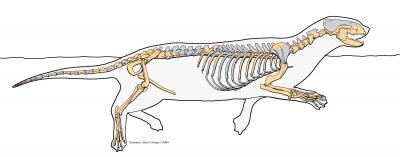 Skeletal illustration of Puijila darwini. Credit: Mark A. Klingler/Carnegie Museum of Natural History
Using information from a suite of telescopes, astronomers have discovered a mysterious, giant object that existed at a time when the universe was only about 800 million years old. Objects such as this one are dubbed extended Lyman-Alpha blobs; they are huge bodies of gas that may be precursors to galaxies. This blob was named Himiko for a legendary, mysterious Japanese queen. It stretches for 55 thousand light years, a record for that early point in time. That length is comparable to the radius of the Milky Way's disk.
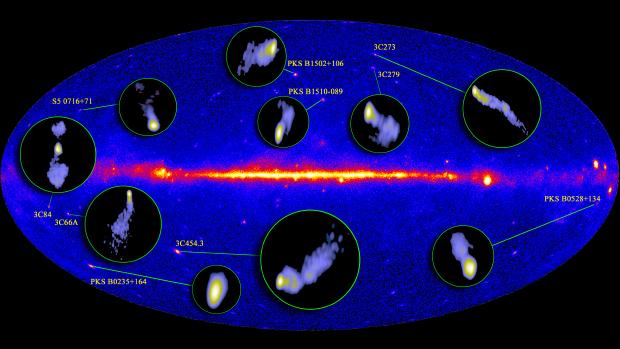
An international team of astronomers has used the world's biggest radio telescope to look deep into the brightest galaxies that NASA's Fermi Gamma-ray Space Telescope can see. The study solidifies the link between an active galaxy's gamma-ray emissions and its powerful radio-emitting jets.
"Now we know for sure that the fastest, most compact, and brightest jets we see with radio telescopes are the ones that are able to kick light up to the highest energies," said Yuri Kovalev, a team member at the Max Planck Institute for Radio Astronomy in Bonn, Germany.
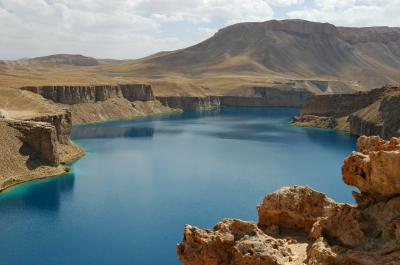
Take that, Taliban. Western decadence, in the form of caring about beauty and nature, has infested your fundamentalist madness and it's here to stay.
We are talking about Band-i-Amir national park in Afghanistan, which opens today.
The United States Agency for International Development (USAID) provided key funding that led to the park's creation, including support of the Wildlife Conservation Society (WCS) to conduct preliminary wildlife surveys, identify and delineate the park's boundaries, and work with local communities and the provincial government. WCS also developed the park's management plan, helped the government hire and train local rangers, and provided assistance to the Afghan Government to design the laws enabling the park to be created.
Los Alamos National Laboratory researchers have discovered a potential chink in the armor of fibers that make the cell walls of certain inedible plant materials so tough. The insight ultimately could lead to a cost-effective and energy-efficient strategy for turning biomass into alternative fuels.
In separate papers published today in Biophysical Journal and recently in an issue of Biomacromolecules, Los Alamos researchers identify potential weaknesses among sheets of cellulose molecules comprising lignocellulosic biomass, the inedible fibrous material derived from plant cell walls. The material is a potentially abundant source of sugar that can be used to brew batches of methanol or butanol, which show potential as biofuels.
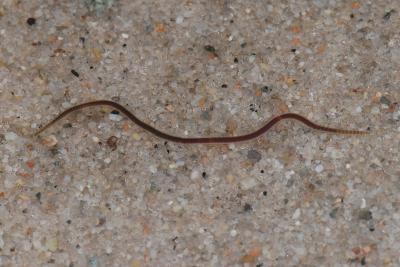
Researchers know that animals which seem identical can actually belong to completely different species. But if it's worms used in laboratory testing, that could be important news in research.
Researchers at the University of Gothenburg, Sweden, say they have used DNA analyses to discover that one of our most common segmented worms, Lumbriculus variegatus, is actually two types of worm. Along with some obvious issues in research it also affirms that the variety of species on the earth could be considerably larger than we thought. "We could be talking about a large number of species that have existed undiscovered because they resemble other known species," says Professor Christer Erséus.