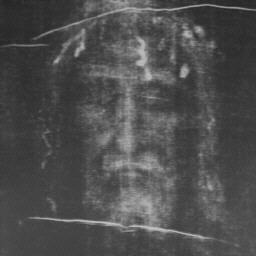
It's spring cleaning time, and while most of us are thinking of packing a way our winter linens and airing out our summer clothes, a historian at the Vatican has decided to drag out another mouldering old bit of cloth to dangle before u
It's an idea so brilliant, I wish I had thought of it (though that gimmicked
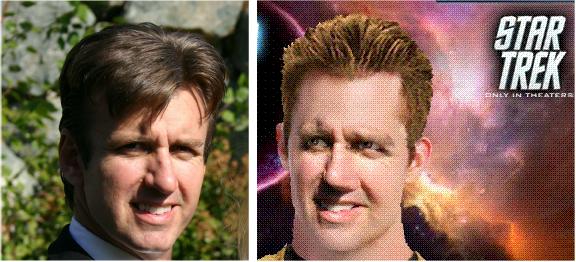
Google street view art project Josh linked to made me a bit jealous as well) ... in preparation for the upcoming Star Trek movie you can make yourself into a Star Trek character. Is it perfect? Well, no, anything that requires some manual input in a system I don't yet understand will be quirky but that is mostly my fault. Side by side, the pic I gave them and what they said is my Star Trek character. Not too bad, actually, though I seemed to have set the width for the eyes strangely (you'll see what I mean if you try it).
The NASA STEREO mission (my mission!) is
visiting L4 and L5. These are the Lagrange points are where the Earth and Sun gravitationally balance each other out. SOHO hangs out at L1, between Earth and Sun (but very near Earth). L4 and L5 are about 60 degrees ahead and behind the Earth's position in its orbit.


Eggs and rabbits were common fertility symbols of the ancient world. Today come the spring equinox, we continue to worship the pagan, egg-laying bunny (with a massive display of consumerism).

Saint Nicolas of Myra presented three impoverished girls with dowries so they would not have to become prostitutes. His modern incarnation was created and popularized by the 18th century cartoonist Thomas Nast. Come winter solstice, it’s time to worship the jolly old elf (with a massive display of consumerism).
Universities, with a young constituency and an employee base of academics interested in new discoveries and ways of communication, should have embraced social media early - but they have not and if they don't embrace new techniques in pedagogy they risk becoming seen as anachronisms in today’s hyper-connected world where information is available freely, says a University of Illinois expert who studies the knowledge economy’s effect on higher education.
Earthstock, Stony Brook University’s 8th annual week long awareness-raising celebration of Earth Day, kicks off at 10 am on Friday, April 17 with a full day of entertainment, food, refreshments, environmentally-oriented activities and visual displays situated all around the Academic Mall.
It is a fact of science that people who consume fewer calories than they burn will lose weight. It is 100 percent effective. But it is equally well-known that some people cannot do that and neuroscience has yet to find a reasonable explanation for it.
For those who truly cannot lose weight by a disciplined approach to diet and exercise, surgery is a last resort but Nick Nicholson, M.D., weight loss surgeon on the medical staff at Baylor Regional Medical Center at Plano, says outside the usual benefits, surgery can actually improve other health conditions.
Here are 5 other improvements weight loss surgery can bring:
If words were people, then "eloquent," "love" and "symphony" would get dates most Friday nights but "vomit," "moist" and "puke" would stay home alone, wondering what went wrong.
How are words pretty or ugly? That's the question Robert E. Wolverton Sr., a Mississippi State University classics professor, recently asked in a survey of some 75 students in his classes. The poll is part of the foreign language faculty member's "semi-frequent" examination of how students at the land-grant university view widely used terms.
Of the 148 different "beautiful" words submitted by students this year are several listed multiple times: eloquent (six), love (four) and symphony (four). Beautiful, lavender and tranquility each received three mentions.
Researchers have reported that they have been able to determine the molecular structure of a plant photolyase protein that is surprisingly similar to two cryptochrome proteins that control the "master clock" in humans and other mammals. They have also been able to test how structural changes affect the function of these proteins.
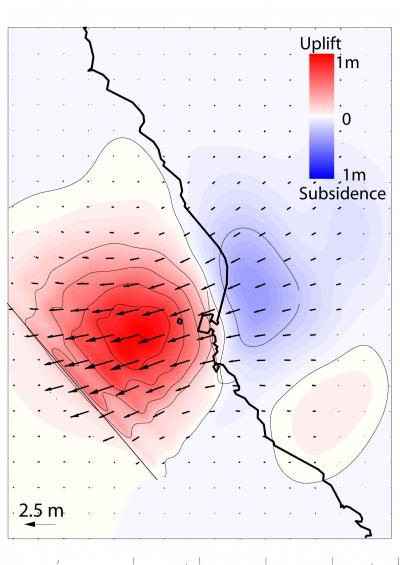
A magnitude 8.0. earthquake destroyed 90 percent of the city of Pisco, Peru on August 16, 2007. The event killed 595 people, while another 318 were missing. Tsunami waves were observed locally, off the shore of Chile, and as far away as New Zealand.
In a study published in the Geophysical Journal International, scientists from the University of Miami's Rosenstiel School of Marine and Atmospheric Science, in collaboration with scientists from the University of Oxford (U.K.) have analyzed data on this earthquake and its impact on regional topography. Using InSAR-based geodetic data and teleseismic data, the scientists were able to use satellite images to identify details of this major plate boundary event.