





Imagine taking a picture of your favorite hockey team as a child and then again as an adult today. Looking back over a quarter of century, the changes you'd see are significant.

Researchers in the University of Alberta Faculty of Physical Education and Recreation looked at an NHL team over a 26-year cycle and discovered players have become bigger ... and fitter.

They studied 703 players from a Canadian-based NHL team from 1979 to 2005. The physiological profile derived from their research shows that over the 26 seasons, defensemen became taller and heavier as body mass increased; forwards got younger and had higher peak aerobic power outputs for cardio-respiratory endurance, while goalies were shorter and more flexible and had lower peak aerobic power outputs. All players combined (defence, forwards and goaltenders) increased body mass, height and anaerobic power over the 26 years.

A team of researchers at Michigan Technological University is harnessing the computing muscle behind the leading video games to understand the most intricate of real-life systems.

Led by Roshan D'Souza, the group has supercharged agent-based modeling, a powerful but computationally massive forecasting technique, by using the graphic processing units which drive the spectacular imagery beloved of video gamers. In particular, the team aims to model complex biological systems, such as the human immune response to a tuberculosis bacterium.

Agent-based modeling simulates the behaviors of complex systems. It can be used to predict the outcomes of anything from pandemics to the price of pork bellies. It is, as the name suggests, based on individual agents: e.g., sick people and well people, predators and prey, etc. It applies rules that govern how those agents behave under various conditions, sets them loose, and tracks how the system changes over time. The outcomes are unpredictable and can be as surprising as real life.

Schools are set for a Star Trek make-over thanks to the development of the world's first interactive classroom by experts at Durham University.

Researchers at the Technology-Enhanced Learning Research Group (TEL) are designing new learning environments using interactive multi-touch desks that look and act like a large version of an Apple iPhone.

The team observed how students and teachers interact in classes and how Information Communications technology (ICT) could improve collaboration. They then set about designing an interactive classroom solution called 'SynergyNet' to reflect TEL's aims of achieving active student engagement and learning by sharing, problem-solving and creating.

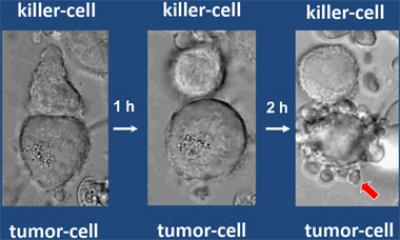
Our body is almost constantly being threatened by pathogens and cancerous cells that appear out of the blue, but our bodies put up a fight: specialized cells in the immune system smuggle small molecules (granzymes) into cancer cells and those body cells that have fallen prey to viruses. The molecules then trigger off the diseased cells' built-in suicide program.

There are two possible ways in which the granzymes gain entry into the cells under attack but despite more than twenty years of research, it remained unclear as to which of these pathways is used to smuggle the lethal amount of granzymes into a cell. Scientists at the Max Planck Institute of Neurobiology have now shown that minute pores on the cell surface open the door to the granzymes for a short period of time. These results provide new prospects for improved methods of treatment of chronic virus infections and cancer.

Over half of deaths in women from chronic diseases such as cancer and heart disease could be avoided if they never smoke, keep their weight in check, take exercise and eat a healthy diet low in red meat and trans-fats, according to a study published in BMJ.

Poor diet, lack of physical activity, obesity, alcohol consumption and smoking increase the risk of diseases including cancer and diabetes but little research has examined combinations of lifestyle factors in younger populations and women.

Dr Rob van Dam and his team from the Harvard School of Public Health and Brigham and Women's Hospital, recruited nearly 80 000 women aged 34 to 59 years in 1980 who were part of the Nurses' Health Study in the US. They analyzed the data of over 1.5 million person-years follow up over a 24 year period.

For the first time in waters surrounding New York City, the beckoning calls of endangered fin, humpback and North Atlantic right whales have been recorded, according to experts from the Bioacoustics Research Program at the Cornell Lab of Ornithology and the New York State Department of Environmental Conservation (DEC).

The recorders were placed about 13 miles from the New York Harbor entrance and off the shores of Fire Island. Information about the seasonal presence of whales will help New York state policymakers develop management plans to protect them. Knowing the whales' travel paths will help ship traffic managers avoid whale collisions in New York waters. Further, the study will characterize New York waters' acoustic environment and examine whether underwater noises, including shipping, affect the whales.

An international team of scientists predict that our galaxy, the Milky Way, contains a disk of ‘dark matter’, in a paper published in Monthly Notices of the Royal Astronomical Society.

Astronomers Dr. Justin Read, Professor George Lake and Oscar Agertz of the University of Zurich, and Dr. Victor Debattista of the University of Central Lancashire used the results of a supercomputer simulation to deduce the presence of this disk. They explain how it could allow physicists to directly detect and identify the nature of dark matter for the first time.

Unlike the familiar ‘normal’ matter that makes up stars, gas and dust, ‘dark’ matter is invisible but its presence can be inferred through its gravitational influence on its surroundings. Physicists believe that it makes up 22% of the mass of the Universe (compared with the 4% of normal matter and 74% comprising the mysterious ‘dark energy’). But, despite its pervasive influence, no one is sure what dark matter consists of.

Genetic studies involving the long term storage and study of human samples hold great promise for medical research—but they also pose new threats to individuals such as uninsurability, unemployability, and discrimination, say Matthias Wjst (Institute of Genetic Medicine, Bozen, Italy) and colleagues.

They argue that the traditional informed consent process—in which the researcher counsels potential study participants about the risks and benefits of taking part in a study—may no longer be appropriate when dealing with long-term studies using biological materials.

Johns Hopkins scientists report success in significantly suppressing levels of the "hunger hormone" ghrelin in pigs using a minimally invasive means of chemically vaporizing the main vessel carrying blood to the top section, or fundus, of the stomach. An estimated 90 percent of the body's ghrelin originates in the fundus, which can't make the hormone without a good blood supply.

"With gastric artery chemical embolization, called GACE, there's no major surgery," says Aravind Arepally, M.D., clinical director of the Center for Bioengineering Innovation and Design and associate professor of radiology and surgery at the John Hopkins University School of Medicine. "In our study in pigs, this procedure produced an effect similar to bariatric surgery by suppressing ghrelin levels and subsequently lowering appetite."

When it comes to aggression, boys are physical and girls are social, it is said, but a new analysis of almost 150 studies of aggression in children and adolescents has found that there's more overlap than stereotypes lead us to believe.

Physical aggression - hitting - is something boys are more likely to do while girls are more likely to spread rumors, gossip, and intentionally exclude others, called indirect, relational, or social aggression.

The analysis of 148 studies, which comprised almost 74,000 children and adolescents and were carried out largely in schools, looked at both direct aggression and indirect aggression and was conducted by Noel A. Card, assistant professor of family studies and human development at the University of Arizona, and researchers at the University of North Carolina at Chapel Hill and the University of Kansas.