






Like video games? Want to also solve puzzles for science?

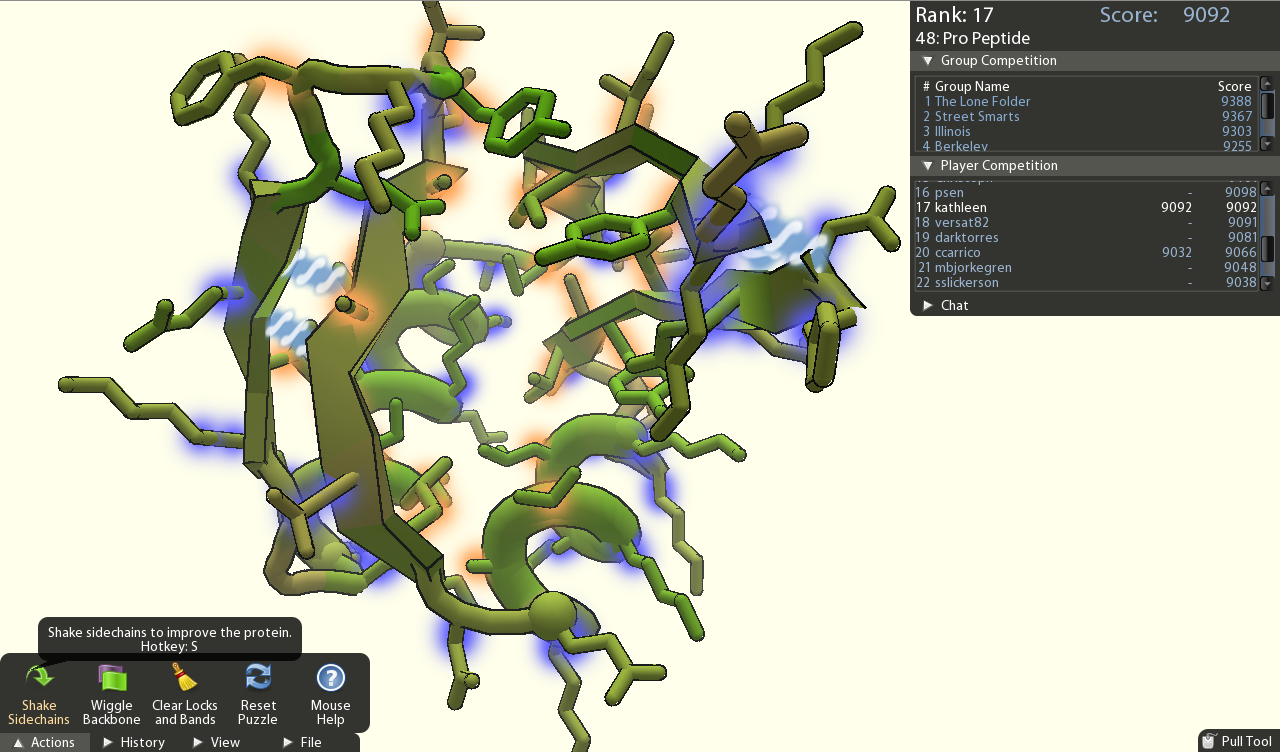
A new game, named Foldit, turns protein folding into a competitive sport. Introductory levels teach the rules, which are the same laws of physics by which protein strands curl and twist into three-dimensional shapes – key for biological mysteries ranging from Alzheimer's to vaccines.

After about 20 minutes of training, people feel like they're playing a video game but are actually mouse-clicking in the name of medical science.

Investigations continue into the cause of a mysterious illness that has resulted in the deaths of thousands of bats since March 2008. At more than 25 caves and mines in the northeastern U.S, bats exhibiting a condition now referred to as “white-nosed syndrome” have been dying.

The U.S. Geological Survey (USGS) recently issued a Wildlife Health Bulletin, advising wildlife and conservation officials throughout the U.S. to be on the lookout for the condition known as “white-nose syndrome” and to report suspected cases of the disease.

USGS wildlife disease specialist Dr. Kimberli Miller advises that "anyone finding sick or dead bats should avoid handling them and should contact their state wildlife conservation agency or the nearest U.S. Fish & Wildlife Service field office to report their observation.”

Neuroscientists at Johns Hopkins have discovered that mice lacking an enzyme that contributes to Alzheimer disease exhibit a number of schizophrenia-like behaviors. The finding raises the possibility that this enzyme may participate in the development of schizophrenia and related psychiatric disorders and therefore may provide a new target for developing therapies.

The BACE1 enzyme, for beta-site amyloid precursor protein cleaving enzyme, generates the amyloid proteins that lead to Alzheimer’s disease. The research team years ago suspected that removing BACE1 might prevent Alzheimer.

“We knew at the time that in addition to amyloid precursor protein, BACE1 interacts with other proteins but we didn’t know how those interactions might affect behavior,” says Alena Savonenko, M.D., Ph.D., an assistant professor in neuropathology at Hopkins.

Researchers at the OU Cancer Institute have identified a new gene that causes cancer, according to an article in Oncogene.

The gene and its protein, both called RBM3, are vital for cell division in normal cells. In cancers, low oxygen levels in the tumors cause the amount of this protein to go up dramatically. This causes cancer cells to divide uncontrollably, leading to increased tumor formation.

Researchers used new powerful technology to genetically “silence” the protein and reduce the level of RBM3 in cancerous cells. The approach stopped cancer from growing and led to cell death. The new technique has been tested successfully on several types of cancers – breast, pancreas, colon, lung, ovarian and prostate.

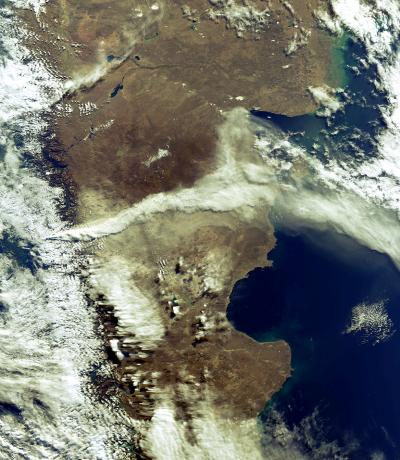
Chile’s Chaiten Volcano is shown spewing ash and smoke (centre left of image) into the air for hundreds of km over Argentina’s Patagonia Plateau in this Envisat image acquired on 5 May 2008.

The 1000 m-high volcano had been dormant for thousands of years before erupting on 2 May, causing the evacuation of thousands. Chaiten Volcano is located in southern Chile 10 km northeast of the town of Chaiten on the Gulf of Corcovado.

Envisat’s Medium Resolution Imaging Spectrometer (MERIS) instrument processed this image at a resolution of 1200 m.

Distiller’s grains are a by-product of ethanol processing that can be used for animal feed. There’s been some skepticism about using distiller’s grains in Texas but one scientist says the type of grain used makes all the difference.

Dr. Jim MacDonald, AgriLife Research beef nutritionist at Amarillo, said, “I believe we can do it successfully, provided we have distiller’s grains that are equivalent in quality to those used in the North Plains states.”

Two years ago, MacDonald began investigating the dramatically different animal performance responses observed in the Northern Plains and Southern Plains, and to determine how to successfully incorporate distiller’s grains into this region’s finishing rations.

As you read In Praise Of Consumerism - It Appeals To The Thoreau In You you may have wondered if I hated poor Henry David Thoreau. Not at all. He inspired me at the young and impressionable age of sixteen and has powered my engines ever since. There's a good chance that he did the same for you. But brace yourself for irony. Thoreau is the perfect example of the positive aspects of consumerism.

What is consumerism? It’s the flaunting of surplus. It’s the conspicuous display of surplus time, of surplus energy, and of surplus luxuries.

And what was Thoreau doing at Walden Pond? He was flaunting a small flood of hidden luxuries. He was flaunting the surplus time that the wealth of his father’s pencil factory had given him. He was flaunting his ability to escape the web of commercial trade and the meshwork of human technologies. He was celebrating his ability to ditch the conventions other rich kids followed - the obligatory trip to Europe and a permanent plunge into the newly-quickening madness of city life.

Would you recognize a legislative push for Creationism if you saw one? After decades of failed legal strategies to overtly ban evolution or make equal time for Creationism in public schools, the latest tack used by the opponents of evolution is to have 'academic freedom' bills that encourage school teachers to include supposed evidence against evolution, or the presentation of 'both sides' of a controversial issue in science class. If you support the integrity of science education, you should oppose bills like this, both because they are redundant when it comes to good science (teachers already can teach both scientific sides of a legitimate scientific debate), and because the Creationist legislators pushing them are up to no good. But are we reaching a point where Creationism is defining itself out of existence? Are they creating a legal loophole too small for their anti-evolutionary propaganda to fit through?

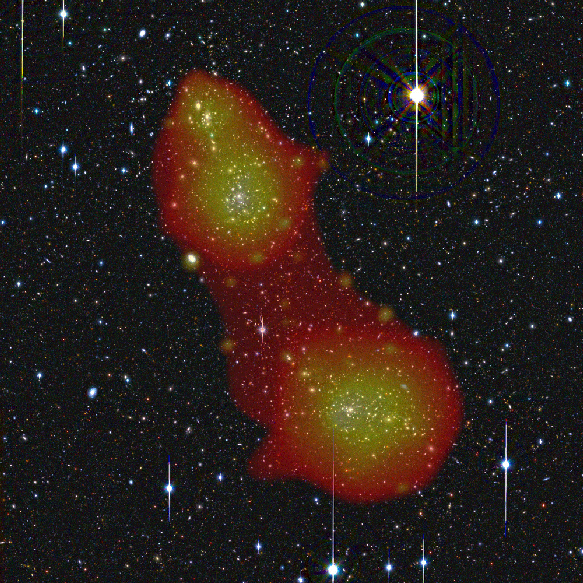
A team of Dutch and German astronomers have discovered part of the missing matter in the Universe using the European X-ray satellite XMM-Newton. They observed a filament of hot gas connecting two clusters of galaxies. This tenuous hot gas could be part of the missing “baryonic” matter.

The existence of this hot gas (with a temperature of 100 000 - 10 000 000 degrees), known as a warm-hot intergalactic medium, was predicted 10 years ago as a possible source for the missing dark matter. Gas at such high temperature and low density is very difficult to detect and many attempts have failed in past years.

The team observed a pair of clusters of galaxies (Abell 222 and Abell 223) using the European X-ray satellite XMM-Newton. Their observations (see Fig. 1) clearly show a bridge connecting both clusters. The gas they observed there is probably the hottest and densest part of the diffuse gas in the cosmic web, which would be part of the missing “baryonic” dark matter.

Scientists used to think that hermaphrodites, due to their low position in the evolutionary scale, did not have sufficiently developed sensory systems to assess the “quality” of their mates.

A new work has shown, however, that earthworms are able to detect the competition by fertilising the eggs that is going to find its sperm, tripling its volume when there is rivalry. This ability is even more refined as they are able to transfer more sperm to more fertile partners.

Hermaphrodites, organisms that have both female and male reproductive organs, such as earthworms, are denied the right to choose their partner. However, a study by researchers at the University of Vigo has shown that worms are capable of telling whether another worm is a virgin or not, and triple the volume of sperm transferred during copulation if they detect a fertilisation competition risk.

