









Infinity was invented to account for the possibility that in a never-ending universe, anything can happen. Life on other Earth-like planets, for example, is possible in an infinite universe, but not probable, according to a scientist from the University of East Anglia.

The mathematical model produced by Prof Andrew Watson suggests that the odds of finding new life on other Earth-like planets are low because of the time it has taken for beings such as humans to evolve and the remaining life span of the Earth. Structurally complex and intelligent life evolved late on Earth and this process might be governed by a small number of very difficult evolutionary steps.

Prof Watson, from the School of Environmental Sciences, takes this idea further by looking at the probability of each of these critical steps occurring in relation to the life span of the Earth, giving an improved mathematical model for the evolution of intelligent life.

According to the Tissue Viability Team at the University of Hertfordshire School of Nursing and Midwifery, around 200,000 peoople in the UK will have a chronic wound, like a pressure ulcer, at any given time. In addition to the pain and suffering caused by these non-healing wounds, the financial costs of their management are high for both the government and the patient.

Non-healing wounds frequently result in extended hospital stays and increased risk of complications such as infections.

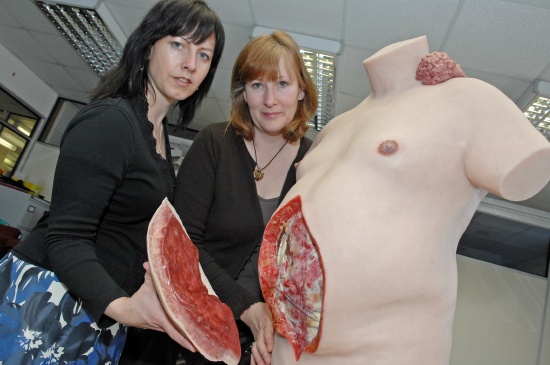
To address the greater training requirements for chronic wounds, Julie Vuolo, a lecturer at the School, joined with Tina Moore, a third year Model Design student, to develop a three-dimensional model complete with a pressure ulcer; a surgical incision which can be removed to reveal a large abdominal wound and a removable fungating tumor.

They named him George.

Results from a one-year prospective, observational study conducted to determine the impact of beginning treatment with AVONEX on MS patients’ overall quality of life (QoL) were announced today. The data showed that patients receiving treatment with AVONEX experienced statistically significant improvements in QoL, as measured by the EuroQol questionnaire (EQ-5D), compared to baseline. In addition, the study demonstrated the negative impact of disability progression (as measured by the expanded disability status scale (EDSS)) on employment status and QoL. These data were presented today as a poster presentation at the 60th American Academy of Neurology annual meeting in Chicago, Illinois.

Why do black patients with advanced kidney disease have higher levels of creatinine, a standard indicator of kidney function, than whites? Contrary to what doctors have thought, the difference may not necessarily reflect differences in muscle mass related to younger age or differences in body composition, reports a study in the July 2008 issue of the Clinical Journal of the American Society of Nephrology (CJASN).

Led by Dr Joy Hsu of University of California, San Francisco, School of Medicine, the researchers measured serum creatinine concentrations and estimated body composition in more than 3,000 dialysis patients. Doctors measure creatinine to estimate how well a patient's kidneys are functioning—a higher creatinine level is generally a sign of lower kidney function. Creatinine levels were compared for black patients versus those of other racial/ethnic groups.

Researchers at the National Institute of Standards and Technology (NIST) have combined a cryogenic sensor and a microrefrigerator on a single microchip.

They combined a transition-edge sensor (TES)(1), a superconducting thin film that identifies X-ray signatures far more precisely than any other device, with a solid-state refrigerator based on a sandwich of a normal metal, an insulator and a superconductor.

The combo chip, a square about a quarter inch on a side, achieved the first cooling of a fully functional detector (or any useful device) with a microrefrigerator. The paper also reports the greatest temperature reduction in a separate object by microrefrigerators: a temperature drop of 110 millikelvins (mK), or about a tenth of a degree Celsius.

I have taken issue before (here and here) with the writings of Stanley Fish in the New York Times, and I’m about to do it again. Fish is a professor of law at Florida State University, and often writes reasonably on a variety of topics in the NYT, but there is a streak of deconstruction running through some of his columns, that brings him to espouse pretty questionable positions when it comes to science, religion or philosophy.

There are many on-going themes in the large discussion of global warming and replacing fossil fuels with renewable, clean energy. One of the dominant ones is that alternative fuels such as solar are much more expensive than fossil fuels. This argument is often put forth by those entrenched in the status quo of the fossil fuel industry. The general argument is that our entire economic world will take a hit if we use solar as it is so much more expensive that oil.

There was a recent news story here at ScientificBlogging saying that it will take another ten years for solar energy to be price-competitive with fossil fuels.

Female fruit flies sometimes choose males who are aggresive, sometimes choose males who do not fight at all, and sometimes choose males for no reason science can explain, write a team of biologists, and the findings help explain the large variation in aggressiveness in most species, including humans.

So females are unpredictable, which means the fittest males don’t always get the girl. This explains why males don't evolve towards super-aggressiveness.

“If aggression makes you more likely to father children, all males should be selected to be very aggressive. Male fruit flies (like humans and other animals) show a lot of genetic variation in aggression, and we wanted to find out why,” explained study leader Brad Foley, a post-doctoral researcher at USC.

Huge star streams in the outskirts of two nearby spiral galaxies have allowed astronomers to obtain a panoramic overview of ' galactic cannibalism' similar to that involving the Sagittarius dwarf galaxy in the vicinity of the Milky Way.

The detection of these immense stellar fossils confirms the predictions of the cold dark matter model of cosmology, which proposes that present-day grand design spiral galaxies were formed from the merging of less massive stellar systems.

The first of these debris structures surrounds the galaxy NGC 5907, located 40 million light-years from Earth and formed from the destruction of one of its dwarf satellite galaxies at least four billion years ago.

The electric solar wind sail developed at the Finnish Meteorological Institute has moved rapidly from invention towards implementation. Electric sail propulsion might have a large impact on space research and moving in space in general.

The electric solar wind sail developed by Dr. Pekka Janhunen at the Finnish Meteorological Institute might revolutionise travelling in deep space. The electric sail is a Finnish invention which uses the solar wind as its thrust source and therefore needs no fuel or propellant. The solar wind is a continuous plasma stream emanating from the Sun. Changes in the properties of the solar wind cause auroral brightening and magnetic storms, among other things.

