

Yet another government science report has found that the Keystone XL pipeline is not going to be risky to the environment. 

The DiscoverE outreach program and its Girls Coding Club program teaching computer programming to girls from grades 3 to 9, has won a Google RISE Award

Last year, DiscoverE, an initiative by the University of Alberta Faculty of Engineering, became the first Canadian group ever to win a RISE Award, now in their fifth year, and now it is first to win two.  

It's the time of year when experts on relationships give advice. Not experts on their own, but rather experts on yours.

All that's needed is a weak observational study based on surveys and it practically writes itself.

Vaccines are the safest, cheapest and most effective way to protect against infectious diseases  but to make a good one remains a challenge, and traditional approaches are now stretched to the limit while fatal diseases, like HIV and malaria, remain without vaccine. 
 But a major breakthrough that turns vaccine design on its head has now been published in Nature on the 6th of February - a new computational method that, from the protective antibodies of patients, can design the vaccine specific to induce them (and protect against the disease).

Are American jobs less stable? Do workers change employers more frequently than in the past?

The reflexive answer is yes, especially since unemployment is the worst it's been in decades, but on average that is not the case. On average, job tenure (the number of years working for the same employer) has been reasonably stable over time between 1983 and 2008 - though that obviously leaves out the 1970s and the recent prolonged economic troubles. 

You learned in high school that light has a dual nature - it exists as both waves and photons. It is this duality of light that enables the coherent transport of photons in lasers. 

Physicists know that, at the atomic-scale, sound has the same dual nature, existing as both waves and quasi-particles known as phonons. Knowing that, phonon-based lasers have also been in development since the first functioning laser was created in 1960, with limited success.

Nine years ago, Dennis Aabo Sørensen of Denmark lost the use of his left hand handling fireworks during a family holiday. 

Now he has become the first amputee in the world to feel sensory-rich information, in real-time,  with a prosthetic hand wired to nerves in his upper arm.

Silvestro Micera and a team at Ecole Polytechnique Fédérale de Lausanne (EPFL) and SSSA (Italy) developed the sensory feedback that allowed Sørensen to feel while handling objects.

A prototype of the bionic technology was tested in February 2013 during a clinical trial in Rome under the supervision of Paolo Maria Rossini at Gemelli Hospital (Italy). The study represents a collaboration called Lifehand 2 between several European universities and hospitals. 

When it comes to discussion about public schools, the administation's education experts call the educators and students they claim to support 'dismal' on a regular basis.
Stars like Sol are relatively easy to understand, because they are numerous, and live for billions of years, but high mass stars are rare and live for only a few million years. As a result, understanding their early evolution has been a challenge.  

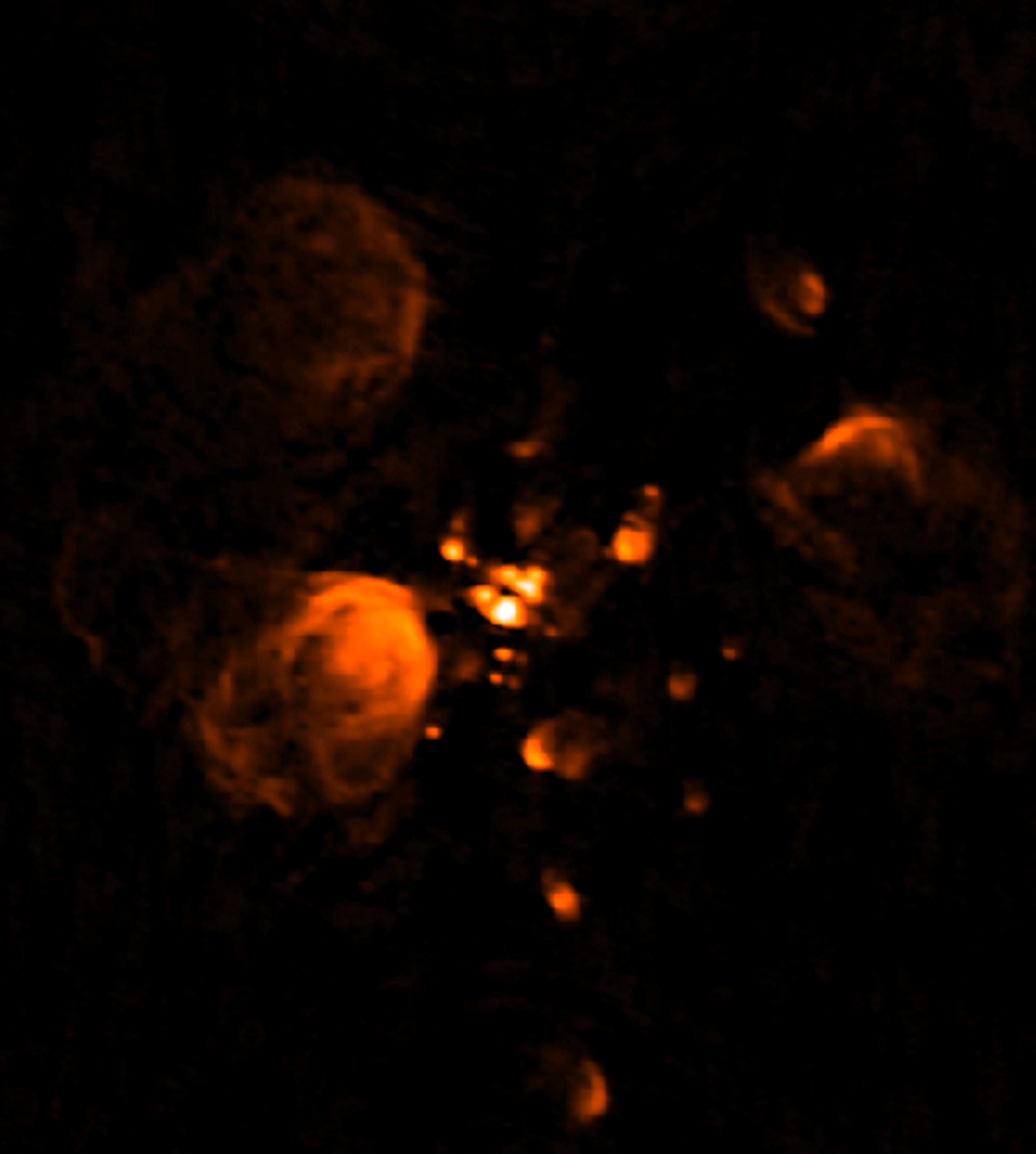
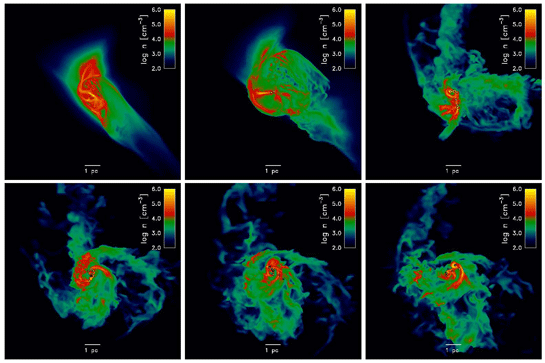
Simple models suggested that when high mass stars become hot enough to ionize the gas around them, heating it to thousands of degrees, the gas will quickly expand. But decades ago, astronomers found that regions of ionized gas around young high mass stars remain small (under a third of a light-year) for ten times longer than they should if they were to expand as predicted. 

First principles are calculations that rely on established mathematical laws of nature without additional assumptions or special models.

But when it comes to the early universe, what are those first principles? We're talking really ab initio - "from the beginning" - as in from the beginning of time onward.  

In the beginning, the cosmos experienced rapid inflation, electrons and protons floated free from each other, the universe transitioned from complete darkness to light, and enormous stars formed and exploded to start a cascade of events leading to our present-day universe.

