I read with pleasure today a proceedings writeup of the Moriond 2010 talk given by S. Andringa on behalf of the Pierre Auger Observatory. It is too bad that I did not visit La Thuile this year: the venue of the Moriond conferences is always a very pleasant place to spend a week, with talks scheduled in the morning and evening which leave the central hours of the day free for skiing. My last trip there was in 2005: I need to make the case for another visit next year!
Since the rediscovery of the cancer stem cell hypothesis by Peter Dirks at the University of Toronto, researchers often use these cancer stem cells (or cancer initiating cells) as the scapegoat to explain why cancers are so hard to treat.
'Hollywoood's job is not to educate but to entertain and inspire', but it turns out they find science inspirational. In the
Going Hollywood podcast, you can listen (or read) about just how scientists get to, well, Go Hollywood.
There are 3 ways for a scientist to enter that bastion of decadence we call "where I'd like to be". The first is basically a dating service for Movie Makers and Scientists. Since Nov 2008, Jennifer Oullette has run the "Science and Entertainment Exchange", a National Academies of Science program that is in LA, that tries to match scientists and writers.
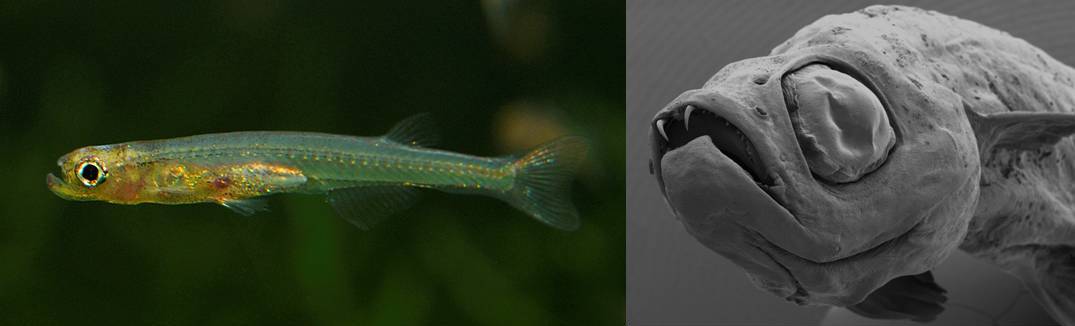
The International Institute for Species Exploration has announced their top 10 new species described in 2009.
Making the cut are a minnow with fangs, golden orb spider and carnivorous sponge.
Using a super-sensitive camera/spectrometer on the Herschel Space Observatory, astronomers have mapped the skies as they appeared 10 billion years ago, giving them a better look at the bright galaxies in the distant universe that appear to be forming stars at phenomenal rates.
They found that these glistening galaxies preferentially occupy regions of the universe containing more dark matter and that collisions probably caused the abundant star production. Results of the research were published in Astronomy&Astrophysics.
Scientists analyzing the temperature and salt levels of the Western Mediterranean Sea between 1943 and 2000 have found that the deep water has become progressively hotter and saltier, and that, since the 1990s, this process has speeded up.
Each year the temperature of the deep layer of the Western Mediterranean increases by 0.002ºC, and its salt levels increase by 0.001 units of salinity. These changes, although minimal from year to year, have been continuously and constantly occurring at a faster pace since the 1990s.
The results are consistent, "but to confirm this accelerating trend, we need to monitor it over the years to come", said Manuel Vargas-Yáñez, researcher at the Oceanic Centre of Malaga of the Spanish Institute of Oceanography (IEO).
Scientists have long wondered what is happening at the cellular and molecular level to bring about the amazing coordination that occurs when birds migrate or fish gather in schools.
A team of researchers writing in Science has found evidence that this collective behavior can arise in cells that initially may not be moving at all, but are prodded into action by an external agent such as a chemical. Their study has shown that food-deprived amoebae are prodded into their coordinated clumping by the chemical cyclic adenosine monophosphate (cAMP), effectively changing the parameters of the cell environment.
Too often, scientists do an inadequate job of communicating information to the public in a factual, non-technical, credible and neutral format.
The authors of a new analysis of science communication in PNAS say they have developed an effective communication strategy that could help experts connect with the public.
"More effective communication is badly needed at almost every level of science," said Kirsten Grorud-Colvert, a research associate in the Department of Zoology at Oregon State University. "It doesn't have to be expensive, but we have to get out of the ivory tower, away from our scientific jargon and work more closely with our various audiences."
Peer Review is universally used to ensure the quality of scientific research, but the process may not be as reliable as people assume. A new study in PLoS One suggests that the recommendations reviewers may not be much more reliable than a coin toss.
"Peer review provides an important filtering function with the goal of insuring that only the highest quality research is published," said William Tierney, M.D., a Regenstrief Institute investigator and study co-author. "Yet the results of our analysis suggest that reviewers agree on the disposition of manuscripts – accept or reject – at a rate barely exceeding what would be expected by chance. Nevertheless, editors' decisions appear to be significantly influenced by reviewer recommendations."
Multiple sclerosis (MS) is a devastating autoimmune disease, where the immune system attacks the white matter throughout the nervous system. While the cause for MS is currently unknown, epidemiological data so far suggests that the disease is likely triggered by both environmental and genetic factors. To pinpoint the molecular mechanism for MS, Sergio Baranzini and colleagues at UCSF conducted a recent twin study on multiple sclerosis using advanced tools such as genomic deep sequencing analysis. In their study published recently in Nature, Baranzini analyzed immune cells from identical twins where one of the twins has developed MS (Barazini et al., 2010). Much to their surprise, the study found no significant genomic differences between the twins.