

Cool Links

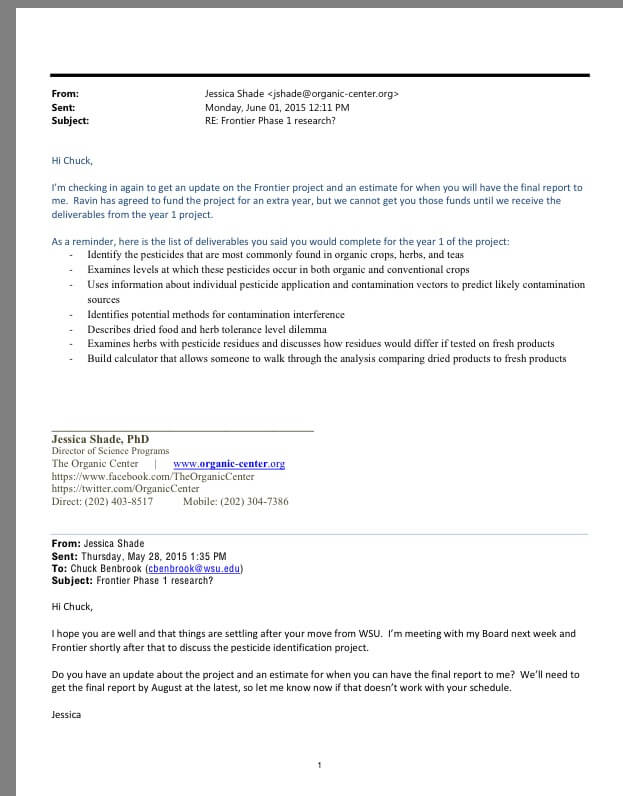
The world of social media has been abuzz with the revelation that anti-science economist Dr. Chuck Benbrook was involved in an orchestrated campaign to demonize scientists and promote the agenda of his corporate sponsors. The chain of dark money wends its way through sites like SourceWatch, US Right To Know, Mother Jones and on to science critics like Michael Pollan, Dr. Marion Nestle and Dr. Mehmet Oz.
A demographic educated to believe they want locally grown and accustomed to cheap should be the perfect target market for organic food, especially after its giant size - a $100 billion industry(!) - has brought costs down, but organic corporations shouldn't rest on their laurels.
Robyn O’Brien—who styles herself as a foodie version of Erin Brokovich - considers economist Chuck Benbrook - who styled himself a Research Professor while an adjunct at Washington State  University - a "mentor" and an "inspiration."
Can the greatest escape artist even escape death?

In the spirit of scientific skepticism, two on-stage séances will summon the ghost of Harry Houdini — on Halloween, the anniversary of his death. The first séance will be earnest, conducted by a professional “psychic medium.” The second will be full of illusion and special effects, conducted by master magician Paul Draper.
Three winners and six finalists of the 2015 Blavatnik Regional Awards for Young Scientists have been announced. The awards were created in 2007 and honor postdoctoral scientists from institutions across New York, New Jersey, and Connecticut. 

Winners are awarded $30,000 each and finalists are awarded $10,000 each in unrestricted funds. 
Bitter taste preferences might be associated with antisocial personality traits, finds an analysis of two US samples (N = 953, mean age = 35.65 years, 48% female).

Participants self-reported taste preferences and answered personality questionnaires assessing Machiavellianism, psychopathy, narcissism, everyday sadism, trait aggression, and the Big Five factors of personality.

Result: Bitter taste preferences were associated with malevolent personality traits and most strongly to everyday sadism and psychopathy.

So if your next date from Tinder orders bitter food at dinner, you know what to expect.
Nature Biotechnology, which by the name obviously supports agricultural science, has come late to the party defending scientists against the icy chill of bullying tactics by the US Right To Know organization, which is itself funded by organic food corporations and has a director that is the well-known political operative and former Clinton lawyer, Lisa Graves, behind the PR group that runs the SourceWatch advocacy site.

But it's never too late to take the correct stance.
A Supreme Court decision in Reed v. the Town of Gilbert (which concerned the constitutionality of certain standards for or restrictions on signage in a town in Arizona) may mean that process-specific food-labeling initiatives are likely to be deemed unconstitutional by federal courts.
If you prefer an organic toxic pesticide over a synthetic one, or prefer food created with older genetic modification rather than the modern kind, then you are willing to pay more for those values.

And it was only a matter of time before companies followed the money. 
If you walk into a store and think you are buying vegan food and it turns out to be made of meat, are you going to be outraged?

That is at the heart of a mayonnaise controversy that has been whipped up by Hampton Creek, which makes vegan food and has a mayonnaise they want to sell as mayonnaise. But Federal law put a stop to just slapping a name on a fake product over 70 years ago, that is why the Code of Federal Regulations, which govern ‘standards of identity’, was created in 1938.

Plus, just inventing your own definitions for food annoys people:


To health experts, sugary drinks and type 2 diabetes are linked because sugar promotes weight gain, and body fat contributes to insulin resistance, which can lead to diabetes. A study a short while ago removed weight as a factor, and claimed that every daily serving of sugar-sweetened beverages increases any person's risk of type 2 diabetes by 13 percent over 10 years.
Nine years ago today, the International Astronomical Union demoted Pluto from a planet to a dwarf planet — a move that was resented because not only was it a tiny percentage of astronomers, actual planetary scientists were ignored, despite the fact that planetary scientists focus solely on planets, moons, and planetary systems while astronomers look at a large variety of celestial objects and cosmic phenomena.

"It's bulls---,"Alan Stern, the lead scientist behind NASA's New Horizons mission to Pluto, told Tech Insider in July (and said we could quote him on that).
Vani Hari, "The Food Babe", has apparently made pretty good money selling pseudoscience to her audience. Obviously, almost anything she has said has been debunked by qualified doctors and scientists, but what was little realized is how much money she makes selling the ingredients she claims are dangerous.

No one's life is in peril, of course, because like her claims on microwaves and air travel, she is goofy, it just seems odd she only worries about a "2B carcinogen" (which applies to lots and lots of stuff,  the International Agency for Research on Cancer [IARC] has done 900 monographs on products and only found 1 that they didn't think is a carcinogen - that's why the UN shouldn't do science) when she isn't selling something that is a 2B carcinogen.
Want to learn Kantian morality? Please don't go to Wikipedia for philosophy - or anything else. Besides, the Stanford Encyclopedia of Philosophy has been around longer. Now 20 years old, America's best resource for philosophy was, like Science 2.0, designed to be much more modest than it became.

It was designed by Edward Zalta, a senior research scholar at Stanford's Center for the Study of Language and Information and the executive editor of the site, to be something of a glossary. Now it has 1,478 entries, 2,000 contributors and about four million pageviews a month, according to the team.
Dr. Oz may have thought he won the culture war by making "Dr." really tiny in his logo and hiring an anti-science fact checker for his program, but serious doctors are not buying it.

In Reuters, a consortium worries about the 6,000,000 people per day being told that homeopathy, Miracle Herbs and whatever else will be popular among the anti-science crowd this week will be taken seriously. 
The U.K. government has lifted a ban on neonicotinoid pesticides that was put in place by the EU after some suspect studies said neonics caused harm to bees. In other parts of the world, like Australia and Canada, where neonics are heavily used, there was no decline in bee colonies even in 2006, like there was in one part of Europe that set off the environmental craze, but Europeans were swayed by a well-organized publicity campaign (and even a conspiracy, as I showed in When It Comes To Neonics, Activists Understand PR Better Than Chemical Companies Do) and banned them. 

The coffee berry borer, Hypothenemus hampei, is a pesky beetle. It is thought to destroy $500M of coffee crop annually, affecting some 20M small farms worldwide. The borer spends most of its life cycle buried inside of the coffee berry, feeding on the sacred bean held within.

Artificial turf may be an abomination of sports but is it also dangerous for health in other ways? 

Dr. Joe Schwarcz doesn't know it is, but he links together some circumstantial evidence that might be worthy of Environmental Working Group. He notes that the “infill” is composed of sand and granules of “crumb rubber” that keep fibers upright and provide shock absorbency. He's talking about old rubber tires and sneakers that were repurposed.

Environmentalism, once the domain of science-based progressives like Dr. Norm Borlaug, has been hijacked by...conservatives.

You read that right. Outside America, 'conservative' usually meant 'attached to the old way', rather than not wanting to hand money over to the government to redistribute for votes. To those classic conservatives, the past is supreme. Sports were better, society was better, it is basically cultural nostalgia and fear of the modern.

That kind of fear of the modern still exists but rather than being old rich white people on the right, it is old rich white people on the left, who pay a lot of political science majors to raise money at environmental groups so they can send us back to the 19th century.
A GMO wheat meant to reduce insecticide use rather than enable plants to survive heavy spraying that was being researched at public institution by government scientists rather than an evil biotech company is being celebrated by environmental groups...because it failed.

Union of Concerned Scientists, Natural Resources Defense Council, Environmental Working Group and others who routinely side against science were still suspicious because it used a pheromone to scare insects away - a trick borrowed from mint plants - and that is confusing to the lawyers and lobbyists they spend their hundreds of millions of dollars on each year.

