shutterstock
By Carsten Maple, University of Warwick

Physician attitudes towards mental illness can reflect the general public's prejudice.
Dariush M/ Shutterstock
By Adam Brenner, UT Southwestern Medical Center
Portuguese researchers have developed a new method which uses images of a protein in cells to quantify its distribution (how much protein there is, and where it is in the cell) for that population of cells.
The discovery has important medical implications because the cellular location of a protein is directly linked to its function, as proved when the new algorithm identified mutations that had the potential to lead to >human diffuse gastric cancer(HDGC).

Credit: EU
By David Glance, University of Western Australia
The Parliament of the European Union last week voted to call on member states and the European Commission to investigate the operation of search engines in Europe to ensure “a balanced, fair and open Internet search structure”.
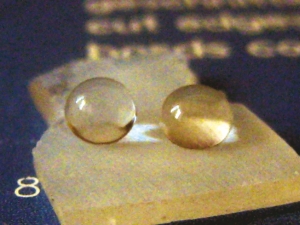
Imagine a car that can't get dirty or a business in Ferguson, Missouri that can't be graffiti'ed by unhinged protesters.
It might be possible with a new class of highly fluorinated super-repellent polymer called a “fluoropore”, which mimics the natural ability of lotus plants and cabbage leaves to make water droplets simply roll away - but for oils too. This lotus effect has been used for producing rough surfaces with special chemical properties. “However, this trick does not work for oils – the lotus plant repels water, but no oil,” says Dr.-Ing. Bastian Rapp of the KIT Institute of Microstructure Technology. “Oil-repellent surfaces need to have another chemical structure, fluoropolymers, for this purpose.”
The Arctic Ocean sea ice cover emerged 2.6 million years ago - and it hasn't changed since. Not in all of the recurring warming cycles we have had and not even in 2006, when pundits predicted it would be melted by 2014.
It wasn't always that way. Between 4 and 5 million years ago, the extent of sea ice cover in Arctic was much less than it is today. Recent IPCC reports believe that the expanse of the Arctic ice cover has been quickly shrinking since the 1970s and that 2012 was the known sea ice minimum in that time.

Not as simple as black and white.
Fred Bchx,
CC BY-NC-SABy Ian Rickard, Durham University
 Igor Stepovik
 Shutterstock
By Roxanne Connelly, University of Edinburgh