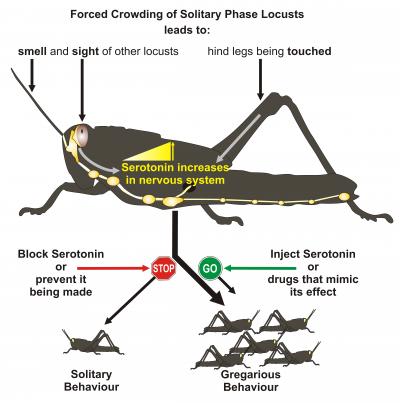





Desert locusts are harmless, solitary creatures until they get a certain chemical - and it isn't firewater, catnip or anything that comes from Colombia.   It's serotonin, a common brain chemical, but in the right amount they turn into hordes of hungry ... well ... locusts.

With desert locusts, the expression of this swarming characteristic generally means serious trouble for nearby farmer.   Locusts are known to sometimes swarm by the billions, and they often devastate crop yields.  Dr. Stephen Rogers from the University of Cambridge and the University of Oxford in the UK says about 20 percent of the world is affected by desert locusts.

Researchers from Northwestern University's Feinberg School of Medicine appear to have reversed the neurological dysfunction of early-stage multiple sclerosis patients by transplanting their own immune stem cells into their bodies and thereby "resetting" their immune systems. 

The patients in the small phase I/II trial continued to improve for up to 24 months after the transplantation procedure and then stabilized. They experienced improvements in areas in which they had been affected by multiple sclerosis including walking, ataxia, limb strength, vision and incontinence. The study will be published online January 30 and in the March issue of The Lancet Neurology

MS is the result of damage to myelin - the protective sheath surrounding nerve fibres of the central nervous system - which interferes with messages between the brain and the body. For some people, MS is characterised by periods of relapse and remission while for others it has a progressive pattern.  Symptoms range from loss of sight and mobility, fatigue, depression and cognitive problems.

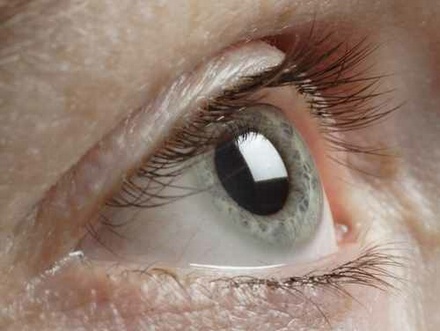
Scientists have known for more than 200 years that vision begins with a series of chemical reactions when light strikes the retina, but the specific chemical processes have largely been a mystery. A team of researchers from the United States and Switzerland say they have shed new light on this process by "capturing" this chemical communication for future study and say it may lead to the development of new treatments for some forms of blindness and vision disorders. 
Researchers at the University of British Columbia have discovered a mimic of one of "nature's antibiotics" that can be used to coat medical devices to prevent infection and rejection.   The study, released today in the journal Chemistry and Biology, found that a synthetic form, short tethered cationic antimicrobial peptides (cationic peptide), can protect surfaces, like those of medical devices, killing bacteria and fungi that come into contact with them. Peptides are small proteins.
A study of college freshmen in the United States and in China found that Chinese students know more science facts than their American counterparts but both groups are nearly identical when it comes to their ability to do scientific reasoning - unfortunately neither group  was very good at it.

The lesson is that educators must go beyond teaching science facts if we hope to produce voters, policy makers and scientists who can make reasoned choices.
Show Me The Science Month, Day 2

How do two populations change genetically when they are subjected to different evolutionary pressures? To answer this question, many intrepid evolutionary biologists have trudged out into the field to painstakingly study wild populations, but in many cases, we can learn more by studying evolution in the lab. In a paper published the February issue of Nature Genetics, a group of Portuguese and US researchers report a study of 28 years of evolution in a set of lab fruit fly populations. Their results are an example of how studying evolution in the lab, even for a short time, can provide insight in to how natural selection shapes the genetic contours of a population.
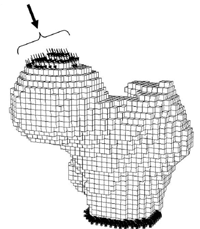
Better keep that resolution to hit the gym - you don't want to end up like an astronaut.  A recent study by Joyce Keyak of UCIrvine suggests that the bones of astronauts  lose up to 30% of their hipbone strength, comparable losses caused by osteoporosis in the elderly.
Morale has plummeted at the National Science Foundation, it seems, due to governmental oversight and interference from above.    The Senate Finance Committee didn't like a report they got from the NSF and are going to do something about it.

What, that sum'bitch Bush came back to haunt scientists and personally rewrite reports and ask why employees aren't doing their jobs instead of doing talk show appearances about how much he stinks?

The Scientific business of Thomson Reuters today announced the results of a study showing that the United States' share of scientific research has shrunk while Asia-Pacific's share of output has risen but the U.S. remains the leader globally in the relative impact of its research.

In its January/February issue of Science Watch, Thomson Reuters analyzes 12 year's worth of data from its National Science Indicators database to determine the U.S.'s global scientific influence based on the nation's research output and impact.

