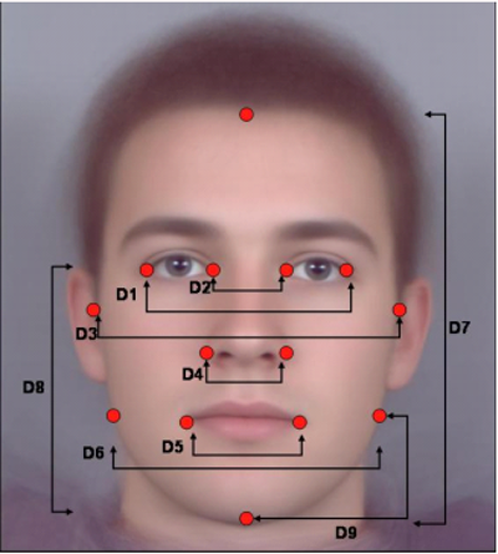









In humans, faces are an important source of social information. One property of faces that is rapidly noticed is attractiveness. Research has highlighted symmetry and sexual dimorphism (how masculine/feminine a face is) as important variables that determine a face’s attractiveness.

But why are these traits attractive?

One idea is that both traits are adverts of genetic quality or some other aspect of quality such as fertility. An alternative view is that preferences for these traits arise through visual experience and therefore not linked to any underlying biological factors. Faces certainly have the potential to be advertisements of mate ‘quality’ and one way to examine this idea is to look at interrelationships between proposed adverts of quality.

Think it's tough for humans to find the right mate? Malagasy mouse lemurs are so similar that picking a mate of the right species, especially at night time in a tropical forest, was thought to be more luck than science, but new research has shown that our desperately cute distant cousins use vocalizations to pick up a partner of the right species.

Until recently, grey, golden brown, and Goodman’s mouse lemurs were all thought to be the same species. But genetic testing revealed that they are, in fact, three distinct, species so similar that they cannot be told apart by their appearance—so called cryptic species.

“A fundamental problem for cryptic species that live in the same area and habitat is the coordination of reproduction and discrimination between potential mates of the same species and remarkably similar individuals of other species” say Pia Braune and colleagues from the Institute of Zoology, University of Veterinary Medicine, Hannover University.

A common weedkiller in the U.S., atrazine, already suspected of causing sexual abnormalities in frogs and fish, has now been found to alter hormonal signaling in human cells, scientists from the University of California San Francisco (UCSF) report.

Atrazine is the second most widely used weedkiller in the U.S., applied to corn and sorghum fields throughout the Midwest and also spread on suburban lawns and gardens. It was banned in Europe after studies linked the chemical to endocrine disruptions in fish and amphibians.

In studies with human placental cells in culture, the UCSF scientists found that atrazine increased the activity of a gene associated with abnormal human birth weight when over-expressed in the placenta. Atrazine also targeted a second gene that has been found to be amplified in the uterus of women with unexplained infertility.

Health care in the United States is expensive, but its funding is crucial because it also is a major contributor to the economy and can better lives, according to an essay appearing in the June 2008 issue of the Journal of the American Society Nephrology (JASN).

Because of the cost of health care, this is not time to shrink the budget at the National Institutes of Health, which funds medical research that leads to potentially curative therapy, according to Dr. Eric Neilson, Editor-in-Chief of the Journal of the American Society Nephrology and Chair of the Department of Medicine at the Vanderbilt University School of Medicine in Nashville, TN.

As the US population increases, health care costs are sure to rise. To help stem rising health care costs, government officials are taking money away from Medicare and Medicaid programs, and budget planners are reducing the funds used to support medical science. But experts question this strategy, noting that health care employs a large segment of the national workforce (and is, therefore, a fundamental feature of the economy) and medical research is a critical enterprise that over the long run will provide more affordable health care—so called “high technology,” as Lewis Thomas once phrased it.

Genetic variation in the DNA of mitochondria – the 'power plants' of cells – contributes to a person’s risk of developing age-related macular degeneration (AMD), say investigators in the first study to examine the mitochondrial genome for changes associated with AMD, the leading cause of blindness in Caucasians over age 50.

“Most people don’t realize that we have two genomes,” said lead author Jeff Canter, M.D., M.P.H., an investigator in the Center for Human Genetics Research. “We have the nuclear genome – the “human genome” – that makes the cover of all the magazines, and then we also have this tiny genome in mitochondria in every cell.”

Canter teamed with Jonathan Haines, Ph.D., and Paul Sternberg, M.D., experts in AMD genetics and treatment, to examine whether a particular variation in the mitochondrial genome is associated with the disease. The genetic change occurs in about 10 percent of Caucasians, referred to as mitochondrial haplogroup T.

A new study by UC Davis researchers provides evidence that methods using human bone marrow-derived stem cells to deliver gene therapy to cure diseases of the blood, bone marrow and certain types of cancer do not cause the development of tumors or leukemia. The study was published online in the May 6, 2008 issue of Molecular Therapy.

"The results of our decade-long study of adult human stem cell transplantation shows that there is little risk of adverse events caused by gene transfer, and that adult human stem cells do not pose a cancer risk when implanted into different organs," said Jan Nolta, senior author of the study and director of the UC Davis Stem Cell Program.

Nolta and her colleagues tested the safety of gene transfer into bone marrow stem cells from human donors in more than 600 mice. None of the transplanted mice developed leukemia or solid tumors caused by the gene therapy treatment, during the evaluation period of up to 18 months.

Current biochemical detectors are slow and produce an unacceptable number of false readings because they are easily fooled by subtle differences between deadly pathogens and harmless substances. They simply cannot fully monitor or interpret the different ways these substances interact with biological systems.

To solve this problem, three faculty researchers in the University of Maryland's A. James Clark School of Engineeringare are learning how to incorporate real cells into tiny micro-systems to detect chemical and biological pathogens.

They are collaborating across engineering disciplines to make advanced "cell-based sensors-on-a-chip" technology possible. Pamela Abshire, electrical and computer engineering (ECE) and Institute for Systems Research (ISR); Benjamin Shapiro, aerospace engineering and ISR; and Elisabeth Smela, mechanical engineering and ECE; are working on new sensors that take advantage of the sensory capabilities of biological cells.

Fallow agricultural land and steppe-formation processes are evidently capable of having a much greater effect on global air quality than was previously assumed, according to researchers who examined a dust cloud that formed over parched fields in southern Ukraine and led to extremely high concentrations of particulate matter in Central Europe.

Over two-thirds of the land area in the Ukraine consists of fields and meadows. The soil on 220,000 square kilometres is regarded as being under threat. Since the 1930s wind erosion in what was then the Soviet Union has increased considerably as a result of collectivisation in agriculture and the resultant large field areas.

In particular, this has affected the regions north of the Caucasus, the lower reaches of the Don river and eastern and southern Ukraine. It is possible that the process is also accelerated by climate change. In particular, previously unaffected semi-arid regions are continuing to dry out.

A gut hormone that causes people to eat more does so by making food appear more desirable, suggests a new report in the May issue of Cell Metabolism. In a brain imaging study of individuals, the researchers found that reward centers respond more strongly to pictures of food in subjects who had received an infusion of the hormone known as ghrelin.

The findings suggest that the two drives for feeding — metabolic signals and pleasure signals — are actually intertwined.

More and more U.S. college students are smoking tobacco using hookahs, a kind of water pipe, and it’s becoming a growing public health issue, according to a new study led by a Virginia Commonwealth University researcher.

In a hookah, tobacco is heated by charcoal, and the resulting smoke is passed through a water-filled chamber, cooling the smoke before it reaches the smoker. Some waterpipe users perceive this method of smoking tobacco as less harmful and addictive than cigarette smoking.

Principal investigator Thomas Eissenberg, Ph.D., associate professor in the VCU Department of Psychology, notes that current and prospective waterpipe tobacco smokers should be made aware that waterpipe tobacco smoking is not as benign as they might think. Waterpipe and cigarette smoke contains some of the same toxins -- disease-causing tar and carbon monoxide, as well as dependence-producing nicotine. Additionally, the exposure to these toxins through waterpipe smoking may be greater due to longer periods of use.


