







Most of the times we have looked at Uranus, it has seemed to be a relatively calm place. Well, yes its atmosphere is the coldest place in the solar system.

But, when we picture the seventh planet in our solar system invariably the image of a calming blue hazy disc that the spacecraft Voyager 2 took in 1986 comes to mind.

However, all we have previously known about the atmosphere of Uranus has been ’thrown to the wind’ with observations made last year.

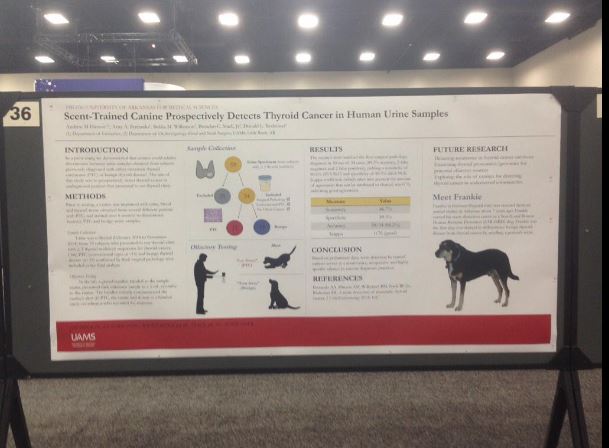
A trained scent dog has been found to accurately distinguish between benign and cancerous urine samples of thyroid cancer patients a terrific 88.2 percent of the time, according to a new study.

That canine diagnostic accuracy is only slightly less than that of fine-needle aspiration biopsy, the method generally used first to test thyroid nodules for cancer - but it is noninvasive and inexpensive. 
An experimental compound known as GC-1 causes loss of weight and fat in mice in lab tests. The drug speeds up metabolism, or burning off, of fat cells, by activating the receptors for thyroid hormone, which play a role in regulating metabolism - the body's conversion of food into energy. Thyroid hormone receptors also help with adaptive thermogenesis, in which the body converts excess energy (calories and fat) to heat.

Until recently, there was no evidence that human adults had  energy-burning, "good" brown fat. It was only known that animals and human infants did  but now it is known that human adults do have brown fat, but it appears to lose its calorie-burning activity over time.

Attempts to put a dollar value on the natural world – so-called “natural capital” or “ecosystem services” – have produced some frankly staggering numbers. A seminal 1997 paper valued the world’s ecosystem services at US$33 trillion (A$42 trillion) a year. This estimate was controversial, given that it dwarfed the entire global market economy, which at the time stood at roughly US$18 trillion a year.

New research published in Diabetologia shows that use of statins is associated with a 46% increase in the risk of developing diabetes, even after adjustment for confounding factors. The study is by Professor Markku Laakso, Institute of Clinical Medicine, University of Eastern Finland and Kuopio University Hospital, Finland, and colleagues.

The number of women in paid employment has risen significantly over the past 40 years. In developed countries especially, there are increasing numbers of women reaching top positions in different fields of work. And new research shows how girls are doing far better than boys educationally across the world.

The use of psychedelics, such as LSD and magic mushrooms, does not increase a person's risk of developing mental health problems, according to an analysis of information from more than 135,000 randomly chosen people, including 19,000 people who had used psychedelics, sponsored by an LSD advocacy group in Norway. The results are in Journal of Psychopharmacology.

Why can cancer cells be so resilient, even when faced with the onslaught of nearly toxic drug cocktails, radiation, and even our own immune system?

A new research report appearing in the March 2015 issue of The FASEB Journal, shows that intermediate filaments formed by a protein called "vimentin" or VIF, effectively "insulate" the mitochondria in cancer cells from any attempt to destroy the cell. Under normal circumstances, VIF serves as the "skeleton" for cells by helping them maintain their shapes.

Sunday marks the 106th celebration of International Women’s Day.

Since New Yorkers first celebrated it in 1909, American women have made great strides toward equality in the workplace, politics and at home. Long gone are the days when women couldn’t vote or sex discrimination was blatant and legal.

A new sequencing technique may provide a clearer picture of how genes in mitochondria, the "powerhouses" that turn sugar into energy in human cells, shape each person's inherited risk for diabetes, heart disease and cancer, according to a study.

The powerful new tool may help researchers better explain why some people get sick and others do not despite being the same age and weight, or having the same bad habits (e.g. smoking). Researchers have long sought to determine these risks by looking at diet and variations in nuclear genes inherited from both parents. These analyses have left out differences in mitochondrial genes (mtDNA), the second kind of DNA in every cell, which we inherit from our mothers.


