




Nova Southeastern University (NSU) researchers recently discovered that, contrary to prior belief, tissues of different mammalian organs have very different abilities to repair damage to their DNA.

These new findings indicate that the heart has the greatest capacity to repair its DNA, followed by the intestines, kidneys, spleen, testes, and lungs. The brain, however, exhibited no ability to repair damage to its DNA.

These studies were performed in murine cell tissue culture, but, based on previous human studies performed by the same investigators, such "tissue specificity" is true of humans, as well.

Massive elimination of neurons is a critical aspect of normal nervous system development but also represents a defining feature of neurodegenerative pathologies, such as Alzheimer's disease, Parkinson's disease, Huntington's disease and amyotrophic lateral sclerosis.

The order in which genetic mutations are acquired determines how an individual cancer behaves, according to research from the University of Cambridge, published today in the New England Journal of Medicine.

Most of the genetic mutations that cause cancer result from environmental 'damage' (for example, through smoking or as a result of over-exposure to sunlight) or from spontaneous errors as cells divide. In a study published today, researchers at the Department of Haematology, the Cambridge Institute for Medical Research and the Wellcome Trust/Medical Research Council Stem Cell Institute show for the first time that the order in which such mutations occur can have an impact on disease severity and response to therapy.

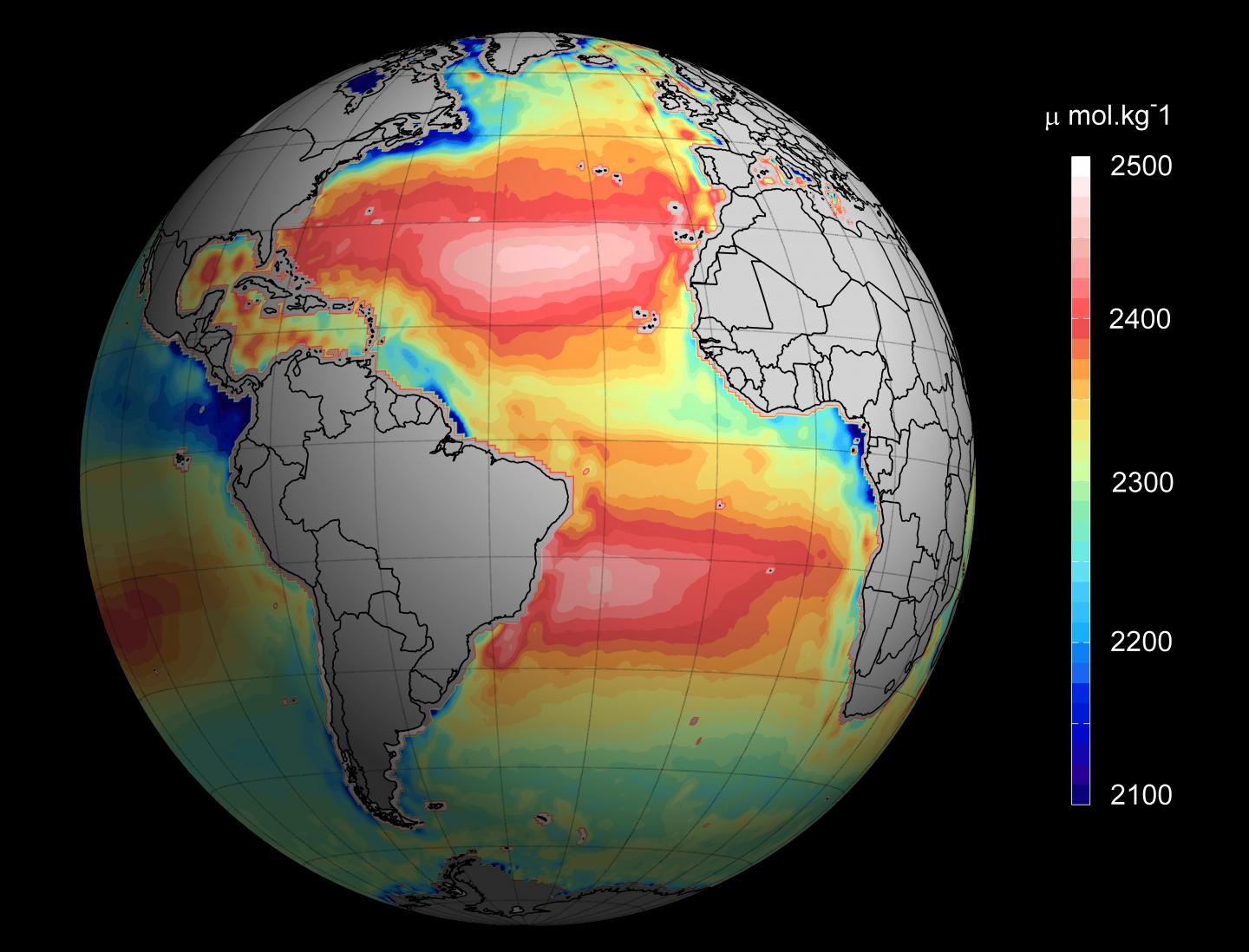
Remote monitoring of large swathes of otherwise inaccessible ocean using satellites reveals an alarming picture: ocean acidity.

The Earth's oceans take up about a quarter of global CO2 emissions, which can turn the seawater more acidic, making it more difficult for some marine life to live.

Rising CO2 emissions, and the increasing acidity of seawater projected over the next century, has the potential to devastate some marine ecosystems, a food resource on which we rely, and so careful monitoring of changes in ocean acidity is crucial.


Total ocean alkalinity as viewed from space. Credit: Ifremer/ESA/CNES
The agricultural development of the Lower Yangtze River Basin around Nanjing and Shanghai is ecologically unsustainable and actions are needed soon to reverse its decline, according to a new study.

The region has been in environmental decline since it passed a tipping point in the late 1970s, which further found that:

* the relatively stable pre-1970s 'agriculture-ecology' system in the region reached a tipping point at the end of the 1970s, as reforms in China allowed farmers to grow surplus crops with more fertilizers and pesticides.

* economic development has created a 'trade-off' between gains in agricultural productivity and increasing environmental degradation, with losses of ecosystem services, such as good water quality and stable soils.
Winter floods are important natural 'disturbances' for maintaining species-rich riparian zones along northern watercourses. Movies like The Day After Tomorrow and An Inconvenient Truth exaggerated some of the big effects of a climate gone crazy but less attention is given to smaller, realistic scenarios, like a disturbance in existing winter floods.

Riparian forests are important as they supply habitat, store carbon, provide shading, and filter water. Ice formation and winter floods are significant factors for vegetation and wildlife in northern regions.  According to Ph.D. candidate Lovisa Lind at Umeå universitet, during cold winter days, frazil ice (tiny ice particles) forms in the super-cooled water of open turbulent stream reaches.
Contrary to common belief, politicians are not in the pocket of highly-paid environmental, corporate or union lobbyists. They certainly do what lobbyists want, as long as it isn't getting too much attention, but government gets a lot more responsive when publicity is attached.
Plumes that reached over 100 miles above the surface of Mars, reported by citizen scientist astronomers in March and April 2012, continue to puzzle scientists. In the past, similar events had been seen, but only up to around 50 miles.  

The features developed in less than 10 hours, covering an area of up to 1000 x 500 kilometers, and remained visible for around 10 days, changing their structure from day to day. None of the spacecraft orbiting Mars saw the features because of their viewing geometries and illumination conditions at the time but citizen scientists and their telescopes did. 
Protecting privacy in an age of online big data is difficult and social network data adds its own challenges, something that has been a concern since Science 2.0 began in 2006, when genomic data was really beginning its ascent. 


Youth may be idealized but that doesn't mean older people aren't getting busy - they just don't take pictures on their cell phones and post them to Instagram. A new survey found that people in the early years of marriage have sex more frequently, and sexual activity tapers off over time, but then a rebound occurs after 50 years.


