




Treatment with creatine monohydrate for at least 5 years for patients with early and treated Parkinson disease failed to slow clinical progression of the disease, compared with placebo, according to a study in the February 10 issue of JAMA.

Psoriatic arthritis is a common form of inflammatory form of arthritis causing pain and stiffness in joints and tendons that can lead to joint damage. Nearly all patients with psoriatic arthritis also have skin psoriasis and, in many cases, the skin disease is present before the arthritis develops. However, only one third of patients with psoriasis will go on to develop psoriatic arthritis.

Anti-vaccine beliefs are going bipartisan, what was once the province of kooky progressives in California and Oregon is now also being embraced by American libertarians, and public service announcements are unlikely to help. Washington State University researchers say that people may be influenced more by online comments than by credible PSAs.

Writing in the Journal of Advertising, WSU marketing researchers Ioannis Kareklas, Darrel Muehling and TJ Weber are the first to investigate how Internet comments from individuals whose expertise is unknown impact the way people feel about vaccines.

Log on to Twitter, Facebook or other social media and you will find that much of the content shared with you comes in the form of images, not just words. Those images can convey a lot more than a sentence might, and will often provoke emotions in the viewer.

Jiebo Luo, professor of computer science at the University of Rochester, in collaboration with researchers at Adobe Research has come up with a more accurate way than currently possible to train computers to be able to digest data that comes in the form of images.

In a paper presented last week at the American Association for Artificial Intelligence (AAAI) conference in Austin, Texas, they describe what they refer to as a progressive training deep convolutional neural network (CNN).

A few years ago, another colony collapse occurred. Though it has happened more times than recorded history has been able to log, the concern was that new pesticides, which replaced the old pesticides blamed for the last colony collapse, might be the cause.

Since then, bees have rebounded nicely. The collapse was limited to one geography, rather than everywhere the newer pesticides - neonicotinoids - were used, so researchers have been scrambling to find out why it happened and therefore make it predictable. 

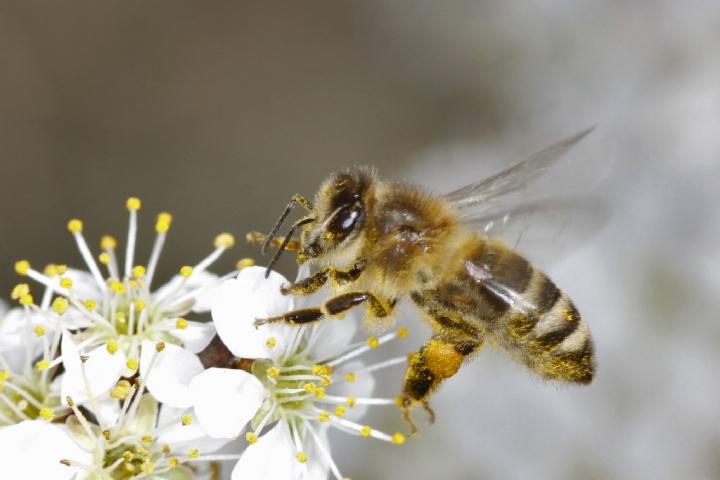
A new study says it could just be stress - young bees are sometimes pressured to grow up too fast. 


Credit: QMUL
What happens when people in one political party in America are presented with science that doesn't align with their political views? The same thing that happens in the other party. They rationalize why it isn't valid science.

Despite claims by liberals that they hold some special acceptance of science - the same thing conservatives claimed until the 2000s - a new study has found it isn't the case when the science issue is political. It's no secret that conservatives are less likely to accept evolution and climate change science, science media has talked about it for over a decade. Yet science media doesn't note that anti-agriculture, anti-medicine and anti-energy views correspond to liberal voting, even though the public recognizes it. 
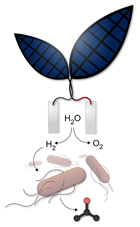
Harvesting sunlight is old technology for plants but it's a level of efficiency in solar energy we would love to be within a billion years of - artificial photosynthesis is needed if we want to go beyond the energy density of things like combustion engines. 
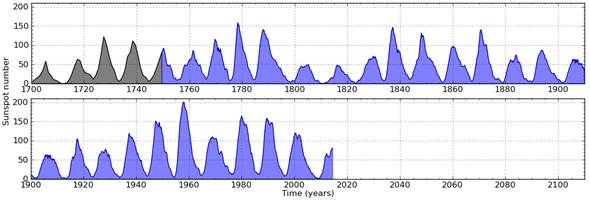
Some people believe we are in a new Enlightenment, with science making food plentiful and likely to make energy cheap enough to be unnoticeable in the next few decades as well. We share one other thing in common with the 18th century - solar activity.

Scientists have been counting sunspots with small telescopes since 1610 so it was quickly learned that the Sun’s activity increases every eleven years, according to the interval in the growth of the number of darker and colder spots in comparison with the rest of its surface. The more spots that appear, the more luminous the surrounding areas are, and our star shines brighter. 

Personal information taken from social media, blogs, page views and so on are used to detect disease outbreaks, however, does this violate our privacy and trust if people do not consent to it?


By:  Karin Heineman, Inside Science

(Inside Science TV) – Shelley Tworoger, an epidemiologist at Brigham and Women's Hospital located in Boston, Massachusetts studied ovarian cancer.

"This is one of the largest and oldest cohort studies in the world. We followed over 230,000 women over several decades and every two years they answered questionnaires about their lifestyle and health, in particular we asked them every 4 years to report back to us the kinds of foods that they eat. We used this information to look at what women ate and we followed them up to see who got ovarian cancer and who didn't," said Tworoger.


