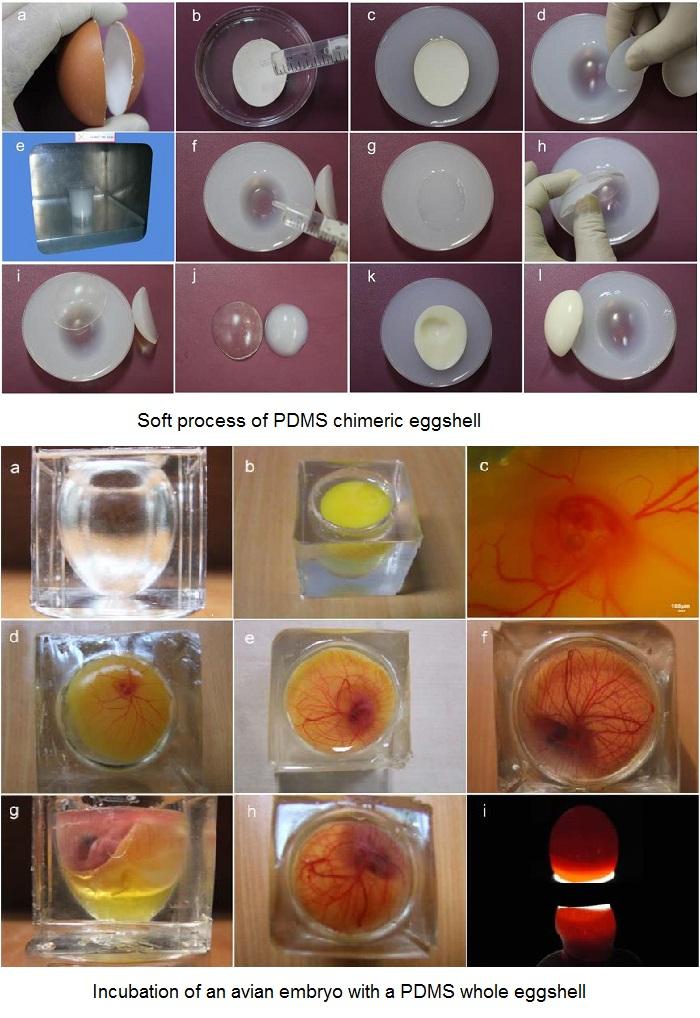



In the two decades existence of lab-on-a-chip (LOC), there have been lots of individual systems developed, ranging from lung-on-a-chip and heart-on-a-chip to the liver-on-a-chip and kidney-on-a-chip - but an ideal embryo-on-a-chip has eluded science because of the challenges in condensing so many life factors inside a conventional LOC. 

But now two scientists have developed a PDMS (polydimethylsiloxane) "soft" process method to fabricate a transparent shell matching the shape and curvature of a real eggshell.

The most important feature of a conventional "Lab-on-a-chip" is its chemically based character, or its scaling down chemical tests into a miniature-size device.

Naturally occurring arsenic in private wells threatens people in many U.S. states and parts of Canada, according to a package of a dozen scientific papers to be published next week. The studies, focused mainly on New England but applicable elsewhere, say private wells present continuing risks due to almost nonexistent regulation in most states, homeowner inaction and inadequate mitigation measures. The reports also shed new light on the geologic mechanisms behind the contamination. The studies come amid new evidence that even low doses of arsenic may reduce IQ in children, in addition to well documented risks of heart disease, cancer and reduced lung function. The reports comprise a special section in the journal Science of the Total Environment.

New research could lead to a better understanding of how the brain works in people with autism. Little is known about the cognitive processes involved.

Researchers from Monash University and Deakin University looked at new hypotheses of autism that focused on the way in which the brain combines new information from its senses with prior knowledge about the environment. Using the 'rubber-hand' illusion, the researchers examined how adults with autism experienced 'ownership' of a fake prosthetic hand.

In the 'rubber-hand' illusion, one of the subject's hands is placed out of sight, while a rubber hand sits in front of them. By stroking the fake hand at the same time as the visible real one, the subject can be convinced the fake hand is theirs.

The discovery of the first gene causing familial scoliosis was announced by an international France-Canada research team today. "Mystery surrounds the cause of scoliosis, which is a three dimensional deformation of the vertebral column. Many researchers have been attempting to uncover the origins of this disease, particularly from a genetic point of view," explained leading co-author Dr Florina Moldovan of the University of Montreal and the CHU Sainte Justine research hospital. "To date, many genes have been suspected of causing scoliosis amongst different populations, but the gene that causes the familial form of the disease remained unknown.

James D. Bjorken, also known as "BJ" by colleagues and physicists around the world, has been awarded the prestigious 2015 Wolf prize in Physics together with cosmologist Robert Kirshner. Bjorken deserves a lot of credit for his contribution to subnuclear physics: the official motivation is 

"For predicting scaling in deep inelastic scattering, leading to identification of nucleon's pointlike constituents "

One saved the U.S. space program, another invented a better treatment for leprosy and a third spawned an industry in the American Midwest - but you have probably never heard of these female "legends of chemistry".

Their names are Mary Sherman Morgan, Alice Ball and Rachel Lloyd and they all had amazing accomplishments in chemistry, but their work was nearly lost to history.


Mary Sherman Morgan, Alice Ball and Rachel Lloyd. Credit: The American Chemical Society

This week ACS Reactions shines the spotlight on them so they can get some proper acclaim:
Mars One, a private effort to do what governments seem incapable of achieving, has believers excited about colonizing another planet, but the long-term consequences of living in low or no-gravity conditions remain unclear. 

Mice are not people but if they are an accurate model, it might not go well. A new paper in The FASEB Journal found that spaceflight may be associated with a process of accelerated aging of the immune system. Specifically, researchers found that mice in low gravity conditions experience changes in B lymphocyte production in their bone marrow similar to those observed in elderly mice living in Earth conditions. 
Public participation will have to be at the heart of big data projects in health care and biomedical research and a new report calls for greater transparency about how people's data are used.

The report warns that if people's preferences and values are not taken into account and are instead picked by government elites, projects that could deliver significant public good may continue to be challenged and fail to secure public confidence. Recent health data projects, such as care.data, 100K Genomes, UK Biobank and the Scottish Informatics Programme (SHIP) have each, in their own way, raised ethical questions surrounding the use of data.  The report recommends the introduction of criminal penalties for misuse of data. 
A new study has linked a previously unexplored biological process to the failure of embryos to attach to the uterine wall during in vitro fertilization (IVF).

IVF only has around a 25% success rate, largely due to the high rates of failure when embryos try to implant. Some women suffer from recurrent implantation failure, where the embryo is transferred but fails to attach to the endometrium – the mucus membrane of the uterine wall. This is a significant cause of the failure of IVF as most embryo losses occur at this early stage.
There’s no scientific definition of picky eating, but parents know it when they see it.  Sharon Donovan, a University of Illinois professor of nutrition, says that picky eaters do exhibit definable preferences and mealtime behaviors.

The analysis showed that kids deemed picky eaters by their parents did react differently to common foods and behaved differently at mealtime than kids whose parents said their kids weren’t choosy. The differences were significant and occurred across 16 assessed behaviors, according to Soo-Yeun Lee of the University of Illinois.


