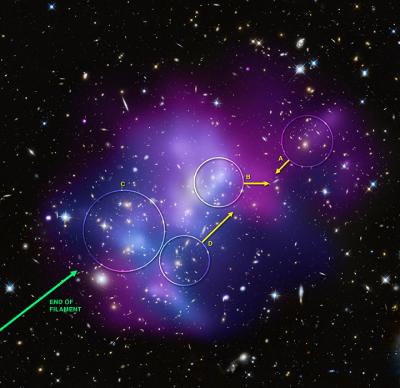
The most crowded collision of galaxy clusters has been identified by combining information from three different telescopes. This result gives scientists a chance to learn what happens when some of the largest objects in the Universe go at each other in a cosmic free-for-all.
Using data from NASA's Chandra X-ray Observatory, Hubble Space Telescope and the Keck Observatory on Mauna Kea, Hawaii, astronomers were able to determine the three-dimensional geometry and motion in the system MACSJ0717.5+3745 (or MACSJ0717 for short) located about 5.4 billion light years from Earth.
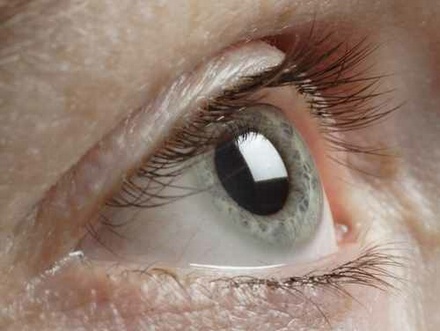
What's different about nocturnal mammals that have 'night vision'? According to a Cell report, the DNA within the photoreceptor rod cells responsible for low light vision is packaged in a very unconventional way. That special DNA architecture turns the rod cell nuclei themselves into tiny light-collecting lenses, with millions of them in every nocturnal eye.
There's a perception among some that it's a man's world and they get all the attention. If you've ever been in a bar or a library or a baseball game, you know this is not true - have a woman drop a napkin and see what happens whereas a man could be bleeding out his eyes and be unnoticed. But women want to keep men on their toes by pretending they are in charge.
Now the gig may be up, thanks to biology.
University of California, Berkeley biologist Doris Bachtrog and her colleagues say that the history of the X chromosome offers important clues to the origins and benefits of sexual reproduction. X even compensates for the degeneration of Y, which will get people talking.
Take that, much-studied male-determining Y chromosome.
What? NASA wants to make Earth Day about space?
Not at all, NASA is instead asking the public to vote for the most important contribution the space agency has made to exploring and understanding Earth and improving the way we live on our home planet. That's right, they call this our home planet, which means there may be a vacation planet on the way. That's thinking big, people.
Combating several human pathogens, including some biological warfare agents, may one day become a bit easier thanks to research reported by a University of Iowa chemist and his colleagues in the April 16 issue of the journal Nature.
Amnon Kohen, associate professor of chemistry in the UI College of Liberal Arts and Sciences, said that the study indicated a new mechanism by which certain organisms manufacture the DNA base thymidylate. This new mechanism is so very different from the way humans synthesize this base that drugs targeting this biosynthetic path in the pathogens are unlikely to affect the human path, thus resulting in very reduced side effects or no side effects at all.
An unmapped reservoir of briny liquid chemically similar to sea water, but buried under an inland Antarctic glacier, appears to support unusual microbial life in a place where cold, darkness and lack of oxygen would previously have led scientists to believe nothing could survive, according to newly published research.
After sampling and analyzing the outflow from below the Taylor Glacier, an outlet glacier of the East Antarctic Ice Sheet in the otherwise ice-free McMurdo Dry Valleys of Antarctica, researchers believe that, lacking enough light to make food through photosynthesis, the microbes have adapted over the past 1.5 million years to manipulate sulfur and iron compounds to survive.
Scientists have found an ancient ecosystem below an Antarctic glacier and learned that it survived millions of years by transforming sulfur and iron compounds for growth.
Sanger F, Nicklen S, Coulson AR. 1977. DNA sequencing with chain-terminating inhibitors. Proceedings of the National Academy of Sciences, U S A 74: 5463-7.
This paper describes the most important (IMHO) technical breakthrough in the biological sciences: DNA sequencing using a single-stranded DNA template, a DNA primer, a DNA polymerase, radioactively or fluorescently labeled nucleotides, and modified nucleotides that terminate DNA strand elongation.
Science is great at finding new rules for expectant mothers. They already can’t have alcohol, caffeine, or cigarettes. They also need to stay away from their cat’s litterbox, stay off of planes and rollercoasters, stay off of antidepressants, drop their acne medication, and forgo even a well-considered vegan diet.
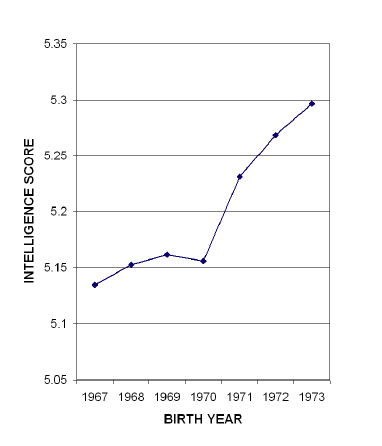
Now they have to avoid the Hong Kong flu, too. The Annals of Neurobiology recently published a study that suggested that exposure to the Hong Kong virus during the first trimester of pregnancy may contribute to decreased adult intelligence.
The Hong Kong flu is fairly easy to avoid now. But it was everywhere in 1969 and 1970. It reached its Norwegian apex in the spring of 1970, affecting up to 40% of the population.
The setup to the classic Melting Ice Cube problem goes something like this: “Fifty grams of ice are melting in a 100-mililiter cup of 35-degree water.” Using simple principles of energy transfer, we can estimate what the final temperature of the water will be, and how much energy transfer was required to make the ice melt.
But what if that ice cube was 20,000 square miles and the cup of water was 300 million cubic miles? What if the ice reflected incoming heat but the water absorbed it? And what if hurricanes, droughts, and forest fires depended on the outcome?