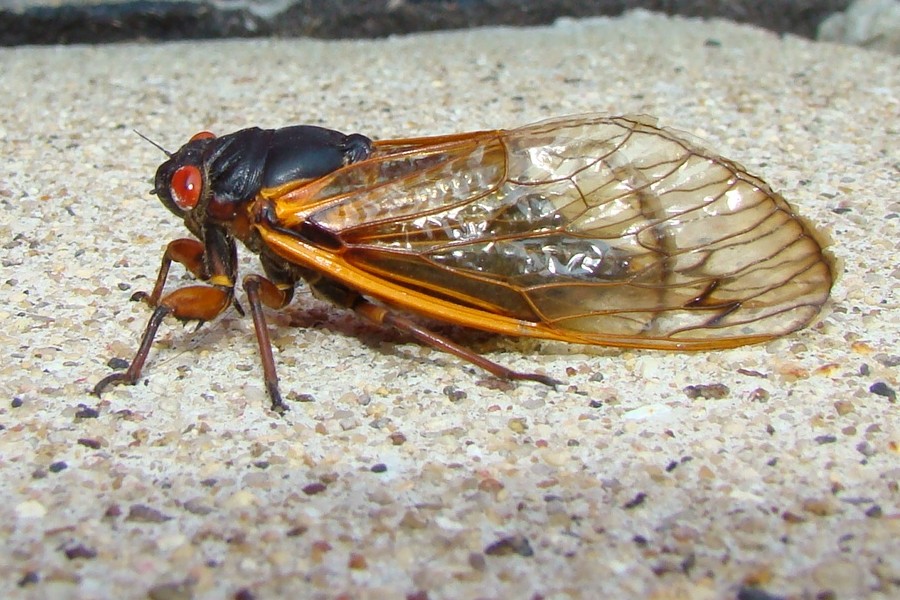
Cicadas are nature’s candy—fat meaty bugs straight out of a
Temple of Doom buffet. Though most cicadas worldwide live typical insect lives, the
Magicicada genus in the eastern US has a special power move to counterbalance its deliciousness: periodicity.
I recently saw W D Hamilton’s 1970 paper “Geometry for the Selfish Herd” described as “a classic in its own right.” As a long-time bibliophile this made it irresistible, but I was also intrigued by the incongruity of “selfish herd” and of linking geometry to animals. I have to report that the paper certainly is a classic, for all the wrong reasons, but it contains a valuable message.
The introduction to the paper began with:
This paper presents an antithesis to the view that gregarious behaviour is evolved through benefits to the population or species. Following Galton (1871) and Williams (1964) gregarious behaviour is considered as a form of cover-seeking in which each animal tries to reduce its chance of being caught by a predator.
Researchers at the universities of Leicester and Oxford have made a discovery about plant growth which could potentially have an enormous impact on crop production as global warming increases.
Dr Kerry Franklin, from the University of Leicester Department of Biology led the study which has identified a single gene responsible for controlling plant growth responses to elevated temperature.
As more research is conducted on the development and spread of pandemic type II diabetes, there is more evidence than ever that diabetes is intricately linked to obesity, which is spreading in the US at an alarming rate.
To combat the struggle of managing type II diabetes, physicians have turned to unconventional methods to reduce fat and likewise combat diabetes symptoms. Obesity reduction was the theme of the 2009 UK Diabetes Professional Conference in Glasgow, and efforts to treat and reverse diabetes through bariatric surgery was one of the most controversial topics.
Dr. James E. Hansen, head of the NASA Goddard Institute for Space Studies in New York and an adviser to Al Gore’s film, “An Inconvenient Truth,” is quoted and referred to in the New York Times article
"The Civil Heretic - Freeman Dyson - Profile" - by Nicholas Dawidoff, March 29, 2009, New York Times, page MM32 and in the New York Times Magazine, March 25, 2009.
Dr. Hansen sent his response to the article to those who have subscribed to his e-mail commentaries the day before its publication in the Sunday New York Times. He has given me permission to convey his clarification in its entirety:
New York Times Magazine
As I briefly laid out in
The Science Of Baseball: Coefficients And Happy Haitians, people like home runs though baseball purists don't necessarily think much of them - unless their team gets one.
Video games that involve high levels of action,like first-person-shooter games, can increase real-world vision, according to research in Nature Neuroscience, including discerning slight differences in shades of gray; an attribute of the human visual system that can't be improved, it has been believed.
Daphne Bavelier, professor of brain and cognitive sciences at the University of Rochester, says that very practiced action gamers can actually become 58 percent better at perceiving fine differences in contrast.
Individuals with autism spectrum disorders (ASD) tend to stare at people's mouths rather than their eyes. A new study of 2-year-olds with the social deficit disorder suggests why they might find mouths so attractive: lip-sync—the exact match of lip motion and speech sound. Such audiovisual synchrony preoccupied toddlers who have autism, while their unaffected peers focused on socially meaningful movements of the human body, such as gestures and facial expressions.
Chemists at the University of Illinois have created a simple and inexpensive molecular technique that replaces an expensive atomic force microscope for studying what happens to small molecules when they are stretched or compressed.
The researchers use stiff stilbene, a small, inert structure, as a molecular force probe to generate well-defined forces on various molecules, atom by atom.
"By pulling on different pairs of atoms, we can explore what happens when we stretch a molecule in different ways," said chemistry professor Roman Boulatov. "That information tells us a lot about the properties of fleeting structures called transition states that govern how, and how fast, chemical transformations occur."