Are Americans bad at science? If so, are they worse than anywhere else? We know the answer to one of those questions.
A new national survey commissioned by the California Academy of Sciences and conducted by Harris Interactive says that the U.S. public is unable to pass even a basic scientific literacy test.
The good news; U.S. adults
do believe that scientific research and education are important. About 4 in 5 adults think science education is "absolutely essential" or "very important" to the U.S. healthcare system (86%), the U.S. global reputation (79%), and the U.S. economy (77%).
When a single female antbird is nearby, those with male partners will sing over the songs of their betrothed in an apparent attempt to keep their messages from getting through, according to a new report in Current Biology.
Males, of course, then change their tune.
This may be the first evidence that such "signal jamming" and "jamming avoidance" (literal cock-blocking) occurs between mates, according to the researchers.
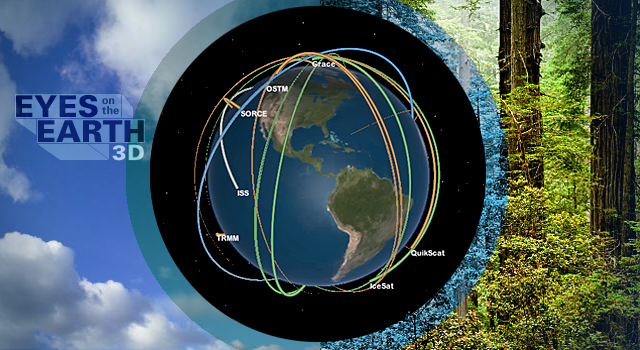
New interactive features on NASA's Global Climate Change Web site give the public the opportunity to "fly along" with NASA's fleet of Earth science missions and observe Earth from a global perspective in an immersive, 3-D environment.
Developed using a state-of-the-art, browser-based visualization technology, "Eyes on the Earth 3-D" displays the location of all of NASA's 15 currently operating Earth-observing missions in real time. These missions constantly monitor our planet's vital signs, such as sea level height, concentration of carbon dioxide in our atmosphere, global temperatures and extent of sea ice in the Arctic, to name a few.
Show Me The Science Month Day 23 Installment 23

Thanks to your parents, you have two copies of each chromosome, which means that you have maternal and paternal copies of every gene. In most cases, having two copies of a gene is no problem, but in some cases, two is too much, and your cells have to shut one copy down. How does a cell do it?
Shutting down one copy of a gene (or an entire section of a chromosome) is called genomic imprinting. (This is not the same thing as the newly hatched duckling that latches on to the first thing it sees, obviously). Genomic imprinting is a critical process used by placental and marsupial mammals to control the dosage of many genes, but how did this process evolve?
The answer, in part, has been discovered by an analysis of the platypus genome. Genomic imprinting appears to have
evolved from a defense mechanism used by cells to knock down parasitic DNA.
Because of the importance of computational genomics, I am writing this article with utmost urgency in hopes of unifying geneticists and biochemists once and for all.
The immune response can protect us from basically any invader but it can also create disease - like it happens in autoimmunity where it attacks the own body - so to understand its regulation is an important tool to assure its proper functioning. In a Nature Immunology article, scientists in Portugal study one of the least understood white blood cells subsets – the gamma delta T cells – and reveal that it is composed by two distinct functional groups that can be identified according to the expression of a molecule called CD27, which is also determinant deciding which subset dominates the immune response.
You wouldn't think that tanking an economy would make anyone happy but it puts a spring in the steps of a small group; economics professors.
If the lousy economy is cause for a party, the election of Barack Obama and more government meandering is apparently icing on the cake. Witness Professor Panicos Demetriades of the Economic and Social Research Council's World Economy and Finance Programme, who is today speaking at the 'Politics of Macro-Adjustment and Poverty Reduction' Conference.
A new study challenges the prevailing assumption that you must pay attention to something in order to learn it. Research in the journal Neuron says that stimulus-reward pairing can elicit visual learning in adults ... even without awareness of the stimulus presentation or reward contingencies.
The story’s Superman figure doubts if humanity is worth saving. Its Batman is impotent. Its Wonder Woman has mommy issues. And its closest thing to a protagonist also is a murderous sociopath.
Welcome to the world of Watchmen, considered by many to be the greatest comic book ever written. Dalhousie University english professor Anthony Enns, who teaches the course “Cartoons and Comics,” appreciates why people feel that way. He remembers Alan Moore’s comic being a sensation from the moment it first hit shelves over 20 years ago.
“If you were into comics then, everyone was taking about it, all the time,” he says. “People would gather and have these endless debates about what would happen next issue.”
Like adults, kids who are more spiritual or religious tend to be healthier.
That’s the conclusion of Dr. Barry Nierenberg, Ph.D., ABPP, associate professor of psychology at Nova Southeastern University in Fort Lauderdale, Florida, who has been studying the relationship between faith and health. He presented on the topic at the American Psychological Association’s Division of Rehabilitation Psychology national conference on February 27, in Jackson, Fla.