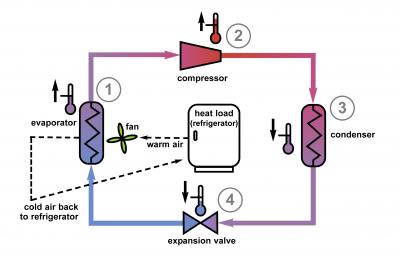
When people think of a refrigerator, magnetism isn't necessarily the first thought that comes to their minds. We've all become accustomed to the loud humming noise of the compressor and blowing fan that keeps our food nicely chilled, and anybody with even a cursory knowledge of thermodynamics knows basically how their refrigerator keeps the temperature down. A new development in materials science, however, may render our current refrigeration design obsolete and lead to far more efficient designs.
Parents and advocates who believe vaccines cause autism were dealt a double blow this week. On the scientific front, a discredited 1998 study that launched the vaccine-autism debate onto the forefront made headlines, and on the legal front, a special U.S. court ruled that vaccines are not to blame for the disease.
This is the year of Darwin (yes, yes, it’s also the year of astronomy, I know), and especially this week -- around the date of Chuck’s birth -- we are seeing a spike of events, radio and tv pieces, and printed articles. (Expect a second peak in November, for the anniversary of the publication of
Origin of Species.)
A well known professor of analog circuit design and theory once said "all models are wrong". Analog design is particularly rewarding and challenging, I believe, for this very reason. Those words have echoed in my mind during many junctures in my journeys to learn something about the physical world. Whether you are a theorist, phenomenologist, experimentalist or some combination of these, this fact is inescapable.
I am fascinated by how concepts of everyday life leak into all scientific thought, whether it be an elementary concept in engineering or within the confines of some rarefied physical theory. And this is a topic I hope to write much about.
The Valentine's Day lovefest on this site - who says scientists aren't warm and fuzzy? - is spectacular. You can learn about the chemistry of love with
Valentine's Day science for women, easy solutions for the
languishing lothario (personal favorites at the moment - "Roses are red, violets are blue. You and me we will stick like clay," and "I wanna be your Viking cleaner breathing in your dust.
Scientists at the University of North Carolina at Chapel Hill say they have helped develop a new genomic test that can help clinicians predict which breast cancer patients are most likely to survive the disease and which treatments may be most effective in increasing those chances of survival.
By specifically measuring the activity level of a small subset of the 20,000 plus genes that may be “turned on” or “turned off” within each tumor, this genomic test can give patients a more accurate picture of how their disease might progress.
Coming up on Darwin's birthday, a lot is written about natural selection by non-biologists because opponents of evolution prefer to believe that biology stopped in 1859. Criticizing Darwin and Natural Selection is a lot easier if you ignore the 20th and 21st centuries.
And that's okay, if the goal is a culture war rather than a science discussion, because even in Darwin's time it wasn't all balloons and ponies for Natural Selection. It was years later that evolutionary biology got help from an understanding of genetics and Natural Selection became accepted after rigorous scientific investigation.
\
Not sure who to date? Garth Sundem answers it in
The Valentine's Day Man-O-Meter. Be sure to take it as gospel because he never just makes stuff up.
If you're still unsure who to pursue, you may be looking in the wrong places. This study says
We Want To Date People Slightly More Attractive Than We Are. How, then, does anyone get a date? It's another mystery of love.
One of the weaknesses of using a surname as a guide in understanding genetic characteristcs has been the belief that 1 in 10 births were the result of infidelity - so the name is not only an incorrect characteristic but could even be deceptive.
Not, so, says a study funded by the Wellcome Trust published this week in the journal Molecular Biology and Evolution, which may help genealogists create more accurate family trees even when records are missing. It suggests that the often quoted "one in ten" figure for children born through infidelity is unlikely to be true.
Sky diving and base jumping are not for everyone. However, for certain people, the more risk and adrenaline involved in an activity, the better! What draws some people to daredevil behavior while others shy away from it? Psychologists Jane E. Joseph, Xun Liu, Yang Jiang and Thomas H. Kelly from the University of Kentucky, along with Donald Lyman of Purdue University were interested in testing how the brains of sensation-seekers differ from those of us who avoid risky behavior.