Sleep apnea is a condition characterized by temporary breathing interruptions during sleep, in which disruptions can occur dozens or even hundreds of times a night. According to the National Institutes of Health, it affects more than twelve million Americans.

Researchers at the University of Pennsylvania School of Medicine have provided a detailed look at the molecular pathways underlying sleep apnea and found that, in an animal model of sleep apnea, poorly folded proteins accumulate in one compartment of a muscle nerve cell, which, under certain conditions, tells a cell to heal itself or destroy itself.

The vision system used to process color is separate from that used to detect motion, according to a new study by researchers at New York University’s Center for Developmental Genetics and in the Department of Genetics and Neurobiology at Germany’s University of Würzburg.

The findings run counter to previous scholarship that suggested motion detection and color contrast may work in tandem.

Whether motion vision uses color contrast is a controversial issue that has been investigated in several species--from insects to humans. In human vision, it had been widely believed that color and motion were processed by parallel pathways. More recently, however, the complete segregation of motion detection and color vision came into question.

Researchers at the National Institute of Standards and Technology (NIST) have set the stage for building the “evolutionary link” between the microelectronics of today built from semiconductor compounds and future generations of devices made largely from complex organic molecules. In an upcoming paper in the Journal of the American Chemical Society, a NIST team demonstrates that a single layer of organic molecules can be assembled on the same sort of substrate used in conventional microchips.

The ability to use a silicon crystal substrate that is compatible with the industry-standard CMOS (complementary metal oxide semiconductor) manufacturing technology paves the way for hybrid CMOS-molecular device circuitry—the necessary precursor to a “beyond CMOS” totally molecular technology—to be fabricated in the near future.


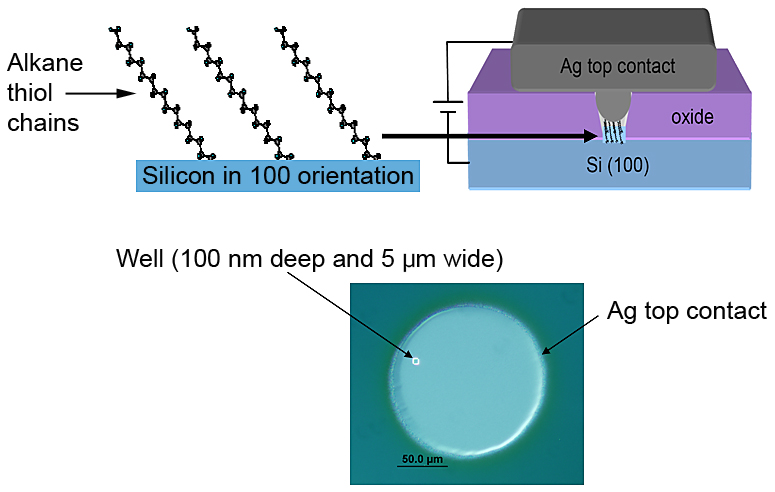
Side and top views of the NIST molecular resistor. Above are schematics showing a cross-section of the full device and a close-up view of the molecular monolayer attached to the CMOS-compatible silicon substrate. Below is a photomicrograph looking down on an assembled resistor indicating the location of the well. Credit: NIST

Researchers at NIST and the Joint Quantum Institute (NIST/University of Maryland) have developed a new method for creating pairs of entangled photons, particles of light whose properties are interlinked in a very unusual way dictated by the rules of quantum physics. The researchers used the photons to test one of the fundamental concepts in quantum theory.

In the experiment, the researchers sent a pulse of light into both ends of a twisted loop of optical fiber. Pairs of photons of the same color traveling in either direction will, every so often, interact in a process known as “four-wave mixing,” converting into two new, entangled photons, one that is redder and the other that is bluer than the originals.


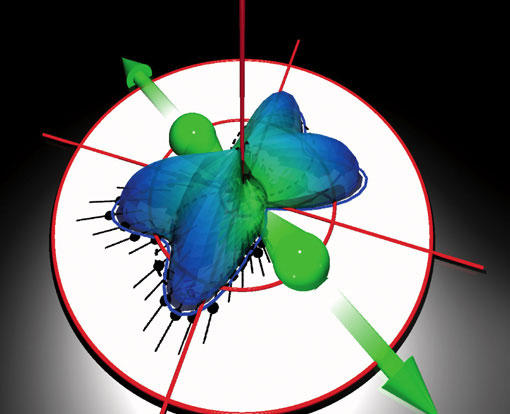
Three-dimensional view of photon-induced fragmentation of a deuterium molecule, showing the angular distribution of one ejected electron in the plane containing the molecular and light polarization axes. Another escaping electron of the same energy is emitted upwards out of the plane. The direction of the molecular axis is given by the exploding nuclei (in green). Credit: Lawrence Berkeley National Lab

If you had one hundred unlabeled DNA samples, taken from people all around the world, could you use that DNA to determine where the original donors came from?

With major improvements in genotyping technology, geneticists are now getting better and better at this game, and a recent paper in Science reports the largest study to date of human genetic diversity: 650,000 genetic differences scrutinized in nearly 1000 different individuals from 51 different populations.

Studies like this one lay important groundwork to help us understand how human genomes differ around the world, how differences in our genes and environments together make us healthy or sick, and how very ancient migrations led to the structure of today's human populations around the globe.

Twice in two days Botulinum toxin (Botox) has graced our front page, and it's not just because it makes Joan Rivers look like The Joker.

Yesterday we reported that Botox has helped infants with CHARGE Syndrome and today we discovered an article in Medical Hypotheses talking about its many beneficial effects.

Not bad press for an often fatal poison produced by a rare type of food poisoning bacteria.

Only two per cent of paediatric drug trials reported that they had established independent safety monitoring committees that can help lead to the early detection of adverse drug reactions, according to a major review in the April issue of Acta Paediatrica.

Child health researchers from the University of Nottingham, UK, carried out a detailed analysis of 739 international drug trials published between 1996 and 2002 to see what safety measures were in place and to monitor the levels of adverse drug reactions.

Just under three-quarters of the trials (74 per cent) described how safety monitoring was performed during the study, but only 13 studies (two per cent) had independent safety monitoring committees.

While significant gaps remain in our total knowledge of the extent of carbon dioxide’s sources, such as fires, volcanic activity and the respiration of living organisms, and its natural sinks, such as the land and ocean, it is known that more than 30 billion tons of extra carbon dioxide (CO2) is released into the atmosphere annually by human activities, mainly through the burning of fossil fuels.

According to the latest report by the Intergovernmental Panel on Climate Change (IPCC), this increase is predicted to result in a warmer climate with rising sea levels and an increase of extreme weather conditions. Predicting future atmospheric CO2 levels requires an increase in our understanding of carbon fluxes.

Using data from the SCIAMACHY instrument aboard ESA's Envisat environmental satellite, scientists have for the first time detected regionally elevated atmospheric carbon dioxide – the most important greenhouse gas that contributes to global warming – originating from manmade emissions.


This animation of carbon dioxide (CO2) shows how our planet ‘breathes’. Each year huge amounts of CO2 are taken up by the growing vegetation in spring and summer and are to a large extent released again during the following autumn and winter when part of the vegetation dies and decays. This is seen in the animations by the up and down of the measured CO2 once per year. By looking carefully at the animation, it is possible to see that the CO2 levels are rising by about 0.5-1 percent from year to year. Dr. Michael Buchwitz and Oliver Schneising from the Institute of Environmental Physics (IUP) at the University of Bremen in Germany based produced this animation using Envisat SCIAMACHY observations from 2003 to 2005. Credits: IUP/IFE, Univ. Bremen


Scientists from North Carolina State University conducted larger-scale field trials and have shown that silencing a demethylase gene in burley tobacco plants significantly reduces harmful carcinogens in cured tobacco leaves.

The finding could lead to tobacco products, especially smokeless products, with reduced amounts of cancer-causing agents.

NC State's Dr. Ralph Dewey, professor of crop science, and Dr. Ramsey Lewis, assistant professor of crop science, teamed with colleagues from the University of Kentucky to knock out a gene known to turn nicotine into nornicotine. Nornicotine is a precursor to the carcinogen N-nitrosonornicotine (NNN). Varying percentages of nicotine are turned into nornicotine while the plant ages; nornicotine converts to NNN as the tobacco is cured, processed and stored.