The documentary film Food Evolution provides a fresh,
scientific look at the technology of crop genetic engineering and some
situations it has, or could, help solve problems for farmers. It shows the ugly politics and distortions
that have maligned a useful technology that has served farmers well for twenty
years, worldwide.
Tormented water masses with distant horizons in flames. Multicoloured reflexions over living oceans. Moving images with an astounding visual impact. These are the first words that come to my mind if I try to describe Paola Nicoletti's paintings. Needless to say, I like them a lot - but judge for yourself from the three images below, or by visiting her web site. And if you do, please drop her a line! Paola is a friend, who has recently taken her painting quite seriously. I believe these pictures give ample justification for it. Here is what Paola herself writes to describe some of her works:
Last night was the premiere of "Food Evolution", a documentary on the science in our dinner, and I saw it with a large audience for the second time.
Wait, premiere? Second time? Which is it?
It's both. And that is how it became a tale of two cities. And maybe even a metaphor for the two Americas we now live in.
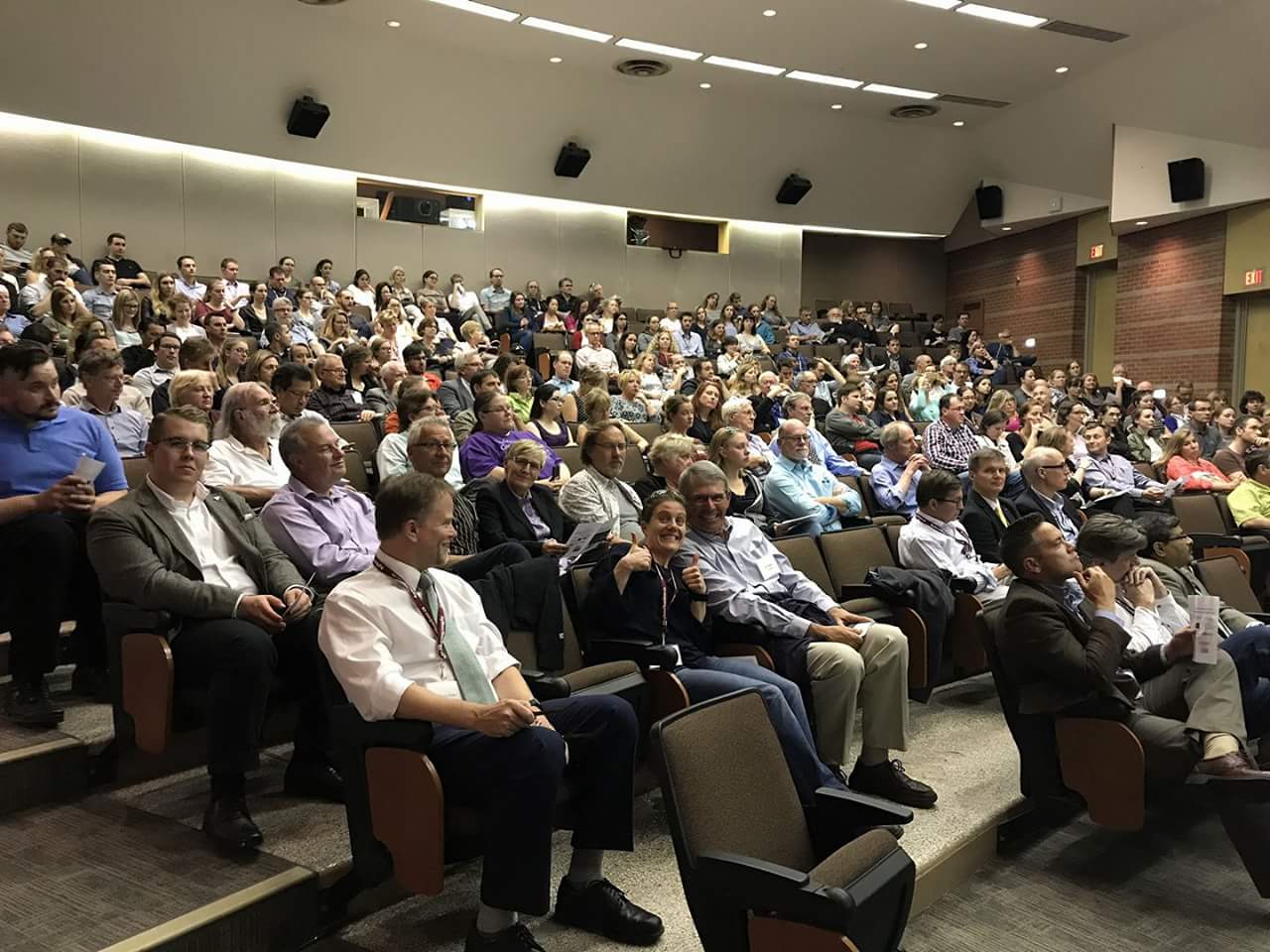
Two weeks ago I moderated a panel on communicating science and, more importantly, risk, at the University of Guelph, Canada's most prominent agriculture school. In the evening, there was a showing of "Food Evolution" in an auditorium there. I don't know how many people attended, it was packed, and before the movie there was a show of hands on how many people were okay with GMOs, how many distrusted them, and how many were unsure.
No, this post is not about some exotic new physics model predicting dark photons or other useless concoctions which physicists sometimes entertain with, in their frustration for the lack of guidance from experimental data of what really is it that the Standard Model is an effective theory of. For that kind of stuff, please wait and check out my blog at some other time.
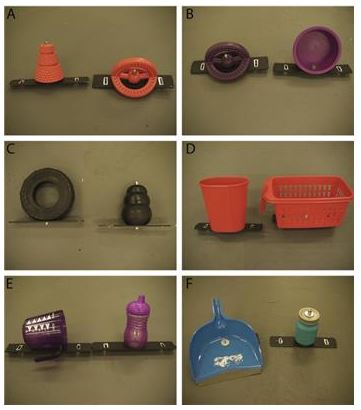
Kids are stimulated by new experiences. So are pigs. If you watched the 2014 video where a camera falls out of a plane and crashes into a pig sty you saw how intrigued they were by it, even though it clearly was not food.
A new study says that such "consumerism", a preference for shiny new stuff, is universal across the animal kingdom. And they showed it in piglets.
Since 2014, China has spent $4 billion on advanced agricultural science and is approving new technologies rapidly. Meanwhile, our food science regulatory system remains trapped in the 1980s, paralyzed by environmental lobbyists who buy full-page ads in the New York Times claiming they are "unsure", it just "needs more testing."
I have always imagined a future that is free of disease. However, we continue to suffer from diseases such as malaria, cancer, and AIDS for which there is no known cure. To make matters worse, other diseases such as poliomyelitis that were once considered to be eradicated are returning. Recall the success of the vaccine developed in 1952 by Jonas Salk (1914-1995) to combat this scourge, but poliomyelitis is still endemic in Nigeria, India, Pakistan and Egypt.
Lab-grown cartilage grown shows similar mechanical and chemical properties to the natural articular cartilage which allows our joints to move smoothly, according to a new study in Nature Materials.
A team biomedical engineers from University of California, Davis, created the lab-grown tissue similar to natural cartilage by giving it a bit of a stretch, growing it under tension but without a supporting scaffold. Their results show similar mechanical and biochemical properties to natural articular cartilage.
A randomized controlled trial of the use of acupuncture in emergency departments has found the treatment is a safe and effective alternative to pain-relieving drugs for some patients who visit looking for relief from things like a self-reported ankle sprain, a headache (invariably called a migraine) or back pain.
The nighttime satellite photos of the Earth reveal much about the population distribution of the developed world through the intensity of the artificial lighting being observed.