It would seem obvious that a diluted nicotine vapor is much less harmful than toxic chemicals in cigarette smoke - yet groups like the Centers for Disease Control and Tobacco Free Kids have instead adopted a 'quit or die' mentality about smoking.
Yet we engage in harm reduction when it comes to needle exchanges and, strangely, the political party that was against those is for e-cigarettes, while the party that is on the other side wants any smoking cessation or harm reduction tool not controlled by pharmaceutical companies to be penalized.
"What area on Mars is the most interesting for us?". My answer to this question isn’t an impressive geological feature like Olympus Mons or Valles Marineres. For me, it’s a rather unremarkable seeming crater, Richardson crater near the south pole. Let me explain why.
First this shows where it is. It is close to the south pole - this is an elevation map and I’ve trimmed it down to the southern hemisphere. You can see Olympus Mons as the obvious large mountain just right of middle, and Hellas Basin as the big depression middle left. Richardson crater is about half way between them and much further south.
The recent appearance of
Hurricane Matthew prompted some harsh memories of hurricanes past. I went
through Hurricane Andrew. I was living in Ft. Lauderdale with my youngest daughter,
Lydia, and I will never forget going three weeks without electricity. The storm
was bad enough – having two days of wind and rain shaking the walls of your
home was scary, but surviving for three weeks with no electricity was a
life-changing experience.
Thanks, but no thanks, say British scientists about controversial British evolutionary biologist Richard Dawkins, primarily known for his criticism of religion.
A majority of those surveyed who mentioned Dawkins’ work during research interviews reject his approach to public engagement and said his work misrepresents science and scientists because he conveys the wrong impression about what science can do and the norms that scientists observe in their work.
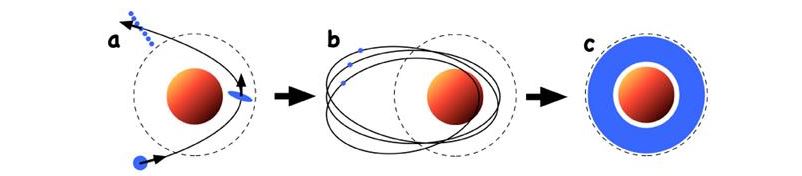
The giant planets in our solar system have very diverse rings. Observations show that Saturn’s rings are made of more than 95% icy particles, while the rings of Uranus and Neptune are darker and may have higher rock content. Since the rings of Saturn were first observed in the 17th century, investigation of the rings has expanded from earth-based telescopes to spacecraft such as Voyagers and Cassini. However, the origin of the rings was still unclear and the mechanisms that lead to the diverse ring systems were unknown.
In the late 16th century, two brothers from the illustrious Fugger merchant family had news from all over the world sent to them in Augsburg by mail. At the time, so-called "novellantes" compiled and wrote down news which they forwarded to wealthy subscribers such as the Fuggers, thus establishing the first commercial news medium in Europe.
The Fugger brothers had these newsletters bound and compiled in annual volumes, which eventually comprised about 16,000 newsletters in German and Italian.
If Elon Musk and Robert Zubrin have their way, we may get migrations of hopefuls setting off from Earth to Mars to colonize what they believe to be a "New World". If so, what they find there will be far more like the nineteenth century Antarctica than the seventeenth century "New World". Indeed, even the climbers who tackled Mount Everest in the twentieth century explored a far more hospitable place than Mars. You could breathe the air on the summit with only the need for an oxygen mask. It's also bitterly cold on Mars - a night in the Martian tropics is colder than the coldest night on Everest in the middle of winter. It's so cold that the air often starts to freeze out as dry ice at night.
The mystery of what clumps galaxy clusters together, and provides for a quarter of the matter-energy budget of the universe, really looks like _the_ most important scientific question we face today. There is nowadays compelling evidence of the correctness of the standard cosmological model, coming from the cosmic microwave background maps provided lastly by Planck as well as from a number of other observations - of supernovae, galaxy clusters, galaxy rotation curves, etcetera. So we know there has to be dark matter out there. But what is it?
The recent crash of the ExoMars Schiaperelli lander on Mars highlights how difficult it is to land there. So why is that? Why are landings on Mars so complex? And why do they fail so often? ESA is getting somewhat bad press for this. In my view it validates the foresight of their approach, to send a test lander first. It also highlights the risk for manned missions to Mars and the planetary protection issues with humans to the Mars surface, which I've written about many times.
Pancreatic cancer is one of the most lethal forms of cancer. Early detection is essential to improve prognoses. Working toward that goal, a collaboration of researchers in Japan has discovered proteins in the blood which improve the detection of pancreatic cancer. When used in combination with conventional pancreatic cancer biomarkers, it enables the diagnosis of early stage pancreatic cancer, which was previously thought to be difficult.