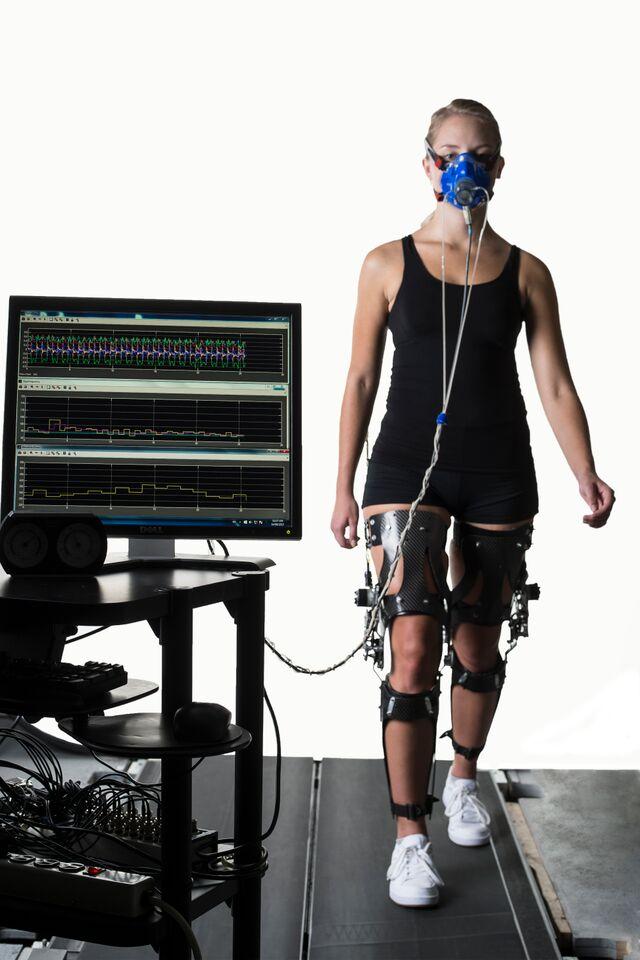

Every time you go to the gym to burn off those Dim Sum calories from the night before, your nervous system is subconsciously working against you.

Researchers have found that our nervous systems are remarkably adept in changing the way we move so as to expend the least amount of energy possible.

In other words, humans are wired for laziness.

The findings, which were made by studying the energetic costs of walking, likely apply to most of our movements, the researchers say.

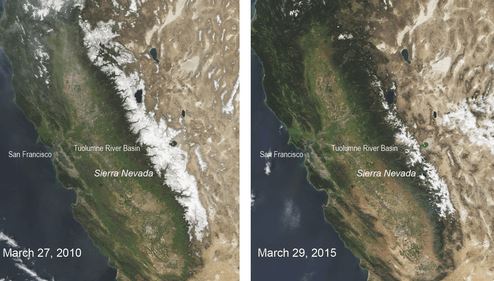
In the Mediterranean climate of California, with its warm, wet winters and hot, dry summers, the snowpack in the Sierra Nevada mountains plays a critical role. It serves as a natural water storage system that feeds waterways and reservoirs during the dry summer months.



That’s why it was very fitting that when Governor Jerry Brown announced the first-ever mandatory statewide water restrictions, he did it from the snow-barren Phillips snow course station in the Sierra Nevada. The April 1 snowpack’s water content has been measured at this station since 1941 and has averaged at 66.5 inches over this period.

Researchers ave shown that well-developed eyes come at a surprising cost to other organ systems. 

Researchers have long associated the presence of a well-developed brain with major energy consumption. This means that animals that develop advanced nervous systems require environments where this is possible. There has to be good access to nutrients, and every investment in an organ comes at a cost to some other organ system that is less essential in that particular environment. Up to now, there have been few concrete measurements of how high the cost of a nervous system actually is.

The study involving Mexican cavefish shows that the visual system can require between 5% and 15% of an animal's total energy budget.

Over one million people in sub-Saharan Africa will contract malaria this year because they live near a large dam, according to a new study which, for the first time, has correlated the location of large dams with the incidence of malaria and quantified impacts across the region. The study finds that construction of an expected 78 major new dams in sub-Saharan Africa over the next few years will lead to an additional 56,000 malaria cases annually.

Since the Food and Drug Administration (FDA) cautioned against using a minimally invasive method to treat fibroid tumors called power morcellation, there was a nearly quarter increase in hospital readmissions and 27 percent increase in major postoperative complications after hysterectomies in Michigan, a new University of Michigan study says.

After the first FDA safety communication in April 2014, the percent of women receiving minimally invasive hysterectomies in a large Michigan database also went down by an absolute 1.7 percent decrease.

The findings appear in the American Journal of Obstetrics&Gynecology.

More than half of Asian Americans and nearly half of Hispanic Americans with diabetes are undiagnosed, according to researchers from the National Institutes of Health and the Centers for Disease Control and Prevention. Additionally, prevalence of diabetes for all American adults went up, from nearly 10 percent to over 12 percent between 1988 and 2012. Diabetes prevalence - how common the condition is - also went up in every age, sex, level of education, income and racial/ethnic subgroup. One bright spot: The proportion of people with diabetes that was undiagnosed decreased 23 percent between 1988-1994 and 2011-2012.

The statistics account for age differences across the surveys.

When Paul Krugman, a famous liberal economist who has gained enduring cultural prominence by writing for the New York Times, actually put his philosophical beliefs to practical use, he helped give us Enron. Today, Dr. Krugman wisely avoids anything that translates to the real world. In the Sarbanes-Oxley culture he helped make necessary, he can stay out of jail if he sticks to polemics about Republicans.

Now that so many teenagers have smartphones equipped with cameras it’s inevitable that they’re used to take pictures, sometimes regrettable pictures, and to share them with others. The problem is that this is not just often regrettable in their own eyes, but also illegal in the eyes of the law.

A 14-year-old boy who took a naked selfie and sent it to a girl at school that he’d been flirting with recently found himself in hot water with his school and with the police. Both his and the girl’s details have been added to a police intelligence database for making and distributing an indecent image. Indecent because, as an image of a minor, it’s classified as child pornography under the Protection of Children Act 1978.

Want fries with that diet soda? You aren't alone, and you may not be saving as many calories as you think by consuming diet drinks, according to a new examination of the dietary habits of more than 22,000 U.S. adults which found that diet-beverage consumers may compensate for the absence of calories in their drinks by noshing on extra food that is loaded with sugar, sodium, fat and cholesterol.


It was a humid, sticky 32°C when I made a quick trip to the grocery store in shorts and a tank top earlier this week. Despite the heat, however, the store clearly wanted me to think it was the fall season – and for us Americans, that means pumpkin spice.

Weaving in and out of each aisle, I was inundated with row upon row of pumpkin spice M&Ms, pumpkin spice yogurt, pumpkin spice Oreos, pumpkin spice cereal, pumpkin spice beer, pumpkin spice cookies, pumpkin spice bagels, pumpkin spice Pop-Tarts, pumpkin spice popcorn, pumpkin spice hummus, pumpkin spice creamer for my pumpkin spice coffee …