



A new study led by investigators at Brigham and Women's Hospital (BWH) reports the discovery of a genetic variant that is associated with a patient's likelihood of responding to interferon-beta, one of the medications used in treating multiple sclerosis (MS). Published in the Annals of Neurology on May 14, the study also presents evidence that the affected gene, SLC9A9, may have a broader role in regulating the development and activity of certain immune cells that play important roles in inflammatory diseases like MS.

A proportion of MS patients experience disease activity despite treatment. The early identification of the most effective drug for a given individual is critical to impact long-term outcome and to move toward a personalized treatment approach.

It is somehow ingrained in my body, I think. The appreciation of biodiversity. I know I love wetlands, growing up by a lake (mostly in it as a child) as I did. It turns out that parts of that lake are so-called Ramsar wetlands of international importance. Little did I know, growing up to be an astrophysicist that these sites existed and that it would once become part of my professional life. Here. On my home planet. bliksvaer
Bliksvaer Ramsar site, Norway. Photo: Bente Lilja Bye
A recent eye infection suffered by 18-year-old Nottingham University student Jess Greaney is the kind of story that fills us with horror.

Greaney had keratitis, an inflammation of the cornea, caused by Acanthamoeba castellanii, a parasite that was living and feasting on her eye.

A paper in Science has been retracted - by the senior author. Because he did not know the data in his paper was fake.

Whether that makes political science or the peer review system look worse will be a matter of debate.
A new study of some Hesperornithiform bird fossils from the Cretaceous shows how several separate lineages evolved adaptations for diving. They began to go fishing.

Living at the same time as the dinosaurs,  Hesperornithiform has been found in North America, Europe and Asia in 65–95 million years old rocks. Dr. Alyssa Bell and Professor Luis Chiappe of the Dinosaur Institute, Natural History Museum of Los Angeles County, undertook a detailed analysis of their evolution, showing that separate lineages became progressively more adept at diving into water to catch fishes, like modern day loons and grebes.
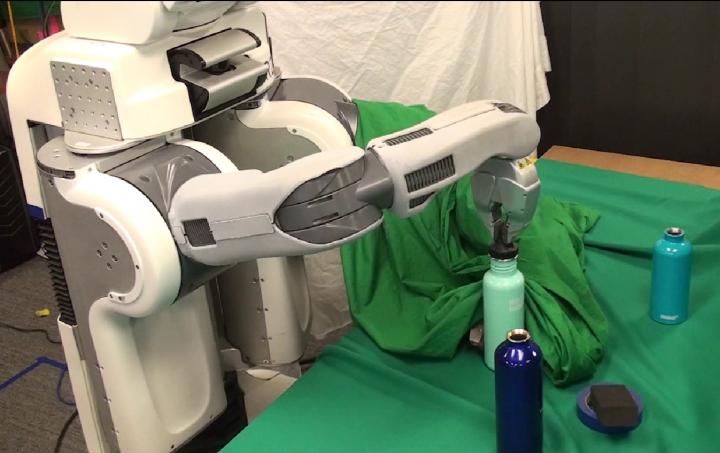
Researchers have developed algorithms that enable robots to learn motor tasks through trial and error, using a process that more closely approximates the way humans learn.

They demonstrated their technique, a type of reinforcement learning, by having a robot complete various tasks -- putting a clothes hanger on a rack, assembling a toy plane, screwing a cap on a water bottle, and more -- without pre-programmed details about its surroundings. 
Though the popular imagery of farming is a small family operation on a tiny patch of land, that isn't really the case.

Over 90 percent of American farms are run by families but they are high-tech operations. Farmers want yields to go up and costs to come down and that means having data.

 Karin Heineman, Inside Science –  Predicting and analyzing weather is a highly sophisticated scientific endeavor these days. But, it is also peppered with a good deal of lore.

We're here to debunk some popular weather myths.

Myth #1: Heat lightning, or the distant flashes of lightning you see in the sky (without hearing the clap of thunder) during the hot summer months, only occur because it is hot out.

Wrong. The truth is you're actually seeing lightning from a storm that's really far away. Since most severe thunderstorms often happen during hot summer months – the name "heat" lightning stuck.

Myth #2: The Earth is farthest from the sun in January.

One day you feel a strange stinging, biting or crawling sensation beneath your skin, which just won't go away. Then fibres begin to protrude from the skin or you may see red or blue lines below the surface of your skin. Eventually sores erupt all over your body, including in places you can't reach such as the middle of your back. You go to the doctor - and - after doing tests to rule out many other similar conditions, he finds that you fit the symptoms of a very rare condition, popularly called "Morgellons". He or she then tells you that this is not a real disease, but rather is a delusional condition. There is nothing physical causing this. It's just something going on in your mind which leads to all these symptoms.

Many of the people who visit me in my therapy practice spend time talking about work. How much work there is, how they never seem to be able to get it all done, how many hours they spend at work, how tired they are all the time and how fearful they are about losing their jobs. They’ve read articles telling them how they can improve their work/life balance. They’ve delegated and relegated, meditated and ruminated.

