







A study of the phenomenon known as loss aversion in two patients with lesions to the amygdala, a region deep within the brain involved in emotions and decision-making, may help explain how we make decisions and what makes us dislike the thought of losing money.

 Loss aversion describes the avoidance of choices which can lead to losses, even when accompanied by equal or much larger gains . Examples in the everyday life include how we make a decision on whether to proceed with an operation: the more serious the potential complications from the operation – even if the risk is low compared to the chances of success – the less likely we would be to proceed.
Using graphene, Swedish and American researchers say they have succeeded in producing a new type of lighting component which they claim will be inexpensive to produce and can be fully recycled. The invention was published in ACS Nano by scientists at Linköping University and Umeå University, in Sweden, and Rutgers, The State University of New Jersey.
There is a presumption among many people that extraterrestrial life is a foregone conclusion and that it is only awaiting our discovery.  The Drake equation is usually highlighted as many astronomers suggest that with the billions of worlds available, that life is all but inevitable1.

Equally there is a sense that life couldn't possibly be unique to a single planet, so there is a strong belief that there must be other planets on which life flourishes.  However, we need to consider what the basis for these assumptions actually is.
The Price Of Arctic Ice

Putting an economic value on the loss of the Arctic's climate regulating abilities

A report by the Pew Environment Group entitled An Initial Estimate of the Cost of Lost Climate Regulation Services Due to Changes in the Arctic Cryosphere is an attempt by scientists to put a dollar value on the climate regulating services of the Arctic Cryosphere.

The report states:
In economic terms, estimated costs in 2010 from the decline in albedo and increase in methane emissions range from $61 billion to $371 billion.  By 2050, this number rises to a cumulative range of $2.4 trillion to $24.1 trillion.

From the Pew Trusts Newsroom:
"The Age of Stupid," a 2009 docudrama set in 2055, asks why didn't we save Earth when we had the chance.

"Stupid" was first conceived by Director Franny Armstrong as a documentary integrating themes of excessive consumption, war and climate change. Armstrong began developing the idea in 2002 and began shooting in 2004. Armstrong and Producer Lizzie Gillett sought out the main characters from seven countries: India airline founder Jeh Wadia; French mountain guide Fernand Pareau; New Orleans Shell Oil Company paleontologist Alvin Duvernay; English wind farm developer Piers Guy, Nigerian Layefa Malemi who wants to be a famous doctor; and Iraqi refugee children Jamila and Adnan Bayyoud who repair American's discarded shoes to sell on the streets of Jordan.
Arctic Melt 2010 Is Faster Than Models Predicted

The National Snow And Ice Data Center - NSISC - reports:
Despite cool temperatures over most of the Arctic Ocean in January, Arctic sea ice extent continued to track below normal. By the end of January, ice extent dropped below the extent observed in January 2007.
...
While temperatures over much of the central Arctic Ocean were 1 to 3 degrees Celsius (2 to 5 degrees Fahrenheit) below normal, temperatures in the Kara and Barents seas were 3 to 5 degrees Celsius (5 to 9 degrees Fahrenheit) warmer than normal. Ice extent was far below normal in the Kara and Barents seas, keeping the total Arctic sea ice extent below average.
...
How Can Ice Work Like A Horse?

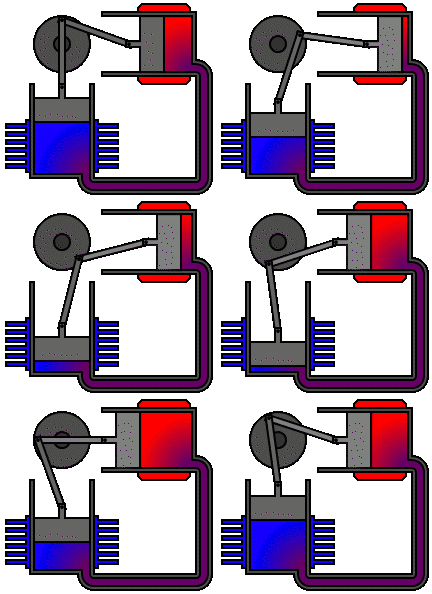
In this short series of articles about coal, engines and energy I am trying to show something of  the history behind our current knowledge of heat, energy and thermodynamics.  As discoveries were made about the nature of heat, improvements were made in the efficiency of engines.  Investigations into the theoretical maximum efficiency of any heat engine led ultimately to the discovery of the laws of thermodynamics. 

The laws of thermodynamics are of wide applicability to the understanding of how, through our profligate use of energy, we humans are having such a dramatic effect on our global environment.
Oh criminy, are we still confused? Didn't we go over this like a zillion times? Wasn't Deep-Sea News' excellent primer on how Humboldt Squid are Not The Same Thing as Giant Squid clear enough?

Sigh. Just let a few fishermen catch a few hundred Humboldt squid, and suddenly the headlines are blaring: GIANT SQUID INVADE CALIFORNIA ZOMG!1!!

Dirty Coal And Boring Science


There was a time when, through the proliferation of steam power, coal extraction in vast quantities became economically viable.  Throughout the U.K. coal was burned to make steam for locomotives, factories and ships.  It was the domestic fuel of choice.  The price of cheap coal was pollution: the skies over many cities were black with soot when coal was king.
... nothing surely was ever more dirty, inelegant, and disgusting than a common coal fire.

