




Being an athlete or merely a fan improves language skills when it comes to discussing their sport because parts of the brain usually involved in playing sports are instead used to understand sport language, new research at the University of Chicago shows.

The research was conducted on hockey players, fans, and people who'd never seen or played the game. It shows, for the first time, that a region of the brain usually associated with planning and controlling actions is activated when players and fans listen to conversations about their sport. The brain boost helps athletes and fans understanding of information about their sport, even though at the time when people are listening to this sport language they have no intention to act.

LHC Kritiks in Switzerland, Germany and Austria survived the first ruling on their case by the European Court for Human Rights, August 29th. So did CERN's Large Hadron Collider, which will go ahead while the court action continues. A stunningly quick decision by the ECHR only 3 days after the complaint was filed against CERN and its 20 member countries from the EC denies any Interim Measures that would have forced CERN to suspend operations of the LHC.

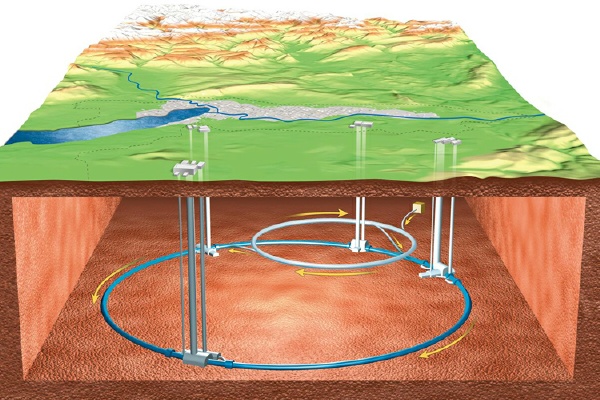
Soon to be the world's most powerful atom smasher and the biggest and most costly science experiment ever, the $10 billion LHC straddles the borders of Switzerland and France, near Geneva. CERN, the giant European nuclear physics lab, has completed the 17 mile underground construction of the ring accelerator and is now in the first stages of start-up. It's goal is to unlock the secrets of the early Universe, through unparalled high energy collisions of hadrons, protons at first and then heavy lead ions. Critics believe that the LHC could pose enormous dangers to the planet.

Sarah Palin, John McCain’s choice for Vice President should he win the November elections, is a worrisome character from the point of view of science education. It is hard to tell whether Palin herself is a creationist or not and, frankly, that’s far less important than the policy positions she holds in the matter. (Though, of course, having a Vice President who is deluded about basic aspects of reality would not be exactly reassuring. Oh, right, we already have had something along those lines for the past eight years, though Dick Cheney’s most dangerous delusions were not about who created the world.)

Older age among fathers may be associated with an increased risk for bipolar disorder in their offspring, according to a report in the September issue of Archives of General Psychiatry, one of the JAMA/Archives journals.

Bipolar disorder is a common, severe mood disorder involving episodes of mania and depression, according to background information in the article. Other than a family history of psychotic disorders, few risk factors for the condition have been identified. Older paternal age has previously been associated with a higher risk of complex neurodevelopmental disorders, including schizophrenia and autism.

Excavations at Kfar HaHoresh, in the north of Israel, led by Prof. Nigel Goring-Morris of Hebrew University's Institute of Archaeology, have revealed a prehistoric funerary precinct dating back to 6,750-8,500 BC. This funerary has grave goods including phallic figurines and sea shells from the Mediterranean and Red Seas, along with other items from Syria, Cyprus and Anatolia.

While fertility symbols during this period are often associated with female imagery, at Kfar HaHoresh only phallic figurines have been found to date, including one placed as a foundation deposit in the wall of the precinct.

Burials at the site now total at least 65 individuals, and display an unusual demographic profile – with an emphasis on young adult males. Graves occur under or associated with lime-plaster surfaced L-shaped walled structures, and are varied in nature from single articulated burials through multiple secondary burials with up to 17 individuals. Bones in one had been intentionally re-arranged in what appears to be a depiction.

If you're someone who likes to buy the best component rather than enduring some average features of an all-in-one tool, driving can be a tricky prospect, manipulating GPS, cell phone, PDA and whatever else.

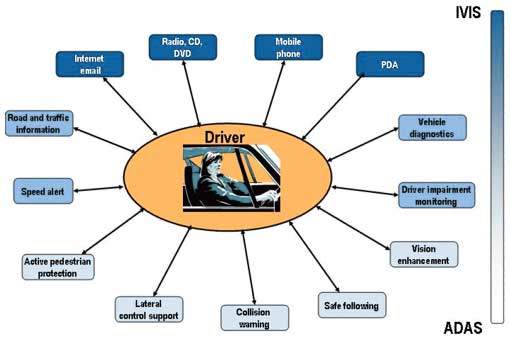
European researchers have come to the rescue by developing a special dashboard computer to act as a single conduit for all your gear. It should mean a better, more relaxed and even safer driving experience.

Dozens of research projects around Europe are working on new technologies to improve automotive safety and to develop intelligent vehicles. But all of these systems must then be added to the dozens of controls and user devices that are already found in a car. Current in-vehicle systems like open door and seat belt warnings will soon be joined by lane assistance, hazard detection and a host of other information and systems for safe and efficient driving.

The autistic disorder was first described, more than sixty years ago, by Dr. Leo Kanner of the Johns Hopkins Hospital (USA), who created the new label ´early infantile autism´. At the same time an Austrian scientist, Dr. Hans Asperger, described a milder form of the disorder that became known as Asperger Syndrome, characterised by higher cognitive abilities and more normal language function. Today, both disorders are classified in the continuum of ´Pervasive Developmental Disorders´ (PDD), more often referred to as Autism Spectrum Disorders (ASD).

The prevalence of (classic) autism in the general population is about 15-20 in 10,000, while all Autism Spectrum Disorders (ASD) affect about 60 in 10,000 children. Males are affected four times more often than females. In approximately 10% of cases, autism is associated with a recognized cause, such as Fragile X Syndrome, Tuberous Sclerosis or diverse chromosomal abnormalities (mean observed rates between 5-10%), but in a vast majority of cases, no known causes are associated with autism (see figure).

Researchers say that surface temperatures in the Northern Hemisphere were warmer over the last 10 years than any time during the last 1300 years.

If the controversial data derived from tree-ring records is considered accurate, the warming is anomalous for at least 1700 years.

The proxies used by the researchers included information from marine and lake sediment cores, ice cores, coral cores and tree rings.

A neuroimaging study in the Sept. 1 issue of the journal Sleep is the first to find that cognitive processes related to verbal fluency are compromised in people with insomnia despite the absence of a behavioral deficit. These specific brain function alterations can be reversed, however, through non-pharmacological treatment with sleep therapy.

Results of functional magnetic resonance imaging (fMRI) scanning during verbal fluency tasks show that people with insomnia have less activation than controls in the left medial prefrontal cortex and the left interior frontal gyrus, two fluency-specific brain regions. However, participants with insomnia generated more words than controls on both the category fluency task (46.4 words compared with 38.7 words) and the letter fluency task (40.1 words compared with 32.7 words).

Global warming data can be like the weather in Kentucky - if you don't like it, just wait a few minutes and it will change. So it goes with the impact of carbon stored in frozen permafrost. In a field beset with both grant-driven hype and irrational optimism, a new study says even the hype was not scary enough.

The study, by Edward A. G. Schuur of the University of Florida and an international team of coauthors, more than doubles previous estimates of the amount of carbon stored in the permafrost: the new figure is equivalent to twice the total amount of atmospheric carbon dioxide.

The thawing of permafrost in northern latitudes, which greatly increases microbial decomposition of carbon compounds in soil, will dominate other effects of warming in the region and could become a major force promoting the release of carbon dioxide and thus further warming, according to this new assessment in the September 2008 issue of BioScience. The authors conclude that releases of the gas from melting permafrost could amount to roughly half those resulting from global land-use change during this century.

