







Johns Hopkins scientists report success in significantly suppressing levels of the "hunger hormone" ghrelin in pigs using a minimally invasive means of chemically vaporizing the main vessel carrying blood to the top section, or fundus, of the stomach. An estimated 90 percent of the body's ghrelin originates in the fundus, which can't make the hormone without a good blood supply.

"With gastric artery chemical embolization, called GACE, there's no major surgery," says Aravind Arepally, M.D., clinical director of the Center for Bioengineering Innovation and Design and associate professor of radiology and surgery at the John Hopkins University School of Medicine. "In our study in pigs, this procedure produced an effect similar to bariatric surgery by suppressing ghrelin levels and subsequently lowering appetite."

When it comes to aggression, boys are physical and girls are social, it is said, but a new analysis of almost 150 studies of aggression in children and adolescents has found that there's more overlap than stereotypes lead us to believe.

Physical aggression - hitting - is something boys are more likely to do while girls are more likely to spread rumors, gossip, and intentionally exclude others, called indirect, relational, or social aggression.

The analysis of 148 studies, which comprised almost 74,000 children and adolescents and were carried out largely in schools, looked at both direct aggression and indirect aggression and was conducted by Noel A. Card, assistant professor of family studies and human development at the University of Arizona, and researchers at the University of North Carolina at Chapel Hill and the University of Kansas.

Young girls from poor neighborhoods with conduct issues are more likely to initiate sex at a young age, according to a new study by researchers from the Université de Montréal, the University of New Brunswick and Tufts University, published in the journal Child Development. The study found that troubled girls living in poor neighborhoods were more likely to engage in sexual intercourse in early adolescence and also to be doing so with older boys.

These teen girls from poor neighborhoods with a history of conduct problems were more likely to associate with deviant peers and to be initiated into sex by males that were three years older or more. "Girls with a history of conduct problems were found to be more likely to have deviant and older male friends when they lived in a disadvantaged context," said lead author Véronique Dupéré, who completed the research at the Université de Montréal. "Deviant peers are thought to provide a pool of willing partners and cultivate a sense that early sexual activity is desirable."

Houses made of hemp, timber or straw could help combat climate change by reducing the carbon footprint of building construction, according to researchers at the University of Bath. The construction industry is a major contributor of environmental pollutants, with buildings and other build infrastructure contributing to around 19% of the UK’s eco-footprint, they say.

Researchers at the BRE Centre for Innovative Construction Materials are researching low carbon alternatives to building materials currently used by the construction industry. Although timber is used as a building material in many parts of the world, historically it is used less in the UK than in other countries.

Diversity is praised as good for business and for promoting creativity but when organizational theorist Viktorija Kalonaityte studied diversity work at a Swedish adult education school, the school wanted to make everyone as “Swedish” as possible.

That means protecting women from 'honor killings' and teaching in Swedish.

In Sweden, diversity is largely about integration policy and the public sector rather than just being corporate policy in places lke America. Viktorija Kalonaityte recently defended her doctoral dissertation at the School of Economics, Lund University in Sweden and her thesis addressed identity and diversity work at a municipal school for adults. The school she studied views itself as working actively with diversity in line with a municipal diversity plan but Kalonaityte says that the diversity plan often collides with people’s understandings of what things should be like at a Swedish workplace.

You know you must be doing something right when both the Discovery Institute and the Institute for Creation Research get on your case! These two outlets of religious-centered non-thinking vehemently attacked my recent post on the inanity of choosing Sarah Palin as a Vice Presidential candidate -- which focused on her positions on teaching (she supports “equal time” for Creationism) and censorship (she has attempted to remove “offensive” books from a public library, going so far as threatening a librarian with being fired).

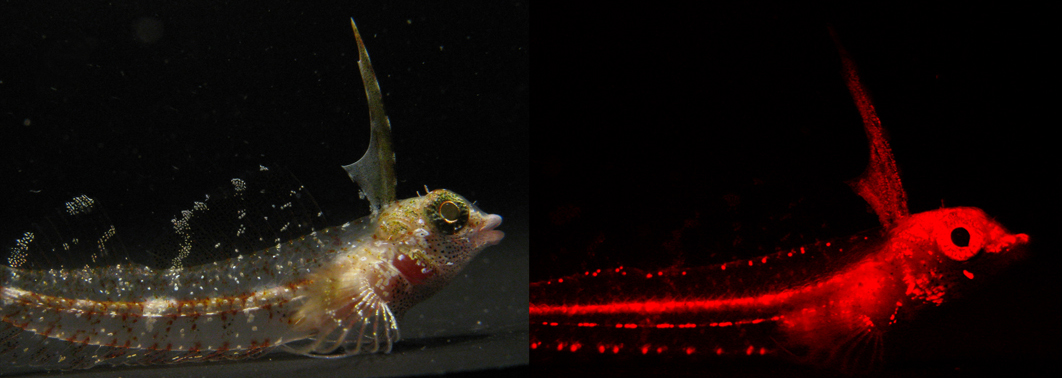
Scientists have discovered that certain fish are capable of glowing red. Research published today in BMC Ecology includes striking images of fish fluorescing vivid red light.

Due to absorption of ‘red’ wavelengths of sunlight by sea-water, objects which look red under normal conditions appear grey or black at depths below 10m. This has contributed to the belief among marine biologists that red colors are of no importance to fish.

Nico Michiels, from the University of Tübingen, Germany, led a team of researchers who captured the striking images in the article which, as he describes, “Shows that red fluorescence is widespread among marine fish. Our findings challenge the notion that red light is of no importance to marine fish, calling for a reassessment of its role in fish visual ecology.”

A long-standing scientific belief holds that stars tend to hang out in the same general part of a galaxy where they originally formed. Some astrophysicists have recently questioned whether that is true, and now new simulations show that, at least in galaxies similar to our own Milky Way, stars such as the sun can migrate great distances.

What's more, if our sun has moved far from where it was formed more than 4 billion years ago, that could change the entire notion that there are parts of galaxies – so-called habitable zones – that are more conducive to supporting life than other areas are.

"Our view of the extent of the habitable zone is based in part on the idea that certain chemical elements necessary for life are available in some parts of a galaxy's disk but not others," said Rok Roškar, a doctoral student in astronomy at the University of Washington. "If stars migrate, then that zone can't be a stationary place."

AUSTIN, Texas—A new species of blind, subterranean, predatory ant discovered in the Amazon rainforest by University of Texas at Austin evolutionary biologist Christian Rabeling is likely a descendant of the very first ants to evolve.

The new ant is named Martialis heureka, which translates roughly to "ant from Mars," because the ant has a combination of characteristics never before recorded. It is adapted for dwelling in the soil, is two to three millimeters long, pale, and has no eyes and large mandibles, which Rabeling and colleagues suspect it uses to capture prey.

Menus and advertising affect our emotions, and if we understand those emotions, we make better food choices, according to a new study in the Journal of Consumer Research.

Authors Blair Kidwell, David M. Hardesty, and Terry L. Childers (all University of Kentucky) examined the "emotional intelligence" of consumers, including obese people. They found that people who made the healthiest choices had high correlations between their emotional intelligence and confidence in their emotional intelligence—what the authors call "emotional calibration."


