Nutrients from the Amazon River spread well beyond the continental shelf and drive carbon capture in the deep ocean, according to the authors of a multi-year study. The finding does not change estimates of the oceans' total carbon uptake, but it reveals the surprisingly large role of tropical oceans and major rivers.

The tropical North Atlantic had been considered a net emitter of carbon from the respiration of ocean life. A 2007 study estimated that ocean's contribution to the atmosphere at 30 million tons of carbon annually.

Geoscientists at the California Institute of Technology have come up with a new explanation for the formation of monsoons, proposing an overhaul of a theory about the cause of the seasonal pattern of heavy winds and rainfall that essentially had held firm for more than 300 years.

The traditional idea of monsoon formation was developed in 1686 by English astronomer and mathematician Edmond Halley, namesake of Halley's Comet. In Halley's model, monsoons are viewed as giant sea-breeze circulations, driven by the differences in heat capacities between land and ocean surfaces that, upon heating by sunlight, lead to temperature differences between warmer land and cooler ocean surfaces--for example, between the Indian subcontinent and the oceans surrounding it.

For generations, people have consumed cranberry juice, convinced of its power to ward off urinary tract infections, though the exact mechanism of its action has not been well understood. A new study by researchers at Worcester Polytechnic Institute (WPI) reveals that the juice changes the thermodynamic properties of bacteria in the urinary tract, creating an energy barrier that prevents the microorganisms from getting close enough to latch onto cells and initiate an infection.

The study, published in the journal Colloids and Surfaces: B, was conducted by Terri Camesano, associate professor of chemical engineering at WPI, and a team of graduate students, including PhD candidate Yatao Liu. They exposed two varieties of E. coli bacteria, one with hair-like projections known as fimbriae and one without, to different concentrations of cranberry juice. Fimbriae are present on a number of virulent bacteria, including those that cause urinary tract infections, and are believed to be used by bacteria to form strong bonds with cells.

The question of whether insulin-producing cells of the pancreas can regenerate is key to our understanding of diabetes, and to the further development of regenerative therapies against the disease. Dr Rosenberg from the McGill University Health Centre (MUHC) and McGill University together with Dr Bernard Massie from the Centre hospitalier de l'Université de Montréal (CHUM) have just concluded that they can. The results of their study have been published in the July issue of the journal Laboratory Investigation.

The researchers have shown in vitro that insulin-producing β-cells (beta cells) can return to a more primitive developmental state called stem-like cells. This process is known as "dedifferentiation" and highlights the plasticity of this cell type. This same result has also been validated for the three additional types of cells that – along with β-cells – make up the islets of Langerhans. Together, these islet cells produce insulin and other hormones in the pancreas.

For millennia, humans and viruses have been locked in an evolutionary back-and-forth -- one changes to outsmart the other, prompting the second to change and outsmart the first.

With retroviruses, which work by inserting themselves into their host's DNA, the evidence remains in our genes. Last year, researchers at Rockefeller University and the Aaron Diamond AIDS Research Center brought an ancient retrovirus back to life and showed it could reproduce and infect human cells. Now, the same scientists have looked at the human side of the story and found evidence that our ancestors fought back against that virus with a defense mechanism our bodies still use today.

Biogeoscientists show evidence of 90 billion tons of microbial organisms—expressed in terms of carbon mass—living in the deep biosphere, in a research article published online by Nature. This tonnage corresponds to about one-tenth of the amount of carbon stored globally in tropical rainforests. The authors: Kai-Uwe Hinrichs and Julius Lipp of the Center for Marine Environmental Sciences (MARUM) at University of Bremen, Germany; and Fumio Inagaki and Yuki Morono of the Kochi Institute for Core Sample Research at the Japan Agency for Marine-Earth Science and Technology (JAMSTEC) concluded that about 87 percent of the deep biosphere consists of Archaea.

Nanotechnology is the ability to measure, see, manipulate and manufacture things usually between 1 and 100 nanometers. A nanometer is one billionth of a meter; a human hair is roughly 100,000 nanometers wide. In 2007, nanotechnology was incorporated into more than $88 billion in manufactured goods. Lux Research projects that figure will grow to $2.6 trillion by 2014, or about 15% of total global output.

An expert analysis in Nature Nanotechnology questions whether industry, government and scientists are successfully applying lessons learned from past technologies to ensure the safe and responsible development of emerging nanotechnologies.

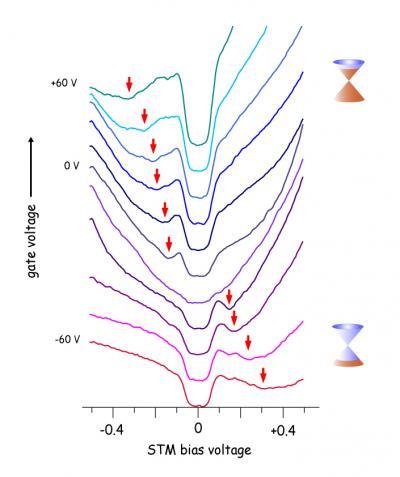
Scientists at the U.S. Department of Energy's Lawrence Berkeley National Laboratory (Berkeley Lab) and the University of California at Berkeley have performed the first scanning tunneling spectroscopy of graphene flakes equipped with a "gate" electrode. The result is the latest in a series of surprising insights into the electronic behavior of this unique, two-dimensional crystal form of carbon: an unexpected gap-like feature in the energy spectrum of electrons tunneling into graphene's single layer of atoms.

If you had to pick one organism with which to tell the story of the modern science of biology, you couldn't do better than to pick the tiny gut bacterium Escherichia coli, commonly called just E. coli. In his latest book Microcosm: E. coli and The New Science of Life, Carl Zimmer, uses E. coli as a decoder ring to open up the dense and diverse world of biological research, taking us on a panoramic tour of some of the most important conceptual advances and outstanding scientific questions in this important realm of science.

Biology, in contrast to a science like physics, is a science of particulars. In physics, if you understand one electron, you understand them all, but in biology every organism is unique. In biology it is more challenging to find universals, to pick an object of study that let's you ask big questions with the hope of finding general answers.

With E. coli we can come quite close: this tiny bacterium is the hydrogen atom of biology, a model simple enough to be experimentally tractable, but representative of general principles that apply to all life. As the pioneering molecular biologist Jacques Monod put it, "What is true for E. coli is true for the elephant," and also true for us. In Microcosm, we follow E. coli through a survey of some of the deep foundations and controversies of biology.


Scientists say they have found a workable way of reducing CO2 levels in the atmosphere by adding lime to seawater. And they think it has the potential to dramatically reverse CO2 accumulation in the atmosphere, reports Cath O’Driscoll in SCI’s Chemistry & Industry magazine published today.

Shell is so impressed with the new approach that it is funding an investigation into its economic feasibility. ‘We think it’s a promising idea,’ says Shell’s Gilles Bertherin, a coordinator on the project. ‘There are potentially huge environmental benefits from addressing climate change – and adding calcium hydroxide to seawater will also mitigate the effects of ocean acidification, so it should have a positive impact on the marine environment.’

Adding lime to seawater increases alkalinity, boosting seawater’s ability to absorb CO2 from air and reducing the tendency to release it back again.