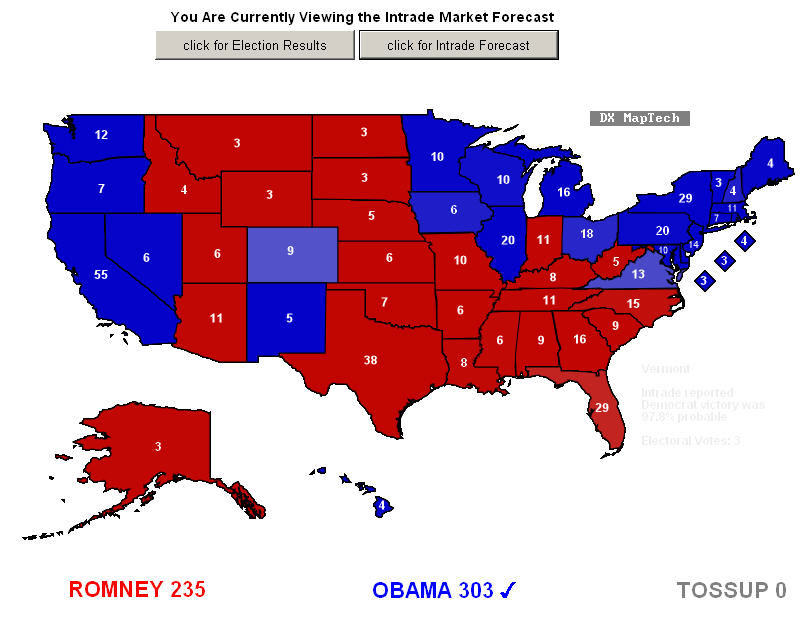
Climate change was ignored for all but the last week of the American presidential election. Then, a hurricane hit and it mobilized voters who were otherwise disappointed that neither party cared about science or the climate.
Yet it's hard to have a real talk about climate change when activist groups are so anti-science about energy and energy produces a lot of emissions. While Hurricane Sandy may have been the 'October surprise' that re-elected a president (1) but it may also have done something that even an earthquake in Japan could not do; force a real, adult conversation about nuclear power.
Researchers have observed the quantum regime in the interaction between nano-sized spheres of gold, thanks to the change of color of the gap between these particles when they are at distances of less than one nanometer.
They have literally 'seen' a quantum kiss between nanoparticles.
Something happened last night that you don't see very often - almost all of the polls were right. Nearly everyone predicted the state electoral results correctly and that, my friends, is truly rare.
In the shadow of Proposition 37's defeat maybe we can have a real conversation. Angry, uninformed discussion based on fear mongering from both sides detracted from a real issue-- how do we provide complete information about food in a manner consistent with science?
Throughout the discussion scientists and some corporate officials stated repeatedly that labeling is not the problem-- Proposition 37 was the problem. A potentially complex and expensive bureaucratic web would be created to police foodstuffs that have no inherent dangers. That's just nuts.
At this time I think everyone in interested in this issue should coalesce around balancing two concepts in complete fairness-- information and science.
A few months ago, before Monsanto and DuPont realized Proposition 37 may have been started by anti-science crackpots but it was not going away and I was one of the few critical of it, I would have predicted GMO warning labels to win by 66% - because that is the percentage of Democrats in California and while Republicans get attention in science media for being 'anti-science' due to global warming, the actual anti-science positions that are dangerous are bastions of the left.
The fossilized fangs of saber-toothed cats, a leopard-sized Promegantereon ogygia and a much larger, lion-sized Machairodus aphanistus, hold clues to how large, extinct mammals once shared space and food with other large predators 9 million years ago.
Paleontologists have analyzed the tooth enamel of two species of saber-toothed cats and a bear dog unearthed in geological pits near Madrid. Bear dogs, also extinct, had dog-like teeth and a bear-like body and gait.
Emergence, for example emergent gravity, implies a lower stratum from which something emerges. “Fundamental emergence” is the idea that all can or must be described as emergent, without however there being a full explanation of lower layers. A lowest fundamental layer may be inconsistent almost by definition (certainly if there is any "ontological commitment") and never more than what the emergence-description must assume. This is non-reductive, since the reduction into a lowest foundation, the resting on the bottom, works only because the bottom "hangs from the top", or better, the whole "floats".
Autologous stem cells from bone marrow 3 or 7 days following a heart attack did not improve heart function six months later, according to a new clinical trial.
The results of this TIME (Transplantation In Myocardial Infarction Evaluation) trial were presented by Jay Traverse, MD of the Minneapolis Heart Institute Foundation Tuesday, today at the 2012 Scientific Sessions of the American Heart Association in Los Angeles.
The results of this trial mirror a previous, related study (LateTIME) which found that autologous bone marrow stem cell therapy given 2-3 weeks after a heart attack did not improve cardiac recovery. Both TIME and LateTIME were carried out by the Cardiovascular Cell Therapy Research Network (CCTRN).
University of Pittsburgh professor Eric Beckman and colleague Bob Enick have been intent on solving a decades-old mystery - how to increase the viscosity of liquid CO2 so it can better extract oil from its hiding spots inside the pores of underground sandstone. Thanks to a $1.3 million grant from the National Energy Technology Laboratory, the researchers are pursuing a promising lead.
In the U.S., each gallon of crude oil we produce requires, on average, anywhere from two to 5.5 gallons of water according to a study from Argonne National Library (pdf). It is a much more water-intensive process than hydraulic fracturing, or fracking, which attracts far more attention.
Scaling down the observable universe to make it fit within our moon's orbit, the Milky Way gets reduced to a village. We live close to the edge of this village, at a comfortable distance from the central marketplace, where a giant black hole is known to be lurking.
Now, this peaceful picture is brutally disturbed by an international group of astronomers who bring us the message that a black hole of at least a hundred solar masses
is likely to ambush us in our own backyard.
 Theta Orionis, a fuzzy star in Orion's sword harbouring a massive black hole?