




Over the last 40 years, the wealth of countries like the United States and Japan have increased substantially. Poor people now have a life that the poor even two generations ago could not imagine would be possible. Yet a new cross-temporal meta-analysis says that despite the changes in wealth which make socializing more possible, young people report more loneliness.
Loneliness is different than social isolation, where people choose to have few friends, and instead is a gap between desired and actual interpersonal relationships. The new results indicate that loneliness increased in Japan from 1983 to 2023, and social indicators such as marriage rates were found to covary with loneliness.
A wealthy society where we can connect with people all over the world still reports greater loneliness when you had to put on shows and go to a library to meet people.
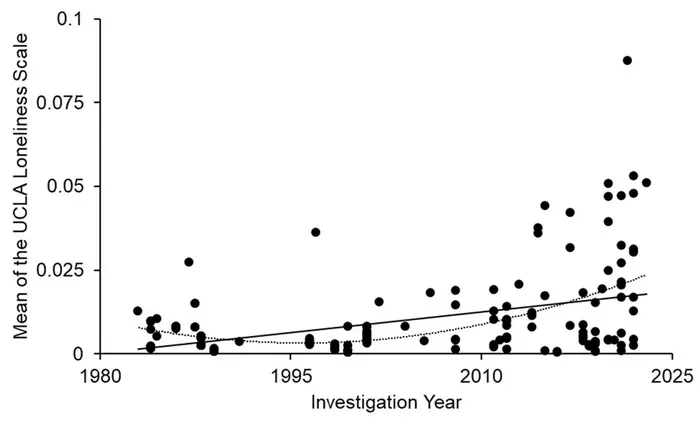
Trends in loneliness from 1983 to 2023. Each dot corresponds to an individual data point. Credit:
Momo Homma, Master's Student, Graduate School of Letters, Chuo University Kenkichi Takase, Professor, Department of Psychology, Faculty of Letters, Chuo University
The authors used four databases to find studies that used the UCLA Loneliness Scale and after excluding low-quality results kept 81 studies comprising 183 datasets of 49,054 responses. Men consistently showed higher levels of loneliness. There were predictable social indicators, such as during the COVID-19 pandemic, but even over time loneliness covaried with the number of single-person households, marriage rates.
And GDP. The wealthier we get, the more likely we are to live alone. In America, we have more houses per capita than at any point in history, yet there are still calls on government to take over that marketplace because not enough young people claim they can afford to live alone. The thing they think they want may be what will make them feel so lonely.
Citation: Homma M and Takase K (2026) Increasing loneliness in Japan, 1983–2023: a cross-temporal meta-analysis. Front. Psychol. 17:1824941. https://www.frontiersin.org/journals/psychology/articles/10.3389/fpsyg.2...



Comments