



Male and female birds often show differences in body size, with males typically being larger. Some birds, like many ratites – large, flightless species such as emus and cassowaries – are the opposite, with the females towering over the males. 

But some extinct ratites, among the largest female birds in the world, were almost twice as big as their male mates. A new paper says that the size difference in giant moa was not due to any specific environmental factors but instead evolved as a result of scaling-up of smaller differences in male and female body size shown by their smaller-bodied ancestors.

New research has questioned the reliability of neuroscience studies, concluding that most had an average power of around 20 percent – a finding which means the chance of the average study discovering the effect being investigated is only one in five. 

The conclusions neuroscience papers drew could be wrong due to small sample sizes, the authors say.

Many factors can push a wild animal population to the brink of collapse and ecologists have long sought ways to measure the risk of such a collapse.

Last year, MIT physicists demonstrated that they could numerically predict a population's risk of collapse by monitoring how fast it recovers from small disturbances, such as a food shortage or overcrowding. However, this strategy would likely require many years of data collection.

The same research team writing in Nature now describes a new way to predict the risk of collapse, based on variations in population density in neighboring regions. Such information is easier to obtain than data on population fluctuations over time, making it potentially more useful, according to the researchers.

Violent crime is undercounted or overcounted, depending on who you ask. Some statistics count gun violence twice, for example, as a criminal getting shot and a police officer doing the shooting.

On the other side, in a paper published in the Canadian Journal of Criminology and Criminal Justice, Wayne State University Ph.D. student Zavin Nazaretian and David M. Merolla, assistant professor of sociology, say that "capping" — which only allows survey respondents to represent a maximum of three incidents per crime type regardless of how many incidents they report — is undercounting violent crime by 87 percent and household crime by 36 percent.

Our sun will one day become a faint white dwarf star - but prior to that, for a few tens of thousands of years as its atmosphere is blown away into space  it could be surrounded by spectacular and colorful glowing clouds of ionized gas known as planetary nebulae.

"What are the radiation doses to airplane passengers from the intense bursts of gamma-rays that originate from thunderclouds?" researchers asked at a press conference during the European Geosciences Union in Vienna today.

An unusual fossil of Euphanerops, a fossil jawless fish that swam in the seas around 370 million years ago, has fins behind its anus - a pair of them.  The find makes the fish one of the first vertebrate to develop paired appendages such as fins, legs or arms. 

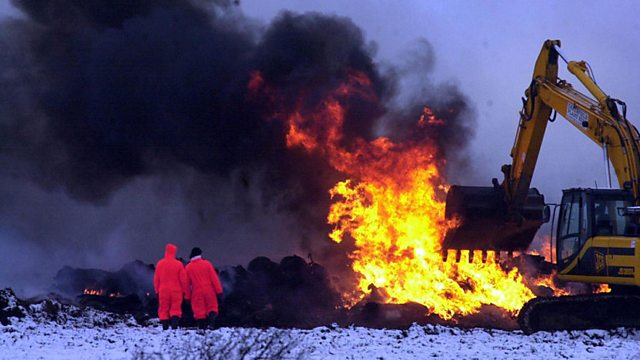
In 2001 there was a massive outbreak of Foot-and-Mouth Disease (FMD) in the United Kingdom.  This caused, in terms of prices at that time £8bn / $13–16bn of loss to the UK economy, and much distress in agricultural communities.

 One of the most memorable things of that time was images of cattle and other carcasses being burned.


You wouldn’t know it by current world events, but humans actually evolved to be peaceful, cooperative and social animals.
‘Man the Hunter’ theory is debunked in new book, February 18, 2006, By Neil Schoenherr
So begins a discussion regarding humans as a prey species rather than predators.  It isn't true, and it doesn't even make any sense.  After all, what do any of those traits have to do with being a predator or prey?

Does anyone believe that wolves or lions aren't social?  or cooperative?  or peaceful amongst themselves?

Long ago, obesity and high blood pressure were signs of being a wealthy elite. But the world has progressed and now even the poorest countries can eat enough to be fat. As recently as 1980 those health risks were more prevalent in countries with a higher income but a new analysis in Circulation shows that the average body mass index of the population is now just as high or higher in middle-income countries. For blood pressure, the situation has reversed among women, with a tendency for blood pressure to be higher in poorer countries.

