







Triggered by a preprint appeared three days ago on the ArXiV -a fundamental resource for particle physicists willing to stay in touch with the latest developments of the theory and new experimental results-  this morning I was gearing up to write a post with a careful, didactical discussion of why we believe that the subnuclear world includes three generations of quarks and three generations of leptons, what is the evidence for this peculiar fact, and what would a fourth generation of matter imply for e.g. searches of the Higgs boson. Unfortunately, my memory is still good enough to let me remember that I did write about those things in my old blog, about one year ago.
MicroRNAs are single-stranded snippets that, not long ago, were given short shrift as genetic junk. Now that studies have shown they regulate genes involved in normal functioning as well as diseases such as cancer, everyone wants to know: What regulates microRNAs?

Scientists at Johns Hopkins were surprised to find an elegantly simple answer: touch.

In a new study, published in the Proceedings of the National Academy of Sciences, the researchers discovered that cell-to-cell contact revs up the manufacture of these small but mighty molecules.
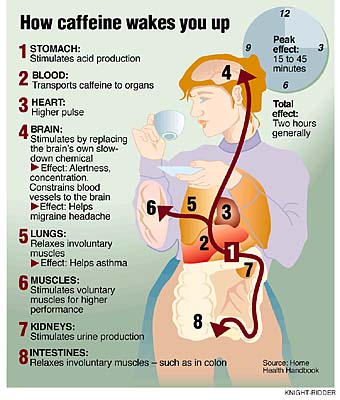
Ever miss your daily cup of coffee and subsequently get a pounding headache? According to reports from consumers of coffee and other caffeinated products, caffeine withdrawal is often characterized by a headache, fatigue, feeling less alert, less energetic and experiencing difficulty concentrating.  Caffeine withdrawal is at its worst between 24 to 48 hours and lasts up to a week.

In a recent study (that yielded some exceptionally interesting results), catalytic RNA molecules were used in order to advance the understanding of Darwinian evolution.  Researchers Dr. Sarah Voytek and Professor Gerald Joyce of the Scripps Research Kellogg School of Science and Technology, choose RNA molecules because they evolve rapidly and self-replicating RNA molecules are hypothesized to be the first organic “life forms” on earth.  With a trillion molecules in a test tube replicating every few minutes, such an approach permits evolution to occur over the course of just a few days.

Following the positive outcomes of shorter studies done on Multiple Sclerosis (MS) drug Betaseron(R), continued testing also yields compelling results.

Analysis from a 16 year follow up study examining long term effects of Betaseron(R) on MS patients showed that early and continued treatment with Betaseron were more likely to avoid negative clinical outcomes than MS patients on alternative treatment options.

 Everyone is blaming H1N1, but could a different strain of Influenza be the cause of Mexican deaths?

A new study by University of Maryland researchers suggests that the potential for an avian influenza virus to cause a human flu pandemic is greater than previously thought and the results also illustrate how the current H1N1 swine flu outbreak likely came about. 

Regular hand washing is recommended by both the WHO and the NHS as one of the most effective ways of controlling infections.   Using a hand sanitizer when soap and water are not available is also a good idea.

With swine flu topping the agenda of business around the world, global risks specialist, Maplecroft has released three new maps and indices revealing the countries most at risk from an influenza pandemic.

The Influenza Pandemic Risk Index (IPRI) consists of three categories: Risk of Emergence, Risk of Spread and Capacity to Contain. Each index generates a list of countries most at risk and that require a tailored policy response on the part of government and business. Maplecroft's research focuses on global risks to business.

The map of Risk of Spread shows the United Kingdom most at risk to the spread of an influenza pandemic, ranking number 1 out of 213 countries.


