







It's not new that dwellers and cities are a little less hearty than rural cousins. There is even a hygiene hypothesis that says kids in the country get dirtier to their benefit and that wealthy, educated helicopter parenting and all those hand sanitizers and antibacterial soaps are doing more harm than good.

Allergies and numerous autoimmune diseases, such as asthma and type 1 diabetes, have become more common in the past 50 years, especially in urban environments. The belief is this is caused by urban issues like pollutants from human activities, a higher level of hygiene and the reduced biological diversity of the city living environment.
With organic food a $105 billion industry juggernaut, various groups are looking to don that health halo. Even frozen food.

If you don't think food can be "fresh" and "healthy" while still being frozen, you probably also do not believe organic food has more antioxidants and uses fewer pesticides and therefore are not the target market and you can stop reading.

One was about 17 Westerners being killed and one was about 2,000 Africans. Guess which got most of the media attention? Kano, Nigeria Stringer/Reuters.

By Ethan Zuckerman, Massachusetts Institute of Technology

Consider two tragic events that took place last week.

A small cell of Islamic terrorists attacked cartoonists at the satirical magazine Charlie Hebdo and shoppers in a Paris supermarket, killing 17 people and sparking international outcry, solidarity and support.


Prices of gas are approaching $2 a gallon. Does that make it a good time to raise the gas tax? Kevin Lamarque/Reuters

By Wallace Tyner, Purdue University

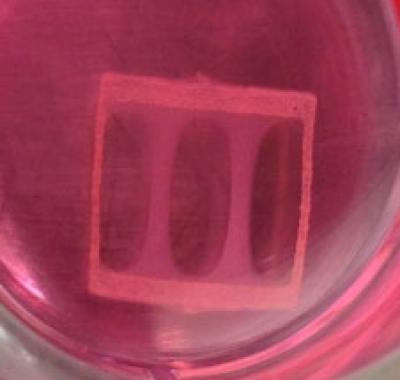
In a laboratory first, researchers have grown human skeletal muscle that contracts and responds just like native tissue to external stimuli such as electrical pulses, biochemical signals and pharmaceuticals. The lab-grown tissue should soon allow researchers to test new drugs and study diseases in functioning human muscle outside of the human body.

The researchers started with a small sample of human cells that had already progressed beyond stem cells but hadn't yet become muscle tissue. They expanded these "myogenic precursors" by more than a 1000-fold, and then put them into a supportive, 3-D scaffolding filled with a nourishing gel that allowed them to form aligned and functioning muscle fibers.
In late 2008, the euphoria over electing a man who specifically said he wanted to put science back in its rightful place began to fade. The president-elect, it seemed, preferred the company of UFO believers, an anti-vaccine conspiracy theorist and a guy who thought girls couldn't do math.
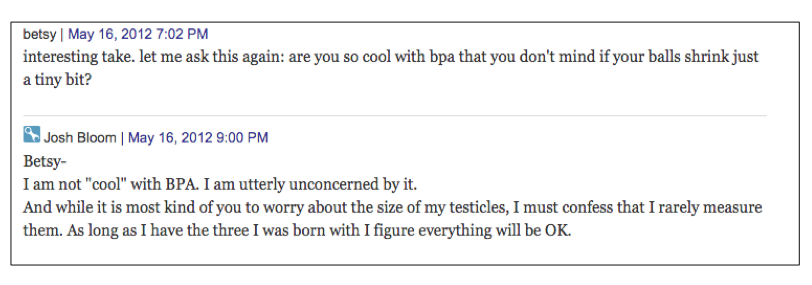
Fear, Inc. is having a very big day on the New York Stock Exchange. It is up 45 percent on heavy volume. How could it not be? After all, the plastic component BPS (bis-(4-hydroxyphenyl) sulfone) — supposedly a safe replacement for bisphenol A (BPA) — isn’t looking so great after all. 
It is well-known that “huffing” - inhaling organic solvents or propellants to achieve a “high” - is extremely dangerous, but less well known is that newer replacement products primarily used by homosexual men, called “poppers”, actually contain harmful solvents and propellants and pose the same health risks as huffing. 

The original poppers, based on alkyl nitrites and related to the medication amyl nitrite, got the name from their glass vials that “popped”, and they have been popular among gay men due to mild psychoactive effects and relaxing of smooth muscle, used to enhance sexual experience. 
Some kids and school districts have objected to the Obama administration's efforts to change lunches to be fare they prefer. The Healthy, Hunger-Free Kids Act changes have led to worries by advocates for the poor that kids whose best meal of the day was a school lunch are now being penalized, while food waste activists see increasing piles of food in garbage cans as a worrying trend. People who prefer freedom don't like that centralized government is now controlling what local school districts feed kids.
Most young children are essentialists, they believe that human and animal characteristics are innate, so traits like native language and clothing preference are intrinsic rather than acquired. It is a natural law that other kids should speak the same language - until other kids don't.

A new study postulates that bilingual kids learn earlier that it's what one learns, rather than what one is born with, that makes up a person's psychological attributes. The study suggests that bilingualism in the preschool years can alter children's beliefs about the world around them. Contrary to their unilingual peers, many kids who have been exposed to a second language after age three believe that an individual's traits arise from experience.

