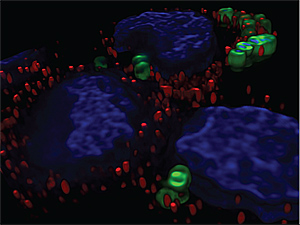



An international team of researchers has, for the first time, identified an avian influenza virus in a group of Adélie penguins from Antarctica. The virus, found to be unlike any other circulating avian flu, is described in a study published this week in mBio®, the online open-access journal of the American Society for Microbiology.

While other research groups have taken blood samples from penguins before and detected influenza antibodies, no one had detected actual live influenza virus in penguins or other birds in Antarctica previously, says study author and Associate Professor Aeron Hurt, PhD, a senior research scientist at the WHO Collaborating Centre for Reference and Research on Influenza in Melbourne, Australia.

How can science help save the wild finches Darwin made famous in the Galapagos Islands from invasive species?

By leaving cotton balls treated with a mild pesticide laying around. In an experiment, the wild finches used the cotton to help build their nests, which killed parasitic fly maggots and protected baby birds.

Self-fumigation works.

"We are trying to help birds help themselves," says biology professor Dale Clayton, senior author of a study outlining the new technique in Current Biology.

A gene that codes for a protein that scientists have found helps the body’s immune cells recognize and fight Group B Streptococcus (GBS) bacteria has been implicated in premature birth risk.

The bacteria are found in the vagina or lower gastrointestinal tract of approximately 15 to 20 percent of healthy women, but may cause life-threatening infections, such as sepsis or meningitis in newborns, especially those born prematurely.

It's a well-known fact that spending on health care has consistently grown faster than the rest of the U.S. economy but what's behind this trend is less certain.

Economists cite multiple variables: rising malpractice costs due to jury awards related to health care; 'defensive medicine', where unnecessary tests are run to have a paper trail if a lawsuit happens; a 'teach to the protocol' environment driven by regulations; the prevalence of diseases afflicting the U.S. population, including an increase in the kinds of conditions that are now considered diseases; and the rising costs of treating diseases.

Skin cancer is a common and growing problem, accounting for one in every three cancers diagnosed worldwide, according to the World Health Organization. Recent findings suggest that malignant melanoma, the most dangerous form of skin cancer, is has grown dramatically in the last few decades. 

Eczema is a blanket term for medical conditions that cause the skin to become inflamed. It affects about 10% to 20% of infants and about 3% of adults and children in the U.S. Most infants who develop the condition outgrow it at a young age.

A research team gave old mice -  the equivalent of 70- to 80-year-old humans - water containing an antioxidant known as MitoQ for four weeks and found that their arteries functioned as well as the arteries of mice with an equivalent human age of just 25 to 35 years.

The MitoQ antioxidant targets specific cell structures - mitochondria - and may be able to reverse some of the negative effects of aging on arteries, reducing the risk of heart disease, they conclude.

DURHAM, N.C. -- Along with our big brains and upright posture, thick tooth enamel is one of the features that distinguishes our genus, Homo, from our primate relatives and forebears. A new study, published May 5 in the Journal of Human Evolution, offers insight into how evolution shaped our teeth, one gene at a time.

By comparing the human genome with those of five other primate species, a team of geneticists and evolutionary anthropologists at Duke University has identified two segments of DNA where natural selection may have acted to give modern humans their thick enamel.

Teeth have been an invaluable resource for scientists who study evolution, the authors said.

Why is science academia so heavily slanted toward one political party in the last generation while private sector science is not? Why, in 1999, would the lead authorship of an IPCC report chapter be someone who had just gotten their PhD, something that would have been an outcry if it had been done at the NIH or the NSF?

An article in Human Nature says a lack social and political accountability make it easy for people to favor their own and penalize outsiders. They argue that more oversight and government control are the solutions.

There may be a reason why emissions regulations that reduced air pollutants like sulfur dioxide, nitrogen dioxide and carbon monoxide haven't really led to a drop in ozone. A report from 2012 found that ambient levels of fine particulate matter had declined by 20 to 60 percent since 2001 but ozone had continued to rise in that same period, up 20 percent.

A new study from the Bradley Hasbro Children's Research Center has says that family-based cognitive behavioral therapy (CBT) is beneficial to young children between the ages of five and eight with Obsessive-Compulsive Disorder (OCD).

Cognitive behavioral therapy is considered by psychologists to be an effective form of OCD treatment in older children and adolescents. 

The paper in JAMA Psychiatry found developmentally sensitive family-based CBT that included exposure/response prevention (EX/RP) was more effective in reducing OCD symptoms and functional impairment in this age group than a similarly structured relaxation program.


