


Genetic blending between Europeans and Asians occurred over 2,000 years ago in the Altai region of Mongolia, according to a new analysis.  The remains of ancient Scythian warriors indicate that this blending was not due to an eastward migration of Europeans, but to a demographic expansion of local Central Asian populations and that was due to the technological improvements the Scythian culture brought with them. 

The Scythians were an Indo-European people dedicated to nomadic pasturing and horse breeding. They crossed the Eurasian steppes from the Caspian Sea until reaching the Altai Mountains during the 2nd and 7th century BCE. We know about them primarily due to ancient texts written by the Greek historian Herodotus.

A device capable of amplifying the information in a single particle of light without adding noise has been created.  The researchers were able to amplify the noisy quantum state of a single photon subjected to loss, without adding noise in the process - their amplification actually reduced the noise in the quantum state. 

It is expected the results will stimulate further interest in the fundamental laws that govern how well amplifiers can work and in developing uses of noiseless amplification techniques for other quantum information technology applications.

I was impressed by the extensive damage done to an Indiana home and surrounding structures a few days ago. It really did look like a bomb blast.

The obvious explanation is that a gas leak was the cause, but could it have been an explosive device?

One way to sort this out is to compare the energy content of natural gas with other types of explosions. Intuitively, one might expect that a 100 kg (220 pound) bomb would do this kind of damage. The energy content of 100 kg of TNT is 400 million joules, so how much gas would contain a similar amount of energy?
It has taken a while, but the rare decay of B_s mesons (particles composed of a bottom and an anti-strange quark) to muon pairs has finally been seen. The authors of the find -we cannot yet call it an observation given the scarce statistical significance of the signal- are the members of the LHCb collaboration, one of the four experiments working with the proton-proton collisions delivered by the Large Hadron Collider at CERN.
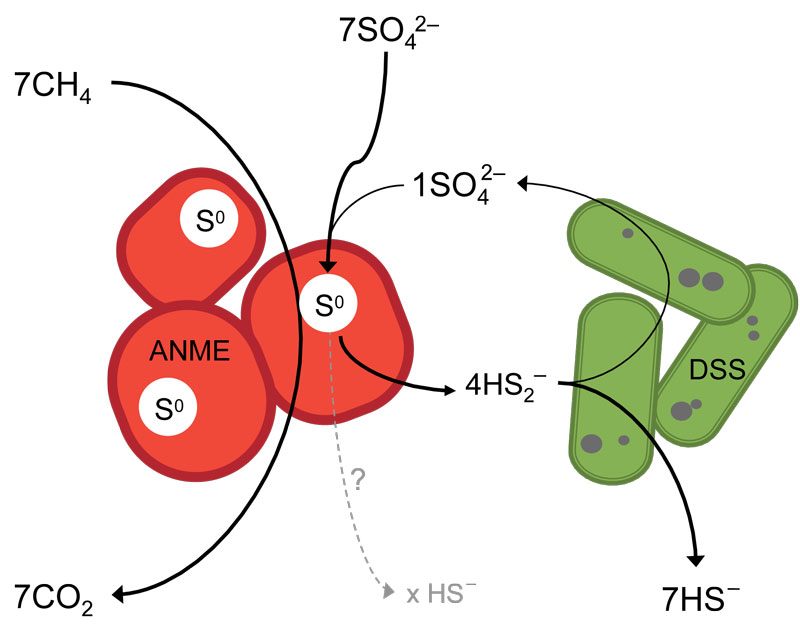
Microbiologists and geochemists have shown that marine methane oxidation coupled to sulfate respiration can be performed by a single microorganism, a member of the ancient kingdom of the Archaea, and doesn't need to be carried out in collaboration with a bacterium, as previously thought.
"China’s Openness no One-Way Alley" appeared in the The Nanjinger. After all, it is called “science outreach” for a reason.

From the article:

One big knock on solar energy is that it is inconsistent; it doesn't work at night or on cloudy days and storing it in batteries takes away the cost effectiveness. But a new technology is in development that can transform that light energy into a storable clean fuel that still has a neutral carbon footprint - hydrogen.

What does it take? Water and iron oxide, better known as rust. Kevin Sivula and colleagues at Ecole Polytechnique Fédérale de Lausanne intentionally stuck to inexpensive materials and easily scalable production processes in order work toward an economically viable method for solar hydrogen production. 
Want to help unlock the secrets of magnetism at the molecular scale without getting a PhD in physics? A citizen science project entitled Feynman’s Flowers lets volunteers from across the world analyze microscope images of individual molecules, which have characteristic flower shapes. Anyone can take part, and only a few clicks of the computer mouse are required to collect valuable information.

There's been plenty of research showing that when people inhale oxytocin, they tend to have more positive social behavior: trust, generosity,empathy and communication. But if taking one whiff of oxytocin can make younicer, will taking oxytocin regularly keep you nicer? If you take a biggerdose, will it make you even nicer?

U.C. Davis researchers wanted to find out the long-term effects of taking oxytocin, so they studied prairie voles, the monogamous rodents that first demonstrated the positive social effects of this brain chemical.

The U.C. Davis research team, led by Karen L. Bales, treateda group of 89 male prairie voles with low, medium or high doses of inhaled oxytocin. The medium dose was roughly equivalent to the amount given to human subjects in lab studies.

Sometimes when things catch the attention of the kookier segments of the public, they really take off. Fracking is a good example.  Though it's been around since the 1940s, once it got really popular people started inventing fake illnesses to get into the mainstream media Scare Journalism of the Week pieces.

