



Fifty years ago, the philosopher and linguist Noam Chomsky speculated that humans are able to learn language easily as children because knowledge of grammar is 'hardwired' into human brains. In other words, we know some of the fundamental things about human language at birth, without ever being taught.

Controversial?  Yes, but a group of cognitive scientists now say he may have been onto something.   They contend we are born with knowledge of certain syntactical rules that make learning human languages easier.
Is someone sitting in the passenger seat of the car?   If so, are they leaning forward and can be damage by the airbag?    Did a person enter the danger zone in front of an industrial machine?

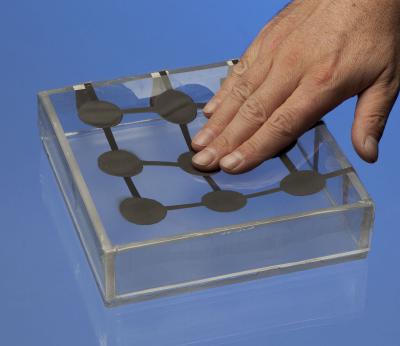
Debuting at the Sensor+Test trade fair in Nuremberg from June 7-9, 2011, researchers have now developed sensors capable of expanding, in extreme cases, to twice their original length - and they are so supple they are virtually unnoticed when sewn into clothing. 
The measurement of the production rate of top quark pairs at the Tevatron is by now a very well developed technology, where it is hard to invent anything new. Eight years ago, however, there was still the chance to develop new techniques and explore new land.
Thankfully,the NFL Draft and all its hype is behind us.  The matchmaking is complete but the guessing game begins as to which team picked the right combination of athletic skill, mental toughness and leadership potential in their player selections.  Hundreds of hours of game film can be broken down to grade performance with X’s and O’s.  Objective athletic tests at the NFL combine rank the NCAA football draftees by speed and strengths, just as the infamous Wonderlic intelligence test tries to rank their brain power.  

It may not be the most eaten fruit, that may be Gogurt or whatever people think is fruit today, but at least the tomato is the most Googled fruit in English-speaking countries, according to a review by World Cancer Research Fund (WCRF) to coincide with Fruity Friday, which everyone who is anyone knows is tomorrow, May 13th. 

 The review, using data from Google's Insights for Search, suggests there are almost twice as many searches for "tomatoes" as there are for "apples", the second most Googled fruit.   The data on Google searches is from Googles Insights for Search, accessed on May 3, 2011. The plural of each fruit was used and they note the results are not intended to suggest overall consumption levels or popularity.

It's common practice among learned people that, the more educated the company, the more obscure the lists of people they will invent any time there is a question about history.   Science may be universally quantifiable but history of science is quite subjective.   So on a site where we all extol Al-Khwarizmi,  Pietro Monti, Zu Chongzhi,  Ibn al-Haytham and too many others to count in our quest to be thorough, I am going to make a bold claim sure to infuriate historians and nationalists from many countries, including America; some of the greatest scientists of any age were all in one place, at one time, and that place was Britain.

Digital communications is no longer a free-for-all, it can take you right to courts of law if you use it and people don't like what it tells them about you.   A US court just slashed alimony payments (Cardone v. Cardone, 2011 WL 1566992, Conn.Super. April 4, 2011) to an ex-wife because of her blog posts, which detailed how she was sailing around the Caribbean for months with her new boyfriend while she rented out her apartment.    The poor sap ex-husband had been paying for 10 years and the court reduced it by 70% because she was clearly living with someone else and being subsidized by her ex-husband.

The Porton Group, the private equity partner of the British Ministry of Defence, has accused 3M Corporation of "negligence and possible recklessness putting lives at risk" due to "botched" 2007 clinical trials of a medical device called "BacLite," which can detect within five hours the presence of the potentially deadly MRSA/staph "superbug." The trials were conducted after notification of the U.S. Food and Drug Administration (FDA) and after seeking FDA advice, which 3M proceeded to ignore, according to Porton. 

As a result, Baclite was withdrawn and the group that sold it to 3M are blaming 3M.

In 2009, Nobel Laureate Carl Wieman published a series of articles here at Science 2.0 with ways to improve science education (see Why Not Try A Scientific Approach To Science Education?) and one of the ideas he advocated was using clickers and consensus groups along with generally remaking the traditional lecture method.
A few years ago, when 2% of astronomers decided Pluto should no longer a planet, the confusion was so great and the definition so arbitrary and so we now have five 'dwarf' planets in our solar system - Pluto, Ceres, Eris, Haumea and Makemake.


