You've heard of Granola, we all have. But is it a green technology? Yes and no. It turns out the name is no longer trademarked so when
Virginia Tech computer science faculty member Kirk Cameron and co-founder Joseph Turner decided to create intelligent software power management green software for use in servers, personal computers, and laptops, they named it
Granola.
Covered in the popular media with the engaging headline
Scientists discover how to make squid go completely berserk is a recent study about squid pheromones.
Squid species of a particular family, Loliginidae, are famous for their spawning aggregations. They gather together in certain areas at certain times of the year, and the females lay eggs in elongate capsules attached to the seafloor. A cluster of capsules is often referred to as an "egg mop" and a collection of mops as an "egg bed." Stumbling upon on egg bed while diving can be a
dramatic sight.
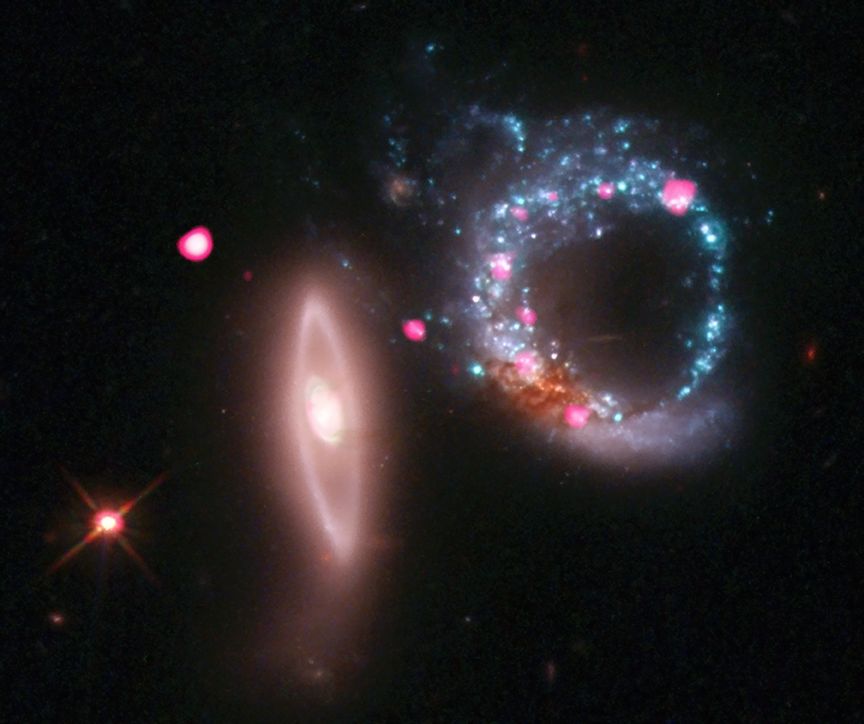
Since Valentine's Day is approaching, it's a good time to combine X-rays from the NASA's Chandra X-ray Observatory (pink) and optical data from the Hubble Space Telescope (red, green, blue) produced by the Space Telescope Science Institute (STScI) into a new image of a ring - not of jewels - but of black holes. The composite image is of Arp 147, a pair of interacting galaxies located about 430 million light years from Earth.
When the shootings in Arizona occurred, various pundits in the media jumped on 'right ring radio' and 'culture of hate' (meaning conservative news programs) despite the fact that the shooter was not political and did not even watch shows like Fox News.
If your prism is left, you tend to view even the center as the right, so mainstream media can be somewhat forgiven for demonizing all qualities they dislike as being right wing (it happens in science also - various scientists and bloggers have no idea there are left wing anti-science positions but can recite entire volumes of anti-science right wing issues) but is it really the case that the right is 'meaner' than the left?
In the somewhat irrational war on incandescent light bulbs, one thing left out is that the current alternatives are not great yet either. If you break a CFL bulb, you'd better call in a HazMat team (
and who knows what the high frequency ballasts are doing to your pets?) but if you break an LED, the lead levels are far too high, according to a new study.
Embarassingly overdue, the slides of my talk on "Heavy Flavour and Quarkonia Production in 7 TeV pp Collisions", meant for the 2011 Les Houches meeting on "Recent Advances in QCD" to be held next week near Chamonix, France, are slowly coming together. Since these days I seem to be straggling my feet on the blog as well, I decided to kill two birds with one stone. So here you are going to get a short overview of recent measurements of b-quark production by CMS.
While providing the results for experts and beginners alike, I will try to make this discussion as simple as possible (but not simpler), something that lately I tend to forget. I do not like my blog posts to be too technical, but maybe I am getting old and my popularization powers are weakening. Let's see.
The existence of functional, non-protein-coding DNA is all too frequently portrayed as a great surprise uncovered by genome sequencing projects, both in large media outlets and in scientific publications that should have better quality control in place.
Eric Lander, writing
a Human Genome Project 10th anniversary retrospective in
Nature, explains the real surprise about non-coding DNA that was revealed by big omics projects.
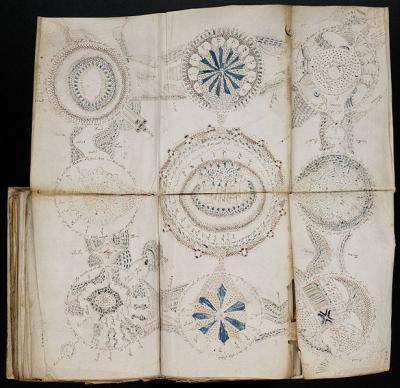
It won't make it readable, but University of Arizona researchers have cracked at least one of the puzzles surrounding the Voynich manuscript, a book filled with drawings and writings nobody can make any sense of.
Using radiocarbon dating, a team led by Greg Hodgins in department of physics says the manuscript's parchment pages date back to the early 15th century, making the book a century older than previously thought.
It's nonsensical structure has kept the Voynich manuscript fascinating for the 50 people who care; rows of text scrawled on visibly aged parchment, flowing around intricately drawn illustrations depicting plants, astronomical charts and human figures bathing in, some claim, the fountain of youth.
Arches in human feet have been instrumental in our ability to walk upright and researchers at the University of Missouri and Arizona State University say they have found proof that arches existed in a predecessor to the human species, Australopithecus afarensis, that lived more than 3 million years ago.
Last year I attended a singularity conference and Ray Kurzweil's avatar predicted it was 25 years away. Well, it's been 25 years away for a long time. It's a nice, safe number, close enough that no one gives up and stops buying books (global warming will happen in 100 years, for example) and not so close anyone looks silly (Al Gore saying in 2006 that we were doomed in 10 years, for example) it if doesn't happen.
In 1993, for example, Vernor Vinge said "Within thirty years, we will have the technological means to create superhuman intelligence. Shortly after, the human era will be ended."