It is accepted wisdom that an increasing marginal rate on income taxes
serve to balance inequality in our society, while also funding the
massive entitlement programs created at the federal and state levels.
Indeed, the credo of so called progressives for solving the fiscal ills
of our public sector is to raise the marginal income tax rate, while
the credo of the republicans is to cut and borrow. however, as has
become patently obvious to any objective observer, both parties
ideologies have driven the state and federal debt obligations to
unsustainable levels, without achieving any of the objectives of wealth
creation and social equity in a sustainable, non-redistributive manner.
So I guess squid are doing really well this year.
It's estimated that around-the-world squid in mass outweighs the human population. . . . Along the coast of California, the squid season has been abundant . . . Certain squid are booming thanks to a slight warming of sea temperatures, in places like Alaska and Siberia . . . There's also been a boom in Humboldt squid along the Pacific coastline ranging from California to Peru.
Observations done at the W. M. Keck Observatory on Hawaii's Mauna Kea have found 16 close-knit pairs of supermassive black holes in merging galaxies.
These black-hole pairs, also called binaries, are about a hundred to a thousand times closer together than most that have been observed before, providing astronomers a glimpse into how these behemoths and their host galaxies merge—a crucial part of understanding the evolution of the universe. Although few similarly close pairs have been seen previously, this is the largest population of such objects observed as the result of a systematic search.
Even for a physicist, this is bad: Larry Moran, in preparation for the appropriate dose of ridicule that this situation deserves, quotes
physicist and pop-science author Paul Davies:
Another physical object with enormous longevity is DNA. Our bodies contain some genes that have remained little changed in 100 million years. An alien expedition to Earth might have used biotechnology to assist with mineral processing, agriculture or environmental projects. If they modified the genomes of some terrestrial organisms for this purpose, or created their own micro-organisms from scratch, the legacy of this tampering might endure to this day, hidden in the biological record.
Is there still gender discrimination in science? We hear about it even today but is it a real problem or is it primarily a problem in that 'if there is even one instance it is too many' way that zealots insist on zero tolerance, even when applied to individuals who sometimes make decisions based on silly reasons.
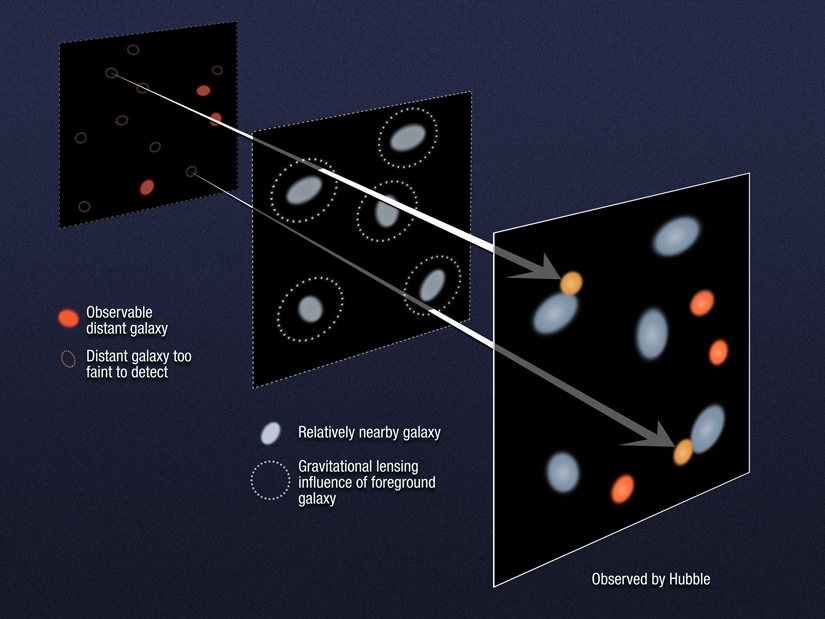
A new paper says that as many as 20 percent of the most distant galaxies currently detected appear brighter than they actually are, because of an effect called "strong gravitational lensing."
How strong gravitational lensing works; from our view on Earth, if a faraway galaxy and a nearby galaxy line up on the sky, the gravity of the nearby galaxy bends the light from the faraway galaxy, as if the nearer galaxy were a magnifying glass, or lens. Einstein predicted decades ago that gravity could bend light, and astronomers have since proven him right. In fact, modern astronomers exploit the effect to find distant objects that would otherwise be invisible, such as planets orbiting other stars.
Scientists are reporting the development of a new, ultra-light form of 'frozen smoke', the world's lightest solid material, and the new kind has amazing strength and an incredibly large surface area. The new "multiwalled carbon nanotube (MCNT) aerogel" could be used in sensors to detect pollutants and toxic substances, chemical reactors, and electronics components.
... as depressing as that may be to hear. Some friends recently described their December trip to India, the first time they've visited in years. India's economy is on fire, unleashing some tremendous pent-up economic demand. What was striking, my friends related, was how strongly India's economic development is geared toward the future, towards not only catching up with wealthier, more developed nations, but also towards anticipating and meeting economic challenges that loom in the future. This is in stark contrast to the US, which seems, at best, focused on defending the status quo.
Who interviewed who? There's
Scopes Monkey Choir-- the podcast interviewing me. And there's
365 Days of Astronomy-- the podcast where I interview them. Welcome to an irrational approach to "music in a rational universe".

You may recognize the famous Russian composer Modest Mussorgsky, whose best known work is “Pictures at an Exhibition”. But the pictures that follow are from a totally different exhibition, that of the
Association for Science Education Annual Conference 2011, held at the University of Reading from 5
th to 8
th January.