Skin cancer is the most common form of malignancy in the United States and the American Cancer Society has estimated that 1 million new cases of melanoma and non-melanoma skin cancer were diagnosed in 2009, while 8,650 deaths were attributable to melanoma skin cancer.
Studies have supported a positive association between increased use of indoor tanning and both melanoma and non-melanoma skin cancers but the indoor tanning industry is still growing rapidly, with more than $5 billion in annual revenues and more than 30 million patrons - mostly women.
Despite the data, few tanners, male or female, mention avoiding tanning beds when asked about ways to reduce skin cancer risk.
Researchers say they have identified a natural substance in dairy fat that may substantially reduce the risk of type 2 diabetes. The compound, trans-palmitoleic acid, is a fatty acid found in milk, cheese, yogurt, butter and meat but is not produced by the body and so only comes from the diet.
The report explains that trans-palmitoleic acid may underlie epidemiological evidence in recent years that diets rich in dairy foods are linked to lower risk of type 2 diabetes and related metabolic abnormalities. Health experts generally advise reducing full-fat dairy products but the trans-palmitoleic acid discovery means once again it's better to avoid fad exclusions and diets and simply have a balanced diet in moderation.
580 million years ago, life on Earth began a rapid period of change called the Cambrian Explosion, defined by the birth of new life forms over many millions of years that ultimately helped bring about the modern diversity of animals.
While fossils can help palaeontologists chronicle the evolution of life since the Cambrian Explosion, drawing a picture of life during the 3 billion years before the Cambrian Period is challenging because the soft-bodied Precambrian cells rarely left fossil imprints; early life forms did leave behind one abundant microscopic fossil, DNA.
Scientists have studied human brain samples to isolate a set of proteins that accounts for over 130 brain diseases and found an intriguing link between such diseases, the leading cause of medical disability in the developed world, according to the World Health Organization, with an economic costs in the USA exceeds $300 billion, and the evolution of the human brain.
Researchers say they have uncovered a clue that may help to explain why the earliest evidence of complex multicellular animal life appears around 550 million years ago, after atmospheric oxygen levels on Earth dramatically rose, from 3% to the modern day level of 21%.
The group says humans share a method of sensing oxygen with the world's simplest known living animal, Trichoplax adhaerens, suggesting the method has been around since the first animals emerged around 550 million years ago and helps us understand how humans sense oxygen and how oxygen levels drove the very earliest stages of animal evolution.
If you're in one of the areas of the world blanketed by snow, it probably feels like winter is already here - the cold weather has NPR pundits in such a panic they are claiming the snow is worse than global warming because it means (to them) that the climate is already 'unstable'.
But December 21st is officially winter and it is bringing with it a lunar eclipse. Last time that happened? 1554 A.D., according to NASA.
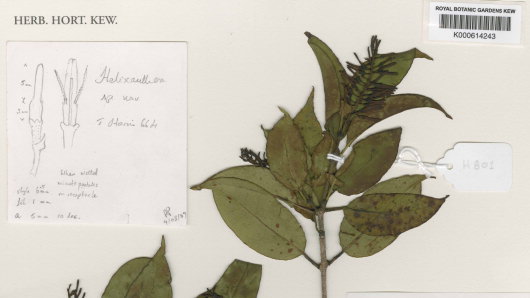
A parasitic, tropical mistletoe has been discovered near the summit of Mount Mabu in northern Mozambique and, just in time for Christmas, this new wild mistletoe has been named Helixanthera schizocalyx.
It was spotted by Royal Botanic Gardens, Kew East African butterfly specialist, Colin Congdon, while the team were trekking up the mountain, on a path that took them from the moist montane forest up to where the broad granite peaks break through the dense foliage. Congdon says he quickly realized this species was different from anything he had seen on the mountains in neighboring Malawi and Tanzania, and on closer inspection back at Kew it was confirmed as a new species.
What's on people's mind? Who or what is impacting us most? That is easy to decide: go to Google, put in the search field the
n-gram (the sequence of n words) that describes the item you want to check,* and watch the number of hits.
So the bigram "John Lennon" (25 million hits) is apparently more talked about than "Elvis Presley" (20 million hits). But both get beaten by "Paris Hilton" (32 million hits), who in turn is dwarfed by "Michael Jackson" (98 million). And of course, "Lady Gaga" (140 mln) is the biggest.
That's pretty clear, right?
In all of the excitement about 'renewable' energy that can replace fossil fuels, we look to the future - algae, seaweed, switchgrass, we have articles on practically every new idea - but forget to look to the past, like in wood.
Unlike 50 years ago, we now know how to make wood truly renewable (the Christmas tree industry was a wonderfully efficient proof of concept) and, say researchers at Fraunhofer Institute for Environmental, Safety and Energy Technology UMSICHT in Oberhausen, Germany, with modern techniques wood is comparable to natural gas in efficiency of heat supply.

In the month of December (and October, November, and January), PA systems in malls around the country play holiday music. And when we hear the telltale pa-rum-pum-pum-pum we want to strangle the nearest elf. Maybe kick a reindeer.
In the month of December (and October, November, and January), PA systems in malls around the country play holiday music. And when we hear the telltale pa-rum-pum-pum-pum we want to strangle the nearest elf. Maybe kick a reindeer.