



A Waymark Called Hvitsark


The Vikings did not use charts and instruments to navigate the open seas.  Having developed skills in coastal navigation they extended those skills to pelagic navigation, or 'island-hopping'.  Using the sun as a reference to determine where south lies, the Vikings could sail a reasonably accurate course.  If the wind was steady, the wind itself could be used as an aid to direction if the sun was hidden by heavy cloud.  It was only when wind and sun both failed the navigator that he was likely to miss his mark.


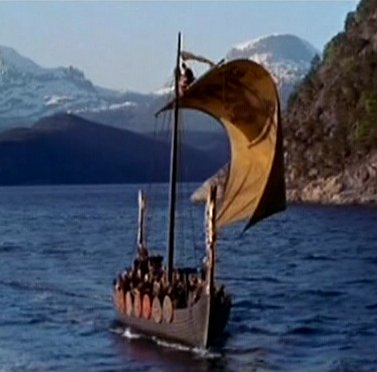
A Viking ship sailing on a beam reach.
Screenshot from The Vikings, 1958.
Here a short outtake of a depressing but interesting piece “The Shadow Scholar: The man who writes your students' papers tells his story” on outsourcing of thesis etc. writing that undermines our at points plainly ridiculous education systems further. This has been already commented on in other blogs, but I would like to stress a different aspect here. Yes, there is much to say about evaluation versus education, about the way teachers cannot pursue cheaters even if they clearly identified them, and so on. I claim however that one of the main culprits is the way we let language be used in general. Just read this:
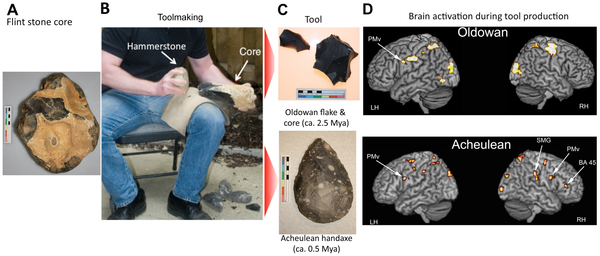
Progressing from crude stone tools to elegant hand axes was a technological leap, but that required the slow, complex process of evolution, says a new study that seeks to explain why it took almost two million years to move from razor-sharp stones to a hand-held stone axe.

Researchers have had different theories about why it took early humans more than 2 million years to develop stone axes. Some have suggested that early humans may have had underdeveloped motor skills or abilities, while others have suggested that it took human brains this time to develop more complex thoughts, in order to dream up better tool designs or think about better manufacturing techniques.


The eye is not just a lens that takes pictures and converts them into electrical signals, it is the first part of an elaborate system that leads to "seeing".   As with all vertebrates, nerve cells in the human eye separate an image into different image channels once it has been projected onto the retina and pre-sorted information is then transmitted to the brain as parallel image sequences. 
A really interesting piece of news comes from the CERN laboratory today. The CMS experiment has detected a handful of Z boson decays in events featuring the collision between heavy ions, accelerated to energies of hundreds of GeV per nucleon.
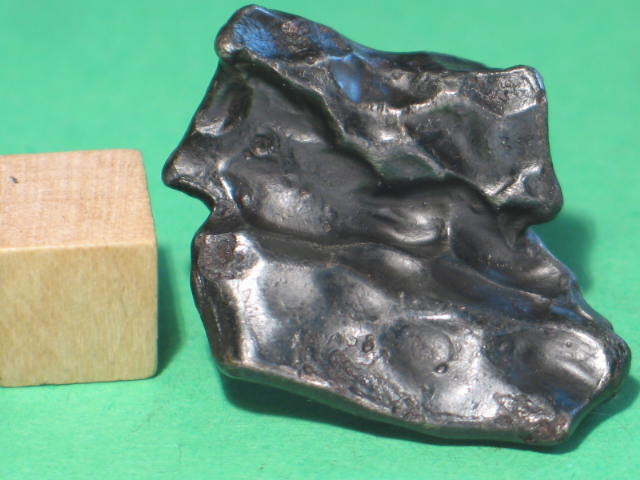
Every wonder what to get an astronomy fan for a present?  In this 365DOA Podcast, Emma the waitress and Sandy the diner roleplay the Meteorite Cafe.  Judging by that name, you can guess what we suggest.  Who can resist a rock older than the Earth?   Even better, who can resist a rock from space that is older than the Earth and costs less than $20?

Technically, meteorites formed in space around the same time the Earth was forming.  While Earth went through various atmospheres and engaged in active rock forming and plate techtonics, meteors just sat out in space, unchanged... and waited.  Finally, they made their move!
With the big holidays just around the corner, thousands of folks are about to get their first taste of the TSA's new virtual strip search machines - X-ray body scanners. Privacy issues may be the main concern for most people, but the safety of these things has some people worried.
The ethical issues surrounding unchecked human embryonic stem cell research are not going away any time soon, regardless of which political party occupies Congress or the White House.   

Given that, researchers have devised various alternatives and now scientists at the Max Planck Institute for Molecular Genetics in Berlin have added one more.   They have managed to convert amniotic fluid cells into induced pluripotent stem cells (iPS cells). These amniotic fluid-derived iPS cells are hardly distinguishable from embryonic stem cells - however, they 'remember' where they came from.
Most researchers regard their work as vital to society, even if that value is only higher order and the chain to societal benefit is tenuous to outsiders.  That's no different than any other job - people at the Department of Motor Vehicles feel like the entire state would halt without them and, in an elaborate food chain, they are right, and the same holds true for environmentalists who worry that some obscure critter going extinct will have a butterfly effect on worldwide ecology.  In a domino world, they are also correct.

But researchers are different than those other examples because they can't just do their jobs, they have to not only show they are doing their jobs, they have to prove they should continue doing them, and then raise the money to do it.
Scientific American features an excellent article by Garrett Lisi and James Owen Weatherell, with title "A Geometric Theory of Everything". It is a rather clear explanation of the ideas behind the recent articles published by Lisi on the E8 group and how this exceptionally rich mathematical structure could embed the representation of all particles and forces of nature.

